
Reggae · 12 de febrero de 2012
4. Especial Ras Cultura: Patois, el sincretismo mántrico del lenguaje rastafari.
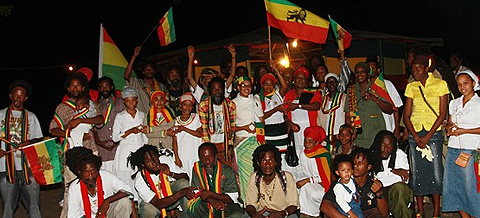
Los rastafaris, como tantos otros nichos culturales de todos los lugares del mundo, poseen una manera propia de expresarse y de usar la lengua. The most common practice is the adoption of a basic vocabulary made up of slang, phonetic derivations of words or neologisms, created words whose meaning escapes outsiders, those who do not belong to or are not familiar with a given group (or cultural tribe). The phenomenon of creating and using slang is part of a natural process of building an identity, of BEING SOMEONE.
In the case of Rastafarians, this resource generated a repertoire (vocabulary or lexicon) and a grammar with semantics and lexicon (vocabulary) so peculiar that rasta speech certainly approaches the status of a dialect, a secondary language. Rastafari language emerged in Jamaica, a Caribbean island that was an important center of large-estate monoculture at different moments of the sugarcane cycle (the period of Western economy in which the sugarcane trade predominated). For this economic reason, Jamaica became a receiving pole for slave labor, Black people from different regions of Africa, from its discovery by Christopher Columbus in 1494.
The Island spent almost two centuries under Spanish rule until it was definitively captured by the English. Called Patois, the rasta dialect is structured around two techniques or modes of appropriation and resignification of terms, a colonial inheritance from the mixture between the English language and African languages. The first technique is semantic syncretism; the second, grounded in an archaic religious dogma, lies in a mystical use of the first-person singular personal pronoun: “Eu” or “I”.
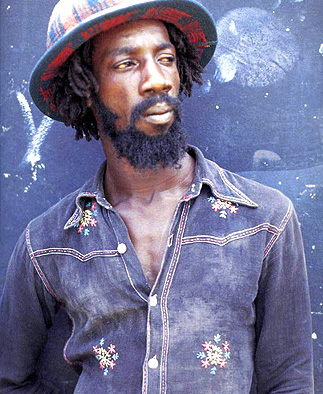 (Leroy ’Horsemouth’ Wallace in the film "Rockers")
Rastafari semantic syncretism promotes the joining of words or fragments of words, such as prefixes and roots, producing a resignification of the forming terms without, however, completely extinguishing the previous meaning of the words in their original use. The new concepts express abstract concepts, subjectivities related to the perceptions and experiences of those who use this language. In many cases, the joining of terms gives the neologism (new word) a clear content of political and social criticism and consequent affirmation of an ideology opposed to the situation to which it refers. In this type of syncretism, words are not simply added together; they relate through an intersection of meanings, through qualities common to the objects to which they refer. Examples of this syncretism include terms such as:
(Leroy ’Horsemouth’ Wallace in the film "Rockers")
Rastafari semantic syncretism promotes the joining of words or fragments of words, such as prefixes and roots, producing a resignification of the forming terms without, however, completely extinguishing the previous meaning of the words in their original use. The new concepts express abstract concepts, subjectivities related to the perceptions and experiences of those who use this language. In many cases, the joining of terms gives the neologism (new word) a clear content of political and social criticism and consequent affirmation of an ideology opposed to the situation to which it refers. In this type of syncretism, words are not simply added together; they relate through an intersection of meanings, through qualities common to the objects to which they refer. Examples of this syncretism include terms such as:
 downpressers = down ^ opressers
The term brings together down=low and opressers=oppressors, objects that share an attribute of existential negativity that can be translated by the understanding that oppressors are depressive, are down, depressing, bad vibes. In other examples, the same logic appears in the following cases:
Poulitricks: politicians “of tricks”, cheats, corrupt people.
Shity: city + shit, an affirmative union of opinion meaning that “city” implies “shit”, a bad situation, or, in short, shit-city; or also:
SHISTEM: (shitty system)
SHITUATION: (shitty situation, trouble).
I-Tal: I-food, I-nourishment, or I-Vital, I-vitalizing-thing
I-shence: incense, I-Incense
I-praises/I-ses: I-prayer
I-reation=I-creation: I-Creation
I-wer= I-power: I-power
In all cases, the meaning of the composition is the affirmation of I AM, reference to the first name of God, I, revealer of the ONE TRUTH hidden in Maya – the illusion of multiple reality. To say I-Vital is to summarize the thought: I AM this being and I also AM this other being, food, vital substance. Thus one affirms I AM TREE, I AM ETHIOPIA, I AM YOU, as a verbal declaration of recognition of God's omnipresence because God is everything and everyone; He is incense, food, water, stone, wind, word, silence, power, creation, planet and grain of sand. God is every kind of BEING: rough stone, mineral, plant, microbe and also human, rational, I-Tal – Everything in the Whole is Vital.
downpressers = down ^ opressers
The term brings together down=low and opressers=oppressors, objects that share an attribute of existential negativity that can be translated by the understanding that oppressors are depressive, are down, depressing, bad vibes. In other examples, the same logic appears in the following cases:
Poulitricks: politicians “of tricks”, cheats, corrupt people.
Shity: city + shit, an affirmative union of opinion meaning that “city” implies “shit”, a bad situation, or, in short, shit-city; or also:
SHISTEM: (shitty system)
SHITUATION: (shitty situation, trouble).
I-Tal: I-food, I-nourishment, or I-Vital, I-vitalizing-thing
I-shence: incense, I-Incense
I-praises/I-ses: I-prayer
I-reation=I-creation: I-Creation
I-wer= I-power: I-power
In all cases, the meaning of the composition is the affirmation of I AM, reference to the first name of God, I, revealer of the ONE TRUTH hidden in Maya – the illusion of multiple reality. To say I-Vital is to summarize the thought: I AM this being and I also AM this other being, food, vital substance. Thus one affirms I AM TREE, I AM ETHIOPIA, I AM YOU, as a verbal declaration of recognition of God's omnipresence because God is everything and everyone; He is incense, food, water, stone, wind, word, silence, power, creation, planet and grain of sand. God is every kind of BEING: rough stone, mineral, plant, microbe and also human, rational, I-Tal – Everything in the Whole is Vital.
 The mystical use of the pronoun EU in language is therefore linked to the religious influences that guide the movement of the worldwide Rastafari collectivity or community. Rastafarians today are like a kind of nation without territory or official political representation. The Rastafari Nation is instituted through the spontaneous sharing of ideological, philosophical and religious values. The ideology positions itself as a critique of current political systems: neo-liberal capitalism and socialism, mere powerless labels in the face of the abuses of the governing egos of the planet's greatest powers.
The philosophy highlights the metaphysical aspects of ontology, of the BEING of man and of the Universe, emphasizing the subtle or subjective reality of the Higher Self through which Unity in Diversity is explained. As a religion, Rastafarianism presents a framework of syncretisms in which predominant Christianity incorporates beliefs, rituals, uses and customs from Judaism, gnostic Hermeticism and even Islam, which is also a religion constituted from a Judeo-Christian mixture.
Although it arose in Jamaica, the main inspiration for Rastafari culture is Ethiopian civilization, ancient Abyssinia, considered the motherland of all African Christians. As in older Churches, such as the Jewish, Orthodox Christian, Roman Apostolic Catholic and Islamic Churches, Rastafari religious thought has internal doctrinal differences that give rise to different congregations. The best known are: The Twelve Tribes of Israel, more Westernized, the Nyabinghi and the Bobo Ashanti, Afro-orientalists who adopted evident practices of Jewish and Muslim origin such as: prohibition on eating pork, prescription to hide hair in public and certain rules applied to women's conduct.
These restrictions could have their origins traced to extremely remote times, once again necessarily passing through the India of the Brahmins and through the inheritance of one of the oldest Jewish tribes, the proscribed Essenes, historically pointed out as probable initiators of Christ Jesus and who to this day preserve their customs while inhabiting the Kashmir valley in northern India.
The mystical use of the pronoun EU in language is therefore linked to the religious influences that guide the movement of the worldwide Rastafari collectivity or community. Rastafarians today are like a kind of nation without territory or official political representation. The Rastafari Nation is instituted through the spontaneous sharing of ideological, philosophical and religious values. The ideology positions itself as a critique of current political systems: neo-liberal capitalism and socialism, mere powerless labels in the face of the abuses of the governing egos of the planet's greatest powers.
The philosophy highlights the metaphysical aspects of ontology, of the BEING of man and of the Universe, emphasizing the subtle or subjective reality of the Higher Self through which Unity in Diversity is explained. As a religion, Rastafarianism presents a framework of syncretisms in which predominant Christianity incorporates beliefs, rituals, uses and customs from Judaism, gnostic Hermeticism and even Islam, which is also a religion constituted from a Judeo-Christian mixture.
Although it arose in Jamaica, the main inspiration for Rastafari culture is Ethiopian civilization, ancient Abyssinia, considered the motherland of all African Christians. As in older Churches, such as the Jewish, Orthodox Christian, Roman Apostolic Catholic and Islamic Churches, Rastafari religious thought has internal doctrinal differences that give rise to different congregations. The best known are: The Twelve Tribes of Israel, more Westernized, the Nyabinghi and the Bobo Ashanti, Afro-orientalists who adopted evident practices of Jewish and Muslim origin such as: prohibition on eating pork, prescription to hide hair in public and certain rules applied to women's conduct.
These restrictions could have their origins traced to extremely remote times, once again necessarily passing through the India of the Brahmins and through the inheritance of one of the oldest Jewish tribes, the proscribed Essenes, historically pointed out as probable initiators of Christ Jesus and who to this day preserve their customs while inhabiting the Kashmir valley in northern India.
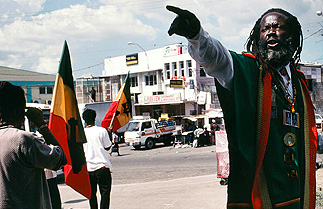 Twelve Tribes is a more liberal congregation regarding customs. Its messianic message affirms an unshakable faith in the return of the Savior (Messiah, Christ). It is a prophetic and apocalyptic religiosity, recommending methodical study of the Roman Apostolic Catholic Bible and also of Apocryphal texts (not recognized by the Vatican). Amid these differences, reverence for divine supremacy, submission to the will of the unknowable I AM, is a unifying trait not only among the Rastafari congregations but also between Rastafari and countless other currents of world theological thought.


(Leroy ’Horsemouth’ Wallace in the film "Rockers")
downpressers = down ^ opressers
The term brings together down=low and opressers=oppressors, objects that share an attribute of existential negativity that can be translated by the understanding that oppressors are depressive, are down, depressing, bad vibes. In other examples, the same logic appears in the following cases:
Poulitricks: politicians “of tricks”, cheats, corrupt people.
Shity: city + shit, an affirmative union of opinion meaning that “city” implies “shit”, a bad situation, or, in short, shit-city; or also:
SHISTEM: (shitty system)
SHITUATION: (shitty situation, trouble).
YO: RECUERDO DE DIOS
The use of the pronoun “EU” is the second characteristic of Rastafari language. This pronoun is used as a prefix and suffix or as part of compound terms. In several expressions it replaces the pronouns you-thou and we in interpersonal communication. This strange grammar, which privileges the first person singular, is explained as a mystical, exoteric practice (of public domain). Its roots, however, are “esoteric” (with S and not with X), that is, they are not knowledge of the people but rather belong to the knowledge of the Tradition of the Occult Sciences, of Hermeticism; in other words, the reason for the peculiar use of EU in Rastafari language can only be explained by Occult Initiates. In all the religions of the world, the first of the thousands of names of God is “I AM” or also “I AM THAT I AM” or “I AM THAT WHICH IS”. This was the answer of Jehovah (Yahvé – Jha+Yehva) when Moses, on top of Mount Sinai, asked the God who had guided him there “how to call him?”, “how to name him before the people?” (HOLY BIBLE, Exodus). Moses is a character of the Jewish sacred books, but “I AM” had already manifested and identified itself in this same way in much earlier times, in the India of the Vedas, scriptures that contain a Book of Creation.
(Abyssinians with "I and I" or "Eu e Eu" in Portuguese)
In this Hindu Cosmogénesis, the objective Universe is born when “the ONE”, in its infinite solitude, has a first perception of itself (of the divine self). At the awakening of a Manvatara (cycle of activity of the Universe) it exclaims “I AM!” - and by adding: “I AM THIS!”, it projected from its ABSTRACT AND IMPLICIT BEING EVERYTHING, all things that exist, existed and will exist, into the explicit, objective Universe.
I AM, as the first and only true name of God, “FIRST PERSON OF A SINGULAR”, is an evident affirmation of one of the three divine attributes: OMNIPRESENCE (besides omniscience and omnipotence). Omnipresent, in fact, means “present everywhere, in everything”. The recurrence of the pronoun I, its repetition in Rastafari language, is therefore due to the higher meaning contained in this monosyllable. In De Magistro, Saint Augustine (medieval philosopher master of Western Catholic Christianity) presents the following thought: if God knows everything, why should man pray, ask for graces or forgiveness if, beforehand, God is already aware of what happens in our lives?
The sage of the Church concludes that praying is a mental exercise man performs; an exercise of memory and self-conditioning. When he prays, in recollection, “in the secret chamber of his heart”, concentrated on prayer, man remembers or re-remembers his mistakes and successes; he corrects himself, forgives himself and rewards himself. By praying, man connects with the presence of God that dwells in him, in man himself, since God is omnipresent.
Psychologists and occultists distinguish, in the human psyche, two “I's”. One is objective and apparent. It is the EGO, personality conditioned by family and society. The EGO is marked by the name and by its mnemonic references (remembrances, memory) of time and place. The OTHER I is called the HIGHER SELF, whose existence precedes and transcends the EGO. The characteristic of the HIGHER SELF is INDIVIDUALITY, which is not confused with personality and subsists beyond names and civil records.
Rastafarians use the sound of the word EU because of the resonance (vibratory force) of its ancestral and even atemporal meaning. The EU or I is present in the composition of words and idiomatic expressions as a daily and constant reminder (1st) of the supremacy of God – THE HIGHER SELF; (2nd) of the identity between Man and God through their metaphysical connection. The eccentricity of this way of speaking functions as a kind of didactics for the reeducation of the perception of self – the self itself – as something greater than the Ego.
When a Rastafarian says “I and I will be there” (Eu e eu estaremos lá) instead of I and he, or I and you, (eu e ele, eu e você), the phrase resonates in the unconscious as a denial of the conditioned Personality-Ego, the counterpart of affirming the Higher-Self-Individual-One with the Whole, One with God. In another case, the pronoun is used as a prefix indicating identification between person-object-God, recognizing divine unity as the essence of the apparent diversity among things. Examples include:
I-Tal: I-food, I-nourishment, or I-Vital, I-vitalizing-thing
I-shence: incense, I-Incense
I-praises/I-ses: I-prayer
I-reation=I-creation: I-Creation
I-wer= I-power: I-power
In all cases, the meaning of the composition is the affirmation of I AM, reference to the first name of God, I, revealer of the ONE TRUTH hidden in Maya – the illusion of multiple reality. To say I-Vital is to summarize the thought: I AM this being and I also AM this other being, food, vital substance. Thus one affirms I AM TREE, I AM ETHIOPIA, I AM YOU, as a verbal declaration of recognition of God's omnipresence because God is everything and everyone; He is incense, food, water, stone, wind, word, silence, power, creation, planet and grain of sand. God is every kind of BEING: rough stone, mineral, plant, microbe and also human, rational, I-Tal – Everything in the Whole is Vital.
Categoría
#Reggae