
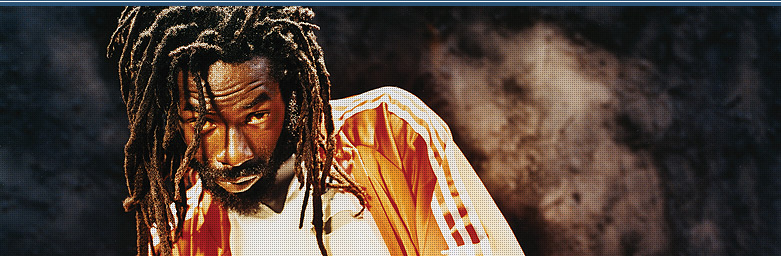
Buju Banton's trajectory is not very different from that of most Jamaican stars. Like many boys who dreamed of pursuing a musical career, the young Mark Myrie, born in 1972 in Kingston, began fighting for his place in the music scene early on, frequenting dancehall nights in search of an opportunity to deliver his message. At first he usually covered the breaks of the main deejays, but gradually he refined his style and made himself noticed. Still at fourteen he released his first single. Other sporadic singles were recorded, without much impact.
Things began to change when the doors of the prestigious Penthouse studio/label, owned by producer Donovan Germaine, opened for him. A studio technician saw him in action and managed to arrange a session. Tall and possessed of a powerful voice, Buju made an impression. His debut single, released in September 1991, went straight to the top of the Jamaican charts.
He was beginning to win over the public and every single instantly became a hit. So it was no surprise when his album 'Mr. Mention', released in 1992 and gathering several successful singles, broke all sales records in Jamaica. Buju placed seven songs on the charts, a feat no artist had achieved until then, including Bob Marley. The apotheosis came at Sunsplash 1992, when he literally stole the show with an anthological performance.
Again like so many other Jamaican artists, meteoric success earned him a contract with a major North American label and the doors of the international market opened. His second album, the excellent 'Voice of Jamaica', released in 1993, only confirmed all his talent, making clear that Buju Banton had a great deal to say, unlike deejays who turned to lyrics full of apologies for violence and sex. But then he was caught off guard by the wave of political correctness, very much in vogue in the United States.
One of his songs, written when he was sixteen, contained crude references to gays, and was taken as an example of intolerance by homosexual organizations and activists. The uproar overshadowed all his work and even the content of his lyrics — social and political commentary, anti-violence messages, respectful references to women — fixing on a minor point, a kind of adolescent slip. Some radio stations boycotted the album, shows were cancelled and negative reports appeared in several publications. The album ended up going unnoticed and he seemed plunged into a dark period.
But in Jamaica the case had no repercussion whatsoever, not least because the song in question was a huge success there. The Jamaican public did not abandon its idol and Buju was able to bounce back. Still in 1993 he released the single 'Murderer', commenting on the death of several deejays and vehemently condemning the violence reigning in Jamaica. This song was the starting point for a whole movement that brought conscious and positive messages back to Dancehall. At the same time he embraced the Rastafari faith, letting his dreadlocks grow and adopting a more spiritual posture.
Many doubted the sincerity of his new attitudes, but the answer to critics came in 1995 with the inspired 'Til Shiloh', a classic not only of Dancehall but of all Reggae music. In the a cappella intro that opens and gives the album its name, he expresses his philosophy: "Strange feelings I am feeling / The love of Jah, we always believe in him / Although you may think my faith is in vain / Eternally we will sing the name of Rastafari".
Buju shows that he has matured, with a work that points to the future of Reggae, uniting Rasta traditions with the modern technology of Dancehall. According to him, his music is the "story of a single music. It was how I formed the bridge between dancehall and roots reggae, because it is the same culture, just a single music. There should be no distinctions".