
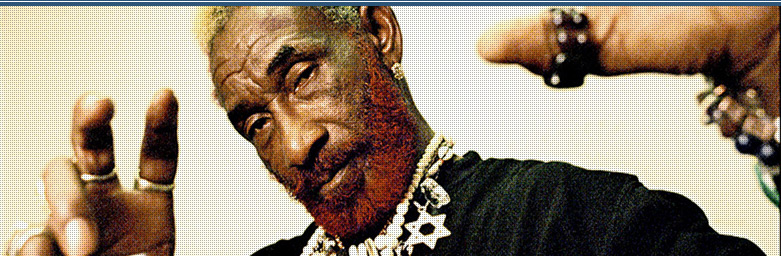
Lee 'Scratch' Perry began his career working as a "jack-of-all-trades" at Studio One, under the orders of legendary producer Coxsone Dodd. By the mid-60s he was a mix of messenger, sound technician, songwriter, deejay, security guard and vocalist, showing all his eclecticism — it was there that he recorded the tracks gathered on CHICKEN SCRATCH.
After seven years of work, he quarreled with Coxsone over low salaries and lack of recognition, and went to work with Joe Gibbs, who at the time was not yet a producer but had plenty of money. Perry took charge of Gibbs's label, achieving some hits with his productions, including a song with direct accusations against his former boss.
Shortly after he left the new boss, again lashing out in all directions, showing his terrible genius and strong personality. From 68 onward he worked on his own, creating his own label, Upsetter, and recruiting some young musicians to form his studio band, the Upsetters.
The lineup included the brothers Family Man and Carlton Barrett on bass/drums, guitarist Alva Lewis, keyboardist Glen Adams and Max Romeo on vocals. At the time they all hung around Kingston watching "spaghetti western" films at the cinema in the afternoon, and spent nights in the studio where, duly inspired, they created demolishing rhythms.
In 69, Perry scored a hit with the band in England inspired by such films, "Return of Django", which earned them six weeks of shows. It was the first tour of a Jamaican group there. Just at that time, Lee Perry's path crossed Bob Marley's professionally, since they already knew each other from ska days, both having worked with Coxsone at Studio One.
Things were changing in the emerging Jamaican reggae scene with the appearance of new independent labels and producers, challenging the reign of the two biggest producers until then, Coxsone and Duke Reid. Thus the Wailers, without a producer after succeeding and falling out with Coxsone, ended up meeting Lee Perry, then fighting for his space in the competitive market.
After some jams and recordings with the Upsetters, Bob Marley urged the group to abandon Perry and join them, arguing that the union of the best studio band with the best vocal group in Jamaica would be devastating. When Lee Perry learned of Bob's attempt he was furious, to the point of wanting to kill him. The case was only resolved in a tête-à-tête between the two, when after hours of heated discussion they reached an agreement, leaving the room amid laughter and pats on the back.
The Upsetters would join the Wailers, yes, but the exclusive producer would obviously be Perry himself. Soon everyone would be in the studio, creating what would be the high point not only of each one's career but also of Jamaican music history itself. The chemistry in the Wailers sessions with the Upsetters under the genius command of Lee Perry was phenomenal, such was the quantity of classics produced that changed the course of reggae, and served as the foundation for the enormous success Bob achieved afterward, establishing Lee Perry as one of Jamaica's great producers.
Many of the songs from these sessions — "Small Axe", "Duppy Conqueror", "Kaya", "Put it on", among others — were later re-recorded by Bob, but the magic of the original recordings would never be surpassed. Between 69 and 70 things worked well, but in 71 the honeymoon between Lee Perry and the Wailers ended. With strong personalities involved, the breakup of the love-hate relationship established between them was almost natural, amid mutual accusations.
The Wailers kept the Barrett brothers, reshaping the group and signing with Island in 72, where they continued to make history. The other musicians went their own way and Lee Perry kept the Upsetter name, calling new musicians for his next project.
With the end of the revolutionary partnership with the Wailers, Lee 'Scratch' Perry began building a studio that would come to be called Black Ark (whose production was compiled in various collections, including the sublime ARKOLOGY), reshaping the Upsetters lineup.
Already established as a producer, he gained independence from the traditional Jamaican bosses and affirmed himself as one of the most important names on the reggae scene. Between 74 and 79, the Black Ark was a powerful musical factory and set the rules for the island's music, under the command of its deranged builder/commander. The sound of Scratch and his crew marked an era with innovative productions ahead of their time.
Names like Max Romeo, Junior Murvin, Heptones, Gregory Isaacs, Junior Byles, Congos passed through Scratch's hands, besides newcomers to whom he gave the longed-for first chance. And he still found time to tend to his solo career.
With the world's attention turned to Jamaica because of Bob Marley's success, it was natural that Lee Perry's music would stand out, taking him to international heights. Island Records signed a distribution contract with him, and his style caught the attention of figures like Paul McCartney and the Clash, who even covered the classic 'Police and Thieves' on their first album.
To keep tradition, after a while he broke with Chris Blackwell, head of the label, to whom he also made accusations through his songs. Lee Perry lived through this entire period locked in the studio, amid endless recording sessions fueled by alcohol and ganja in profusion.
This combined with the burdens of stardom led him to suffer a serious nervous breakdown, which culminated in the burning of the Black Ark, set by himself, in 79, in a tragic episode. Besides shooting himself in the foot, he was abandoned by his wife, tired of having to endure his lifestyle. The event signified a radical rupture with the past and marked the beginning of a phase in which he began to behave somewhat eccentrically.
Sometimes he received journalists acting strangely, amid the studio ruins, totally covered in graffiti and other paintings, and did all kinds of crazy things, always with a somewhat off-orbit discourse. For these and other reasons, he gained a reputation as mad. Perry would spend the following years wandering between Europe and Jamaica, even living in Amsterdam and recording (few) albums. One of his decisions was to stop producing other artists, and there was a time when he tried to rebuild the studio, but the attempt ended in failure.
In 82 and 84 he gave the first signs that he might return to his old form with the release of two excellent albums, but it was only in 87 that the genius's definitive return to his best days finally happened. Working together with English producer Adrian Sherwood and his band, the Dub Syndicate, Perry would release the classic "Time Boom X De Devil Dead", much more than a masterpiece.
It was his return to the scene in grand style. Excellent releases followed, as well as various reissues of his now legendary 70s productions. Established in Switzerland with a new wife, Lee 'Scratch' Perry remains one of the most important and decisive names in Reggae history. The latest news about him is that he would be working with his son Omar, trying to recover old tapes with material recorded at the Black Ark, and building a new studio at home, this time called Blue Ark, from which great productions will certainly emerge.