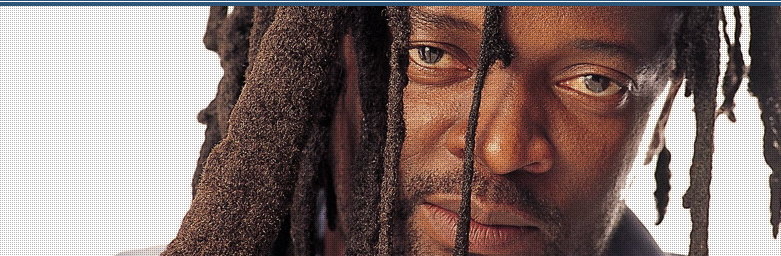
Lucky Dube was born on August 3, 1964, in Ermelo, South Africa. At age 9, he was chosen as assistant at his school library. The desire to learn about the rest of the world and South African history led him into Literature. He became familiar with Rastafari philosophy through an encyclopedia. Soon after, he discovered Reggae, which had much to do with Rastafarianism. His interest in reading and acquiring knowledge kept growing. He worked to buy Peter Tosh records (which at the time were the only Reggae albums available in South Africa). Still in school, he formed his first band — the Skyway Band.
Lucky's talent soon caught the attention of producer Richard Siluma, a relative. Richard knew Lucky Dube's potential was high and worth investing in. In 1979, Lucky directed his career as an mbaganga singer and with Future Slaves members Thutukani Cele and Chris Dlamini recorded an album in 1982 as The Love Brothers entitled Mbaganga. Over the next 3 years Lucky Dube released a solo album "Lengane Ngeyetha" with his first single, a great success. He then released three more albums, continuing his brilliant music.
In 1985, without his label Teal Records' knowledge, Lucky and Richard entered the studio to record "Rastas Never Die" — the first reggae album recorded in South Africa. Due to political situation and government media censorship, the album did not go far and was immediately banned. It gained awareness but did not sell well. In 1986 Lucky recorded his second reggae album "Think About The Children". That was when Lucky Dube's backing band began to solidify. In 1987 the third album "Slave" was released — featuring big hits like "I've Got You Babe", "Slave", and "Back To My Roots". With The Slaves he performed huge shows in Johannesburg for crowds of over 50,000. In 1988, due to popular demand, "Rastas Never Die" was re-released.
Lucky embarked on his first international trip to promote "Slave". In 1988 "Together As One" was released, with title track lyrics based on South Africa's situation, calling for racial unity between blacks and whites. Lucky hit the road again performing for crowds of over 65,000. In 1989 he embarked on a series of shows in France, establishing himself as an internationally renowned artist. That year he also recorded in the film "Voice In The Dark" and released "Prisoner", which earned double platinum in five days. 1990 saw shows in Africa, one drawing 80,000 people. In 1991 Lucky went to the United States and made a historic appearance at the world's most famous Reggae festival — Reggae Sunsplash Festival in Jamaica — the first time a South African artist realized this great dream. The tour continued to Australia, Japan and Ghana.
"Prisoner" was Lucky Dube's best-selling album with 1,000,000 copies sold worldwide. The live album "Captured Live" brought some of his best known songs and earned platinum. Lucky Dube won "Best Vocalist of the Year" at South Africa's annual OKTV awards. "House of Exile" led him to the first Reggae festival in South Africa, "Reggae Strong For Peace", later released as album and video. Other albums: "Serious Reggae Business", "The Way It Is", "Taxman", "Victims", "Trinity" and the most recent "Soul Taker". Unfortunately, Lucky Dube was murdered in an attempted robbery in Johannesburg, South Africa's capital, in front of his son.