
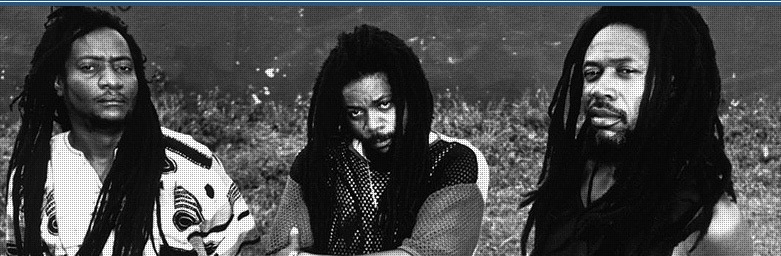
Even by Jamaican standards, the beginning of the Meditations' career is convoluted, and both Ansel Cridland's and Danny Clarke's careers were already well underway before the pair joined forces. Cridland, born in 1951, moved to Kingston as a child and became a jockey apprentice. However, he ended up working odd jobs before deciding to pursue a career as a singer, and formed the vocal group The Linkers during the rocksteady era.
The group's lineup was flexible, but in any case The Linkers recorded nearly a dozen singles, although none became a hit with the public. Clarke, a Kingstonian by birth, had briefly sung with The Flames, Alton Ellis's backing band. Another member of The Flames, Sweet P., introduced Clarke to Cridland, and the two quickly became friends.
By the early 1970s, both were recording as solo artists, even though both preferred harmonic sound. Things finally came together in 1974, when the pair decided to audition together at Studio One. There, Junior Delgado was auditioning for label head JoJo Hookim. He was surprised by the pair's song "Woman Is Like A Shadow", as was the young and promising Winston Watson, who offered his harmonic falsettos to the band. The embryo of the Meditations was now complete, but the group had not yet been born.
"Woman Is Like a Shadow" was recorded, but Hookim, unhappy with the results, refused to release it. The three continued writing songs and rehearsing together. Then, in late 1975, Clarke and Watson went to Federal Studios where Dobby Dobson was holding auditions. Clarke played "Babylon Trap Them" and Watson "Woman Piabba"; Dobson recorded both. Although Cridland provided backing vocals on both songs, they were released as solo singles. In 1976, the trio recorded Cridland's song "Tricked," credited to Ansel & The Meditations.
This single brought the singers to television and helped them on their first Caribbean tour, an excursion that included Culture, The Tamlins, Carl Dawkins and Leroy Smart. By the end of the year, the group had officially become The Meditations.
During this time, they continued recording steadily with Dobson, and released "Message From The Meditations", a breathtaking debut album. The entire album had in practice, or soon would be, released as singles, from "Woman Is Like A Shadow" (which Dobson had taken from Hookim) to their first recordings for the producer, through Cridland's seminal "Running From Jamaica" to the jovial "Changing of the Times". In 1977 they were at Madison Square Garden with Calypso Rose and, back home, the trio prepared their next album. The seminal "Wake Up" arrived in 1978, once again filled with another batch of singles, including "Fly Natty Dread", "Turn Me Loose" and "Wake Up". Curiously, the set also included a re-recording of "Nyah Man Story", a song dating from Cridland's days with The Linkers.
However, by this time the trio was extremely unhappy with the remuneration they received from Dobson and strengthened their ties with producer Lee "Scratch" Perry, who was eager to take the reins. The Meditations re-recorded several tracks from "Message From Meditations" at his Black Ark studio, leaving the producer highly impressed. Although the group did not agree to his demand to produce their next album, they were willing to record some singles for him. "No Peace," "House of Parliament," and "Think So" followed, with the last song gaining great prominence in Britain, where Island released it on the B-side of the single "Life Is Not Easy" produced by Cridland.
It was Perry who introduced The Meditations to Bob Marley that same year, a fortuitous meeting that resulted in the trio serving as backing band for the Wailers on "Rastaman Redemption," "Blackman Redemption," and "Punky Reggae Party". The Meditations provided harmonies for countless other artists during the late 1970s, such as Jimmy Cliff and Gregory Isaacs.
As the decade faded, the trio's star was rising. Bob Marley's Tuff Gong label intended to release the Meditations' new album, and put out the exuberant single "Miracles". A portion of the Wailers provided the musical backing on this song, as well as on a small handful of other recordings from this period. Unfortunately, Cridland had a falling-out with the Tuff Gong label manager, and the planned album was abandoned. However, the Meditations performed two songs at the legendary Peace Concert at Marley's request.
It was in 1980 before the group finally released its third album, "Guidance", once again filled with classic songs. But by this time international interest in reggae was beginning to wane, as Jamaicans were now under the sway of DJs.
Three years passed before the trio returned with another record, "No More Friend", sublimely supported by the Roots Radics. The set was supervised by Linval Thompson, who had produced some singles years earlier, including 1982's "Sit Down & Reason". In 1984, the group recorded a handful of songs, including a re-release of "Quiet Woman" and its B-side "Reggae Crazy," both played by The Revolutionaries. By the end of the year, the Meditations were no longer the same. Or at least not the original Meditations. Cridland continued alone under the name Ansel Meditations, while Clarke and Watson continued as a duo still under the name Meditations.
Cridland's solo career continued rapidly, through singles and two albums, 1988's "Thunder on the Mountain" and 1990's "African Vengeance". Later, he joined forces with Yami Bolo for the excellent album "Tribute to Marcus Garvey". Meanwhile, the Meditations followed a similar path, touring successfully, and finally gaining a new recording contract with the US label Heartbeats. This resulted in the excellent 1988 album "For the Good of Man".
To the surprise of many fans, part of the recording was supervised by Cridland. However, the trio's differences were more geographical than personal or musical, with Cridland wanting to remain in Jamaica while his colleagues preferred the green pastures of the United States. And so, in 1990, the trio reformed, and two years later announced the fact with the album "Return of the Meditations". Compilations of their older material continue to be published since then, and the group is seen today as respected veterans of the roots reggae scene, which they were so instrumental in defining.