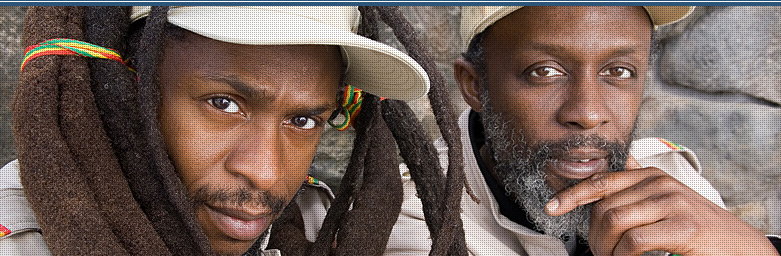
It was the year 1975 in Birmingham, England, when three young men from the black neighborhood of Handsworth — descendants of Jamaican immigrants — decided to channel their energies and frustrations into music, forming a band that would become one of the most beloved and respected among reggae fans worldwide, Steel Pulse.
The trio was formed by bassist Ronald McQueen and guitarists Basil Gabbidon and David Hinds, who described the situation at the time: "There were repeated confrontations between the police and the community youth. There was a decaying education system and a high unemployment rate, so we needed something to keep our spirits up and aware of what was being done to blacks as a minority in England. So we turned to music".
They were soon joined by keyboardist Selwyn Brown, drummer Steve Nisbett, percussionist Phonso Martin and singer Michael Riley. For three years they rehearsed and battled for shows, doing covers of Burning Spear, Gladiators and Bob Marley. One of the biggest difficulties was finding places to play, because even black clubs closed their doors to them, fearing problems because of the bad reputation of rastas. Ironically, the best chances for the band came with the punk movement, which at the time was shaking the structures of the music industry and English society itself.
Amid shows with some bands of the time, such as Clash, XTC, Police, Stranglers, Steel Pulse found space to pass their vehement anti-establishment message to skinheads and punks, who loved the band. David Hinds attributes to the exchange of experiences with those bands the fact that Steel Pulse is as perfectionist and professional as possible in their creations.
The strength of the shows and the relative success of three EPs funded by the band led them to sign a contract in 78 with the powerful Island Records, a label that then gathered the cream of reggae artists, such as Bob Marley, Gregory Isaacs, Burning Spear, Lee Perry, U Roy, among others. It was then that they met Jamaican engineer and producer Karl Pitterson, who had a certain name due to the work he had done with Bob, Peter Tosh and Bunny Wailer. The chemistry established between the parties worked perfectly, with the first two albums released, Handsworth Revolution and Tribut to the Martyrs, consecrating Steel Pulse as a first-tier reggae band. But there was more. Steel Pulse went to America in the wake of the punk rock invasion at the end of the 70s. David Hinds recalls:
 Before leaving England, we were called by Island. 'Why do you want to go to America? Nobody knows you... you'll be wasting your time'. (...) We came to the United States almost as poor people. We came without knowing that everyone knew Steel Pulse, we were prepared to face that. And our first show was at a place called Mud Club, in Manhattan. We thought 'Yeah, we'll play here and maybe a handful of people will come and after we play at other clubs, we'll probably get a small return'. And the place exploded, man, we couldn't believe it".
In 81 the group was the main attraction at Sunsplash, which that year honored Bob Marley, who had passed away shortly before. The success of the performance earned a contract with Elektra, and the album True Democracy, released in 82, was acclaimed by critics and the public. It was the consecration and the peak of Steel Pulse as a top name on the world reggae scene, but it also marked the end of the original lineup and the musical proposal the group had been following.