
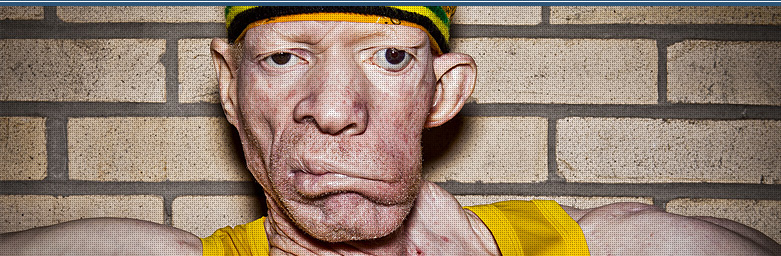
Winston "Yellowman" Foster is a winner who overcame the adversities of his life with grit and persistence. Moreover, he built one of the most extensive discographies in reggae, releasing nearly two albums per year. Let us comment on some of the main albums of the Yellow Man.
On his records Yellowman strictly fulfilled the goal of entertaining people while making quality music. His songs spoke of love, sex and women, with lyrics that were either spicy or good-humored, and still served to exalt his performance as a man and DJ. But here and there he made room for fierce social commentary.
The beginning of his career was devastating. In a short time Yellowman released a flood of hits and conquered Jamaica, which was starved for idols since the death of Bob Marley. In this phase he released great albums such as 'One in a Million' or 'Bad Boy Skanking' (sharing vocals with Fat Head), with a sound still very close to roots, cementing his reputation as the island's best DJ.
The secrets of his overwhelming success are revealed on 'Live at Reggae Sunsplash', a record of the historic 1982 festival show. Until the mid-80s he would still release plenty of good material, such as "Zungguzungguguzungguzeng" and 'Two Giants Clash', where he musically duels with DJ Josey Wales over the rhythms of the excellent Roots Radics Band.
With Jamaica at his feet, the natural path for Yellow was to try his luck in America. And as usual, right on his debut for a major American label he crushed it, making 'King Yellowman' (EMI) a true classic. This album, the only one released in Brazil, features memorable appearances by Afrika Bambaata and Bill Laswell, plus the always sharp Sagittarius. Yellowman put Jamaica — and reggae — back on the musical map, paving the way for the dancehall explosion.
His production in this phase follows the characteristic quality pattern. Great albums such as 'Mr Yellowman', 'Galong Galong Galong' and 'Yellow like Cheese', the last two with the duo Sly & Robbie, kept up the pace. The compilation '20 Super Hits' compiles the successes of this period.
Health problems forced a pause, but Yellowman bounced back and resumed his output. On 'Blueberry Hill' he re-recorded the old Fats Domino hit, one of his best albums. Next came the unusual 'Yellowman sings the Blues', which proved his versatility. The repertoire consists of 50s covers and the band is the always competent Sagittarius. While critics turned up their noses at his lyrics and competition grew with the emergence of new stars, 'King of the Dancehall' came out, fully digital, with rhythms provided by the duo Steele & Clevie.
On 'Party' he is once again backed by a band, the Roots Radics, and puts on a show of vibration and energy. Around this time Yellowman was in Brazil during one of his countless tours. 'Reggae on the Move', from 93, follows his old recipe. 'Prayer', an excellent 1994 album, can be considered one of his best works and even made the most stubborn critics praise the albino. Even if his popularity in Jamaica is not what it was in the 80s, Yellowman remains firmly in the gallery of reggae's sacred monsters.
Where the band plays the most
Pulled from the Surforeggae archive
- 01JUN 831
Montego Bay · JM