
Reggae · April 04, 2005
Learn more about the release of Natiruts' new CD "Nossa Missão"! See it on Surforeggae!
Reggae made in Brazil quickly gained great acceptance from the public and, at the same time, an inexplicable rejection from major record lab
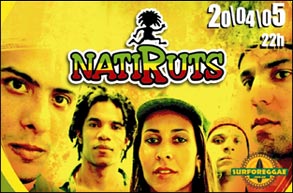
Reggae made in Brazil quickly gained great acceptance from the public and, at the same time, an inexplicable rejection from major record labels and the media. It took a long time until a major label assimilated the idea that by investing, they could obtain good commercial results from those groups – most coming from the periphery – with protest lyrics and "matted" hair. Nevertheless, Reggae yielded good fruits, with bands that consolidated in the music market and did not disappear from sight like a passing fad.
At the same time, a scene began to form with various new bands and a very loyal and numerous audience, making it so that even in independence, Reggae gained its own strength rarely seen in the Brazilian music market. As a fruit of this scene, but with a very particular and fascinating history, Natiruts was born in Brasília. With the bold marketing strategy of distributing their hard-earned debut album to everyone who bought a show ticket, they managed to sell out the first 3,000 copies in a few months, making the band gain considerable popularity among Brazilian reggae fans. From that same album, they reached the incredible mark of 40,000 copies sold in less than a year still independently, without the resource of major distribution.
This phenomenon was necessary for a major label to become interested in signing them, releasing the album exactly as it was conceived, working two songs on the radio and enjoying the unbelievable sales of 400,000 copies of a debut album from a band that until then was little known. That year, the chorus of "Presente de um beija-flor" echoed like an anthem of a new generation throughout Brazil, mainly on the coast, where Reggae had already established itself with considerable strength.
 Over their almost 10 years as a band and 4 albums released, Natiruts faced several setbacks that would easily cause the dissolution of many other bands without the same unity (such as the lawsuit they suffered in 2000 demanding a fortune for the name Nativus – forcing them to change their name to Natiruts). At the same time, they were touring intensely throughout Brazil, packing every venue they performed at and consolidating not only in the Reggae circuit, but also in the upper echelon of national pop rock.
In this latest work, after 4 albums released on a multinational label, Natiruts returns to independence on the album "Nossa Missão", where they point to a new path, a new lineage. Right away, one notices as a differential from previous albums the strong approximation with Dub – the more psychedelic branch of Reggae that emerged in the mid-70s in Jamaica incorporating experimentation, without restraint in adding effects such as Delays and Reverbs.
Produced by Alexandre Carlo himself, vocalist and main composer of the group, the album comes packed with somewhat unusual collaborations. From the intense contribution of Lirinha, from Cordel do fogo encantado, reciting his spoken song in "Não chore meu amor" to the raspy vocals of Funk Búia, from Z'Africa Brasil, exalting love in the form of Raggamuffin in "Toca Fogo", passing through the Rap of fellow countryman GOG in the politicized "Quem planta preconceito?" and the international participation in "Au de cabeça" by Willy Rodriguez, vocalist of band Cultura Profetica, from San Juan / Porto Rico.
As with every Natiruts album, there obviously cannot be missing songs that are candidates for absolute hits, such as the romantic "Quero ser feliz também" and "Cheiro de flor" and also the contemplative "Caraíva" and "Nossa missão". In "Bossa Nova em Kingston" the Brazilian touch is evident, resulting in a kind of 'Bossa-Roots' – quite creative and particular.
I believe Natiruts is writing with this album yet another extremely important page of this history, through their return to independence and their flirtation with other cultural movements from the ghetto, which have in their essence the appreciation of freedom and contestation – just like Rap. In fact, Rap is one of the only examples of a peripheral musical movement of social contestation that established itself in the market without the use of media or a multinational label. And as was sung almost 20 years ago in an almost prophetic way, "O Rap e o Reggae são irmãos, e isso basta!".
Daniel Ganjaman is a musician and music producer, with great activity in the Brazilian Rap scene, having worked with Racionais Mc´s, Sabotage, Marcelo D2 and Planet Hemp, Nação Zumbi, Seu Jorge, Rappin Hood, Mv Bill and many others. He currently integrates the collective INSTITUTO and acts as a musician in the bands of Helião and Negra Li and Otto.
Over their almost 10 years as a band and 4 albums released, Natiruts faced several setbacks that would easily cause the dissolution of many other bands without the same unity (such as the lawsuit they suffered in 2000 demanding a fortune for the name Nativus – forcing them to change their name to Natiruts). At the same time, they were touring intensely throughout Brazil, packing every venue they performed at and consolidating not only in the Reggae circuit, but also in the upper echelon of national pop rock.
In this latest work, after 4 albums released on a multinational label, Natiruts returns to independence on the album "Nossa Missão", where they point to a new path, a new lineage. Right away, one notices as a differential from previous albums the strong approximation with Dub – the more psychedelic branch of Reggae that emerged in the mid-70s in Jamaica incorporating experimentation, without restraint in adding effects such as Delays and Reverbs.
Produced by Alexandre Carlo himself, vocalist and main composer of the group, the album comes packed with somewhat unusual collaborations. From the intense contribution of Lirinha, from Cordel do fogo encantado, reciting his spoken song in "Não chore meu amor" to the raspy vocals of Funk Búia, from Z'Africa Brasil, exalting love in the form of Raggamuffin in "Toca Fogo", passing through the Rap of fellow countryman GOG in the politicized "Quem planta preconceito?" and the international participation in "Au de cabeça" by Willy Rodriguez, vocalist of band Cultura Profetica, from San Juan / Porto Rico.
As with every Natiruts album, there obviously cannot be missing songs that are candidates for absolute hits, such as the romantic "Quero ser feliz também" and "Cheiro de flor" and also the contemplative "Caraíva" and "Nossa missão". In "Bossa Nova em Kingston" the Brazilian touch is evident, resulting in a kind of 'Bossa-Roots' – quite creative and particular.
I believe Natiruts is writing with this album yet another extremely important page of this history, through their return to independence and their flirtation with other cultural movements from the ghetto, which have in their essence the appreciation of freedom and contestation – just like Rap. In fact, Rap is one of the only examples of a peripheral musical movement of social contestation that established itself in the market without the use of media or a multinational label. And as was sung almost 20 years ago in an almost prophetic way, "O Rap e o Reggae são irmãos, e isso basta!".
Daniel Ganjaman is a musician and music producer, with great activity in the Brazilian Rap scene, having worked with Racionais Mc´s, Sabotage, Marcelo D2 and Planet Hemp, Nação Zumbi, Seu Jorge, Rappin Hood, Mv Bill and many others. He currently integrates the collective INSTITUTO and acts as a musician in the bands of Helião and Negra Li and Otto.
 Date: 20/04/2005
Time: 22:00 hs
Venue: Via Funchal
Date: 20/04/2005
Time: 22:00 hs
Venue: Via Funchal
 Support:
 Click here for more details.
Click here and enter the promotion! Win 20 CDs from the band, 10 t-shirts and 2 backstage passes.
Click here and learn more about the band.
Official Website: www.bandanatiruts.com.br
Click here for more details.
Click here and enter the promotion! Win 20 CDs from the band, 10 t-shirts and 2 backstage passes.
Click here and learn more about the band.
Official Website: www.bandanatiruts.com.br
UPCOMING EVENTS
Don't miss the launch show for the CD "Nossa missão". Date: 20/04/2005
Time: 22:00 hs
Venue: Via Funchal
Support:
Click here for more details.
Click here and enter the promotion! Win 20 CDs from the band, 10 t-shirts and 2 backstage passes.
more information
Click here and learn more about the band.
Official Website: www.bandanatiruts.com.brCategory
#Reggae