Reggae · October 11, 2016
The impact of sound system culture!
Many know what a sound system is and that they were created on the Jamaica. However, most people are unaware of its true history and especia
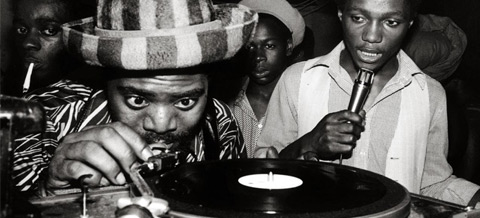
Many know what a sound system is and that they were created on the Jamaica. However, most people are unaware of its true history and especially how its creation impacted the culture of the island and, why not say, the world. For those who don't know, the sound systems are literally powerful sound systems controlled by the DJs that take turns playing a selection of songs and often improvising on them.
Initially, the first sound systems were basically made up of a deck, a tube amplifier and the largest set of speakers commercially available.
Throughout the 50s they became more powerful and sophisticated, being able to be heard a few streets away, which at the time impressed people. Sound systems were usually named after the exact name or name related to their founder, and the pioneering "sounds" were "Goodie’s", "Count Nick the Champ" and "Count Jones".
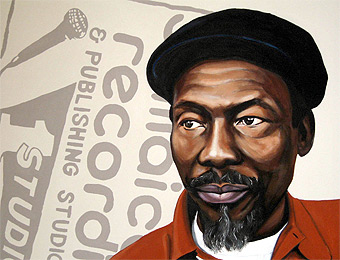
Illustration by Sir Coxsone Dodd, one of the giants of the medium
The rivalry between them was tremendous, and their fans can easily be compared with the supporters organized in our beloved football country. You were simply either "Coxsone," "Reid," or "King," depending on which dance you attended. Sabotage was also frequent among them, especially starting from Duke Reid, a former police officer who lived surrounded by "bad boys".
The records they played were obtained on countless trips to Estados Unidos, where styles such as jazz, r&b and boogie woogie were loved. The only one who managed to threaten the hegemony of the big three was Cecil Campbell, better known as Prince Buster, ex-boxer and leader of a gang in Kingston, the capital of Jamaica.
To attract followers each sound system needed exclusive songs and this created a huge demand for truly obscure recordings on the American scene. From this, another culture (or anti-culture?) emerged, widely followed to this day, including in Brazil by radio stations, which is to remove titles, artist names and even the serial number of records.
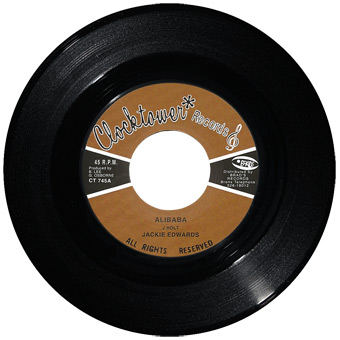 (The famous 7’’ records that are still produced and consumed worldwide today)
Jamaican indigenous traditions spoke louder in the momento when music began to develop and new artists emerged. Particularly the mixture of ingredients such as African rhythms with Caribbean touches, performed by musicians well familiar with American rhythm, gave rise to Ska, which reigned for years and gave rise to other styles.
At that time, big hits were made, including by the island's biggest star of all time - Bob Marley. Names like Jimmy Cliff, Desmond Dekker, Derrick Morgan, The Maytals, The Dominoes, The Skatalites and the great youth star Delroy Wilson were just a few whose recordings on 7'' records rocked the sound system dances of the period until the end of 60s.
Revolutionizing the island's cultural market, the demand for new hits to be played on sound systems not only gave rise to a series of new artists, but also new producers, which proves the true cultural shift promoted by this market not only in music but in Jamaica's future and international fame.
(The famous 7’’ records that are still produced and consumed worldwide today)
Jamaican indigenous traditions spoke louder in the momento when music began to develop and new artists emerged. Particularly the mixture of ingredients such as African rhythms with Caribbean touches, performed by musicians well familiar with American rhythm, gave rise to Ska, which reigned for years and gave rise to other styles.
At that time, big hits were made, including by the island's biggest star of all time - Bob Marley. Names like Jimmy Cliff, Desmond Dekker, Derrick Morgan, The Maytals, The Dominoes, The Skatalites and the great youth star Delroy Wilson were just a few whose recordings on 7'' records rocked the sound system dances of the period until the end of 60s.
Revolutionizing the island's cultural market, the demand for new hits to be played on sound systems not only gave rise to a series of new artists, but also new producers, which proves the true cultural shift promoted by this market not only in music but in Jamaica's future and international fame.
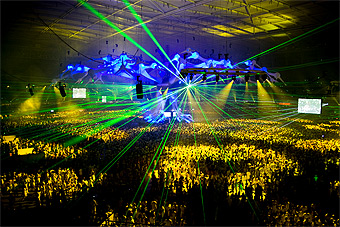 (Electronic music: also the result of the Jamaican DUB)
After the international explosion of rhythm that came with Bob Marley, the world began to pay more attention to what comes from this island that today has only 2 million and 700 thousand inhabitants, but is so culturally rich. It was through the creativity of its people that the sound systems emerged, which have always been side by side in the country's cultural development, and also giving rise to other worldwide known manifestations such as rap itself and electronic music. Salve a Sound System and its history!
(Electronic music: also the result of the Jamaican DUB)
After the international explosion of rhythm that came with Bob Marley, the world began to pay more attention to what comes from this island that today has only 2 million and 700 thousand inhabitants, but is so culturally rich. It was through the creativity of its people that the sound systems emerged, which have always been side by side in the country's cultural development, and also giving rise to other worldwide known manifestations such as rap itself and electronic music. Salve a Sound System and its history!
THE NASCIMENTO
The first sound systems actually appeared in the late 40s, and not in the 50s as several sources cite. At that time, parties or dances were dominated by bands that played primarily American r&b or mento (officially the first Jamaican rhythm to be recorded). However, this format began to become unviable for producers for a simple reason - economic. Basically, the profit from these dances came from the sale of drinks and a very traditional dish at the time, curried goat. According to the great producer Bunny Lee, the bands or orchestras at that time were quite numerous, and always played for an uninterrupted hour before taking breaks. During this break, the musicians ate and drank a lot, which in the end was expensive. In this momento, especially in a very poor country with people with very low purchasing power, the idea of only having to pay for a sound system and a DJ to entertain people proved to be more appropriate and profitable.
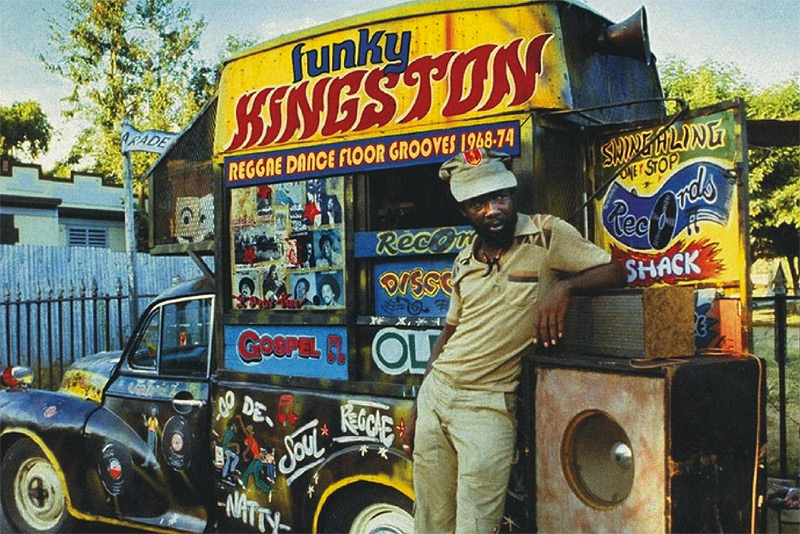 (Sound System + traveling record store in old Jamaican models)
DESENVOLVIMENTO
Many reggae enthusiasts proudly comment that even the RAP appeared in Jamaica. Besides being the purest truth, this was just one of the contributions that this small island made to the world, also originating through sound systems. Officially, a citizen called Winston Cooper, better known as Count Machuki, was the first DJ to become a true master of ceremonies (MC), and be the precursor of today's rappers. While Machuki rhymed and improvised, creating jargon that is still copied today, Duke Vin chose the songs, which made Tom "The Great" Sebastian the best known of the pioneering sound systems. However, it was only in the mid-1950s that three figures emerged who would not only revolutionize this market, but also cause a radical change in the course of Jamaican culture. They were Clement Seymour Dodd (known as Coxsone Dodd, founder of Studio One), Artthur "Duke" Reid (creator of the future label Trojan) and Vincent "King" Edwards, which in 1959 had the most powerful system on the island.Illustration by Sir Coxsone Dodd, one of the giants of the medium
JAMAICANA MUSIC INDUSTRY: THE EMERGENCEENTO
The Jamaican music industry was also the result of the culture of sound systems and its greatest exponents. At the end of the 50s and beginning of the 60s, some important labels emerged, such as Treasure Isle, Trojan and Studio One. While the owners of the systems used them to promote their first productions on acetate or wax discs, artists developed their talent in freshman and variety shows, often imitating American artists of the time such as Little Richard. Therefore, being successful in these talent contests was a prerequisite for producers to become interested. The famous 7'' compact vinyls began to be produced commercially in 1959, revealing future stars of Jamaican music such as Alton Ellis, Owen Gray and Derrick Morgan who at the time recorded r&b and boogie. At the same time, followers of the Rastafarian philosophy were already emerging, and by the end of the decade there were already ten to fifteen thousand followers.
(The famous 7’’ records that are still produced and consumed worldwide today)
CONTRIBUTIONSES
In addition to motivating the creation of the Jamaican music industry by making them produce their own music, the culture of sound system was also directly responsible for the emergence of new rhythms derived from the first musical manifestations recorded there. The popularization of not only the Rocksteady (successor of the Ska), but also the DUB, Dancehall, Ragga and practically almost all styles related to the Reggae or the music of that country also occurred through the massification and emergence of countless sound systems who fought over the entire island. The climate of competition between them not only fomentou the creation of studios, labels, record companies, record factories, but evidently caused the tiny island to develop artists of international standard who to this day perform all over the world. Reggae, despite prejudice, is one of the few musical styles that can be said to be universal, as it is heard and appreciated in practically every country in the world, each evidently with its own intensity. Along with it, the culture of sound systems also developed throughout the world, having enormous cultural representations such as in Brazil with the radio stations of São Luís, in Europe in countries such as Inglaterra and França, in the Estados Unidos and even in the Japão.
(Electronic music: also the result of the Jamaican DUB)
Category
#Reggae