
Bárbara interviews the band Massai!
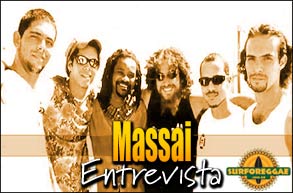
 Bárbara: How did you become interested in music, in learning to play an instrument?
Lúcio: I started to become interested when I was very young, about ten years old. I heard an album by Titãs, Cabeça Dinossauro, and for me that was very new, lots of guitars, lots of things I wasn't used to hearing. Then the idea came up of wanting a guitar; I talked to my mother about her getting me one and she said she would only give me one if I took lessons. Because she thought I was into it as a fad or that it would be something fleeting. But then I picked up the guitar and started playing. I took some classical guitar lessons, about three months of lessons, then I started learning by ear. Then I got into seventies rock 'n' roll and metal. Not long after I discovered the music of Chico Buarque de Holanda, which also influenced me a lot. I asked for a guitar for my birthday, and my grandmother gave me that guitar, a black, used, well-worn Dolphin. I started learning songs by ear. Later I had a trio, a power trio actually, because it was: me on guitar, another brother on bass and another on drums. Then we started playing the songs we liked, building our sound. And that band was my great school, because there was only one guitar and I had to do many things, I had to be extremely focused. For almost two years, for me it was really a school.
Bárbara: And what kind of sound were you making at that time?
Lúcio: It was straight-up rock 'n' roll.
Bárbara: Because of the influence of the guitars.
Lúcio: Rock 'n' roll in general, covering all its subdivisions. Heavy style, Led Zeppelin, Deep Purple, Black Sabbath, that heavy Metallica thing. Plus Hendrix, Janis Joplin, Jethro Tull, Pink Floyd, The Clash, The Police, Raul Seixas... Later I became interested in reggae, I discovered Bob Marley, then Peter Tosh, Burning Spear, Black Uhuru, Soul Syndicate, Steel Pulse, Aswad and countless other reggae artists.
Bárbara: You also started to become interested in reggae.
Lúcio: These days I'm interested in everything. Rock, reggae, baião, blues, jazz, samba, hip-hop, salsa..... If you ask what my favorite style of music is, it's easier for me to say what I don't like than what I like.
Bárbara: And Alex, how did you start to become interested in music, in learning to play an instrument?
Alex: Music for me started with my father. My father played guitar when I lived in Ilhéus, he did shows. There was a New Year's Eve when he put together a band to play in Olivença.
Bárbara: Dance band?
Alex: Yeah, dance band. I was young, but I would watch the rehearsals and play along, drumming. Then he said: "Grab the percussion over there." Then everyone liked it and I stayed on percussion. Later I picked up drums, guitar, bass. At Maristas school, where I studied, there was an evangelical band called Renovar, I started playing bass there. There was no bassist and I started doing improv work, you know? I played bass in that evangelical band at Maristas. From that day on I started playing. I met João, then Iuri came along, we formed a reggae band, then we changed the lineup. We met Marquinhos...
Bárbara: How did you meet Marcos, the vocalist?
Alex: There was a school event at Serravale, a public school here in Salvador, where we played backing Duda, vocalist of Diamba, and Serginho from Adão Negro. It was a band put together to back those guys.
Bárbara: What year was that, do you remember?
Alex: In '98. We formed the band to back Duda and Serginho, me on bass, Iuri on drums and João on guitar. When we got there, a friend who set up the drums said there was a guy from São Caetano, a rasta and a keyboardist, an Argentine. There was this Black rasta guy who sang, but they still needed drums, guitar and bass. And we needed a vocalist and keyboard, so it fit perfectly. We went to São Caetano, a peripheral neighborhood of Salvador, and started rehearsing at Marquinhos's house. Then the band started; the name was The Massaia, since a local Jamaican resident, a friend of Marquinhos's, called him Massaia in reference to Marcus Mosiah Garvey, the great Jamaican Black leader, preacher of Pan-Africanist ideology, who upheld the idea that all Black people living outside Africa should return to that mother continent. Bob Marley portrayed this very well in the song Exodus. At the same time a band was forming here in Pituba called Mosiah. In other words, the sound of the word was very similar. So I would tell Marquinhos: "Man, there's a band in Pituba called Mosiah, that name won't work."
Bárbara: And when did Lúcio join?
Alex: Lucinho came later. About two years later. We had already played together; I did sound with him at Skareggae, in some places.
Lúcio: He talked to me about the reggae he was doing with what was then Massaia, and I hadn't played in a year, I was idle, because the band Skareggae, formerly Lion Roots, had ended. He said: "Go to your house and get your guitar." I was completely unprepared, somewhat insecure, but I went for it anyway. And I don't regret it. I fell in love with the guys' sound, the repertoire, the group's performance. It was my first performance with them.
Bárbara: And what was the repertoire at that time?
Lúcio: One thing that marked me a lot, that they played, that at the time none of the bands in Salvador played, was Steel Pulse. It was a band I didn't know that well at the time, but the song they played, Reggae Fever, I knew and it was a song that particularly moved me. And they played that one, besides the band's songs and some Bob Marley songs, but that one in particular touched me. So much so that the band still plays it today and it became the band's signature.
Alex: We met Lucinho, he joined, the guys really liked Lucinho. Then a keyboardist left, another keyboardist came in. Then the lineup that's still going today was set: Marcos – vocals, Alex – bass, Lúcio – guitar, João – guitar, Iuri – drums and Michael on percussion.
Bárbara: When the João/Iuri/Alex trio met Marcos, was the idea already to play reggae for real?
Alex: It was.
Bárbara: Why the choice of reggae?
Alex: Because we liked reggae, we're reggae fans, you know? We really like reggae, Jamaican reggae.
Bárbara: How did you start listening to reggae? Before you started playing, experimenting, how did you begin to listen? Who introduced reggae to you?
Alex: Iuri, because he's a collector. You go to his house and there are records by Black Uhuru, Third World, Soul Syndicate, Midnight, Red Meditation...
Bárbara: Well, since Iuri lives in the lower city, which is an area of reggae fans, someone must have shown him the music.
Alex: There are many people in the lower city who collect reggae. It's a hotbed of musicians and reggae fans. We owe nothing to Maranhão, because here we really listen to reggae.
Bárbara: So was it Iuri who introduced the new stuff to you?
Alex: Iuri and Marquinhos Massai. Marquinhos Massai introduced me to Steel Pulse, which I didn't know.
Bárbara: At that time, did you have contact with material from people in the Recôncavo, from Cachoeira?
Alex: Of course, Remanescentes. At the time it was tapes, right? There were lots of tapes. There was even a rehearsal tape of Diamba.
Bárbara: Did you go to Pelourinho, to Sine's rehearsals at Novo Tempo?
Lúcio: I used to go to Pelourinho to see Sine Calmon and band Morrão Fumegante and that was a strong influence for me to start playing reggae.
Alex: I lived in Ilhéus at that time, I didn't have that vision of reggae yet. I only knew Bob Marley.
Bárbara: And how did the Remanescentes material reach your hands?
Alex: Through a tape on Itaparica Island, with the father of a friend of mine. It had Remanescentes and another band from the Recôncavo that did Gregory Isaacs covers. At that time Bem Aventurados already existed, a band that today is perhaps one of the most faithful to roots reggae here in Salvador. I played with a rasta from Bem Aventurados, I called João to back him, but it didn't work out. We experimented a lot until we got to Massai.
Bárbara: Did you follow the emergence of Salvador bands such as Diamba and Adão Negro?
Lúcio: Naturally. Both are an influence on all the other new bands that emerged up to then. Diamba has even helped us.
Alex: I heard about Diamba back in Ilhéus, in '96.
Lúcio: I had a band from which three bands came out; the band was called Lion Roots, later it became Skareggae. We played at Babilônia – Pelourinho and at Novo Tempo. The band's big show was opening for Diamba in Alagoinhas; Alex joined us on guitar, since our other guitarist had already left the band. That band had members of the current bands Mosiah, Scambo and Massai. And there was the vocalist who has a band today called Lion Soul. In other words, four more bands came out of that one.
Bárbara: Who were those guys?
Lúcio: Alexandre, guitarist of Scambo; Márcio, percussionist of Mosiah; me, guitarist of Massai and Sandro, vocalist of Lion Soul. Not to mention Marcão, percussionist of Mano Véio, who for a while also played in that band. And the drummer plays in a band here in Salvador called Soma, which I heard is playing at alternative festivals around the country. So I followed it very closely, even because I had those guys around me. When the band was nearing the end each one was already saying where they would go, you know? I remember Alexandre talked a lot about Scambo. Márcio was already talking about Mosiah too. I followed it very closely and when those bands started playing I went to their shows, just as I still do today. They're all my friends.
Alex: And Diamba and Adão Negro opened space for the scene, but before that, Sine Calmon, who broke out at Salvador Carnival.
Bárbara: Serginho played with Sine in Morrão Fumegante, right? Adão started with musicians from Morrão Fumegante: Artur Cardoso, Vitor Hugo, Raimundo Guabiraba and Serginho. The lineup changed later because of Morrão Fumegante's commitments, which at the time played many shows. I also followed Diamba's first performances, the sound the guys were making at the Adm Bar (UFBa School of Administration). Now I'll ask the classic question about the band's name. How did it come about?
Alex: The name Massai comes from the African tribe. It came about because before that the band's name was The Massaia, as already explained.
Alex: He wanted to call Marquinhos Mosiah, in allusion to Marcus Garvey, but with his Jamaican accent it came out Massaia. So we decided to use that as the band's name.
Alex: Marquinhos had a friend who studied philosophy who came up with the idea of using Massai. Massai, the warrior tribe that has the tradition of killing lions; when they reach adulthood they kill lions and the lion, as we all know, is one of the symbols of reggae.
Lúcio: Yes. The lion also represents bravery. Because we formed an independent band and to be an independent band you have to be brave, you have to kill a lion every day, pure resistance.
Bárbara: I want to know what each of you brings that is different and special and that forms the unity that is Massai's sound?
Lucio: Iuri is the most faithful of all to reggae. I bring rock 'n' roll, a bit of blues and jazz; João also rock; Alex is more MPB; Marquinhos more Soul and Michael is more regional sounds, roots sounds. In common: love for reggae.
Alex: I'll take the opportunity to talk a little about Marquinhos Massai's trajectory. He discovered he could sing late, starting to play in Cachoeira in the Recôncavo with the band Só as Cabeças. Marquinhos sang the songs in English, by Bob Marley. He was bald at that time. He started singing, then came to Salvador, played in São Caetano. When the meeting at Serravale happened, a school here in Salvador, we met. We made the arrangements for the songs A bala, Greve, Natural Beleza, among others. One of our newer songs is called Cante pra MPB, which is about the scene mixing MPB with reggae. That's when Marquinhos emerged with the group and started doing the work. We really have this fusion of MPB with Reggae; we really enjoy that. We have great respect for the Natiruts guys, who have that proposal too... You notice that through the guys' compositions and arrangements.
Bárbara: Who writes songs in Massai?
Alex: I write some songs, Marquinhos does too.
Bárbara: Tell me a little about the songs.
Alex: I wrote Natural Beleza, Você Já era, Quem dera; from experiences I had, and Marquinhos's, A bala, Levada do Recôncavo, because he lived there and the Levada is actually the name of a waterfall there in the Bahian Recôncavo that he always told us about, then he wrote the song. There's Greve, by a friend of ours, Julião Rasta, who lives in Gantois, a neighborhood here in Salvador; Eu sou luz is by a brother of ours who's 40, a Hari Krishna, a philosopher, he only passes positive vibrations if you talk to him. There's a current song called Efeito Colateral, by a friend of ours, that we're working on. There are some new songs where everyone composes.
Bárbara: What are these new songs about?
Alex: Critical of the system, love, poetry, a very positive mix. From our experiences...
Bárbara: Moving from the lyrics to the music, what musical influence does each of you bring to the band?
Lúcio: I think musical influence merges with each person's life experience. On my part, my approach is more blues, because I listen to a lot of blues, a lot of Brazilian music, Djavan, Chico Buarque de Holanda, mainly. Also jazz, rock 'n' roll and roots reggae.
Alex: The guys, being from Bahia, have a very strong musicality that comes from MPB, samba, axé.
Bárbara: But what do you listen to that influences your compositions?
Alex: MPB, mainly Gonzaguinha, João Bosco...
Bárbara: And within the band, how does the musical creation process work?
Alex: Usually the songs I write already come with melody, then someone else does a solo, everyone contributing ideas to the arrangements.
Bárbara: Is the process collective?
Alex: It's collective. The songs already come with the notes, key and lyrics, then each one works on an arrangement, collectively. For drums I usually tell Iuri the beat... We've been playing together for five years now.
Bárbara: Tell us about your participation in the Kaya no Reggae compilation.
Alex: It was very important because reggae at that stage was very strong. Salvador had many reggae parties and there was a coming together. It was good to promote Bahia's music, because here is the capital of reggae. The Kaya no Reggae compilation was important to record the moment we were living here.
Lúcio: Our song made it on and so did songs by bands also on the rise like the band Naya. It was special because at the time there were several bands, new and old; there was a fusion of experience with novelty, you know?
Alex: What was really missing was the media opening its eyes more to what was happening; the due importance wasn't given, because it was reggae music.
Lúcio: It would even be good to demystify the false idea that Bahia is the land of axé and pagode. Anyone who lives here or even comes from outside and has more contact with local bands realizes that Bahia isn't just axé and pagode—not wanting to belittle those styles, but I think there should be sincere democratization by the media of all strands, because Bahia is a musical hotbed.
Bárbara: Tell us a little more about that moment. There was a union of newcomers and veterans; did you believe something good would come from that?
Alex: We believed in that because Kaya no Reggae is a compilation by Bahia Discos, a company of Rede Bahia, which is a Globo affiliate. When they took on reggae music, which is a discriminated music, associated with marijuana, with a distorted image, and saw that in reggae there is a light, a movement, resistance, lyrics and musicality, it seemed there was a light at the end of the tunnel... And for a broadcaster like Rede Bahia to make a compilation was very good, especially because it was distributed throughout Brazil by Som Livre. So here's a suggestion for friends who visit the Surforeggae site: look for the album Kaya no Reggae and judge for yourselves how reggae music made today in Bahia is doing... You can check out great bands like Edson Gomes, Nengo Vieira, Diamba, Mosiah, Adão Negro... Although some good bands were left out, such as the promising band Zuluz.
Bárbara: I want to know why a few years ago, before you started playing, the middle class didn't like reggae so much, or reggae didn't draw so much attention from the middle class.
Lúcio: Actually it never had.
Bárbara: How do you view the sudden interest of the white middle class in reggae? Do you think it's genuine interest or a fad?
Alex: I'm very radical about that, because I think it's more about having a good time, people going along with the "fad."
Lúcio: That's true, I think the minority is interested in the music, although we shouldn't generalize, because every form of generalization is unfair.
Alex: It's more because fashion is leaning that way, "let's go there." It's a fad and you see there are many people who throw the parties, make millions of reais off the reggae crowd and there's no giveback. For example, there could be someone from Central Reggae here in Bahia, start a movement and expand it across Brazil, show that Bahia is a reggae hotbed: Edson Gomes, Nengo Vieira, Sine Calmon, Diamba, Massai, Mosiah, everyone who plays reggae. Others who are starting now like Skaypora...
Bárbara: So is there rivalry?
Alex: There isn't the unity there was with Jacob Miller and Bob Marley, of doing music festivals together, recording on each other's albums, living together.
Lúcio: I was born in Porto Alegre and when I go back there I feel a kind of envy, positive envy, you know? Because the unity of the people there is really genuine. Here what we observe is the imposition by certain producers and entrepreneurs of only booking certain bands; it even became something forced and the audience itself noticed, except the fad audience, because for them music matters least; what matters most is showing up and acting like they dig reggae, smoke marijuana, make things happen, etc. On the other hand the musicians are super united and I know that if it depended only on us musicians there would be room for everyone; the only requirement would be that the songs be made with love and be quality music... That's why I'd like to mention here some bands, just some, it's worth stressing, that in our humble opinion are doing quality reggae work, regardless of anything. They would be: Zuluz, Mosiah, Scambo, Diamba, Adão Negro, Edson Gomes, Dionorina, Nengo Vieira, Sine Calmon, Los Baganas, Bem Aventurados, Red Meditation, Dedo de Hulk. Diamba and Mosiah, by the way, have already helped us...
Alex: I don't want to name names here, but there are bands that only like being at the best parties, they don't hold the true essence of reggae. Reggae didn't come from the upper classes. Reggae in Bahia has to be an NGO, get involved with social work, food donations, go to daycare centers, help. We have to use this gift to help.
Bárbara: I think that with the emergence of middle-class bands there was an "elitization" of reggae.
Lúcio: But we can't lose sight that this was also positive on one side. The media opened more space, although it's still not the space we deserve. Having reggae bands playing at Festival de Verão was impossible a few years ago. Who knows, maybe they'll even play on the event's main stage...
Alex: Reggae is difficult music; the media doesn't open space for reggae, so we have to make the most of these moments. Natiruts too, we have to mention them, because they opened doors, Sine Calmon too.
Bárbara: We should remember that Natiruts was born more or less at the same time as Diamba and later Adão Negro, more or less without knowing of each other's existence. It's also worth remembering that this was very cool because Brasília has no tradition of making reggae, unlike Salvador and São Luís.
Alex: I heard a cool compilation, O Reggae do Cerrado, and the bands there have a very roots approach; the movement there is strong. And we're new at this, we have five years. Dionorina has more than 20 years in reggae and can speak perfectly about how this works. Edson Gomes...
Bárbara: Besides reggae, what other musical movement has been catching your attention in Salvador?
Alex: The movement that's really been catching my attention and that I like is the alternative movement, which has many good things. Salvador is rich in musicality, from jazz to blues, from rock 'n' roll to maracatu, forró...
Bárbara: Can you name some bands?
Alex: I can. Mano Véio, Zaccatimuana...
Lúcio: For jazz there's Os Melódicos, which I love; for rock 'n' roll there's Retrofoguetes, which plays first-rate Surf Music and owes nothing to any foreign band; for forró there's Forró no Kilo, a group that rescues pé de serra making a blend with reggae, nicknamed forreggae. We can't fail to mention these new things. For rock 'n' roll there's also Nancyta, Rebeca Mata and of course we couldn't fail to mention Pitty, who worked hard here in Salvador before getting where she is.
Alex: Salvador's alternative scene is very rich.
Lúcio: If Brazil knew what's here it wouldn't believe it. For those who think there's only pagode here...
Bárbara: And in the rest of Brazil, what has been catching your attention?
Alex: O Rappa, Nação Zumbi...
Lúcio: O Rappa and Los Hermanos today for me are the most honest bands with themselves and with their fans and that's why they're among the most praised today. Marcelo D2 too.
Alex: Marcelo D2, I was always a fan of his, now I'm even more, because he's been doing the blend of hip-hop with samba really well. There are lots of good people.
Bárbara: And in reggae?
Lúcio: Mystical Roots from Maranhão and Macucos from Espírito Santo. Wonderful bands we had the opportunity to play with in Itacaré, southern Bahia, and develop a friendship. The Mystical guys, for example, became real friends; they stayed at our houses in Salvador, we would take them to parties, introduce them to local reggae fans... It was a blast! Macucos were here in Salvador at Festival de Verão 2003 and we met up, it was pure joy... Fred and Júnior Barriga are really great guys!
Alex: Mystical Roots, of course.
Lúcio: Natiruts has a more mature work; I had the opportunity to talk with Alexandre about that. Tribo de Jah, I love them because I think it's a band with a strong Jamaican influence, both musically and visually and philosophically. We met Fauzi in Itacaré, talked a bit and he has a totally Zen style, you know? He has a life experience that has everything to do with the reggae he shows.
Alex: It's an established band, with consistent work.
Lúcio: We can only thank these bands that work and put themselves out there, because that way we look to their example and see that we can get there too.
Alex: For sure we already count on their help and I think if they can help, they will.
Bárbara: I want to know what the band's plans are for 2004.
Lúcio: We're going to record a demo CD now, with new songs. We're working on the arrangements, finishing some, we're going to start recording in December now.
Bárbara: Tell me the names of those songs, just so we can get a feel for what's coming.
Lúcio: Natural Beleza, Você Já era, Efeito Colateral, Cante pra MPB...
Alex: That song is about the influence of MPB, reggae singing to MPB, a fusion without prejudice of one style with the other.
Lúcio: Other songs: A bala, Quem dera, Levada do Recôncavo...
Alex: There's a new song we're arranging called O feitiço das Estrelas, about a romance between the sun and the moon, like Natural Beleza, musically speaking. There are many new songs coming that the crowd will really like. Soon we'll be in the South to show Bahia's reggae.
Bárbara: How do you define the sound Massai makes for people who don't know the band?
Lúcio: The sound Massai makes is a sound made with love, sincerity, honesty, because we could do a thousand things, but we chose this because it's what we like. We promise the crowd will dance, learn and have fun with our sound.
Alex: Speaking of the musicality, it's melodic roots reggae, with dashes of rock 'n' roll, forward-looking. In our sound you can perceive the fusion of Reggae, including dub, MPB, rock and nobody usually stays still, because the group's energy on stage is also very positive, combined with a carefully crafted and very danceable repertoire.
Lúcio: With dashes of rock 'n' roll, but nothing pop in the negative sense that expression sometimes carries. It's pop in the sense of bringing together diverse musical styles.
Alex: We're very influenced by Black Uhuru, Steel Pulse, Third World. Anyone who knows these bands will notice our sound has a lot of that. We seek that approach.
Bárbara: Do you have anything else to say to the people who visit SURFOREGGAE, any message from Massai?
Lúcio: The message we at Massai want to leave is for people all over Brazil who visit SURFOREGGAE to open their minds to the new musicality emerging in Bahia, especially reggae, which has actually been reformulating Bahia's musical concept for about eight years. The more people come across this kind of sound and spread it—to their neighbor, their friend, their father and their child—the better for all of us, because music is a wonderful thing. You hear a song and when you like it you want to share it with someone.
Alex: And another thing, to stress that reggae is not a fad. Reggae is essence, reggae is music and universal.
Lúcio: The band's plans for 2004 include a trip to the South, Porto Alegre, Florianópolis and Curitiba. I was born in Porto Alegre, I always spend vacations there, so I've already noticed the crowd is super receptive to Bahian reggae, especially. Anything from Bahia there and they're already super happy. Capoeira is a huge hit there. So we're arranging to go down in January or February to Porto Alegre, play with some local bands and maybe with some bands from elsewhere. On December 30 we'll play with our friends from Adão Negro in Itacaré and we should do a few more shows there before going to the South of the country. Beyond that, the whole Massai band would like to send a big hug to everyone, lovers of good music!
Category
#Reggae