
Reggae · August 16, 2004
Surforeggae interviews one of today's main roots reggae bands: Soldiers of Jah Army!
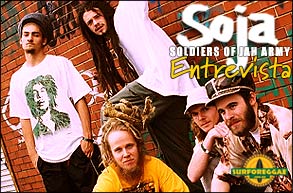
Continuing the new wave of excellent bands that have been emerging outside Jamaica lately, the young Americans from Soldiers of Jah Army, without a doubt, have all the requirements to become one of the greatest powers of modern world Reggae. The band, which emerged in Washington – DC, capital of the United States of America, stands out for highly "rebellious" lyrics and criticism of the system we live in.
With very beautiful and conscious compositions and arrangements worthy of Jamaican professionals, S.O.J.A. currently has 3 CDs released, one of which, "Peace in a time of War", won in three categories of an annual award directed at Reggae. Jacob Hemphill, leader and vocalist of S.O.J.A., throughout all this time showed himself fascinated by Brazil and says they are waiting for an invitation to come play in the country. Check out the exclusive interview granted to Surforeggae, represented by Rafael Costa.
 Rafael – What do you think about American reggae? Tell us a bit about the evolution and what Americans think about the music and philosophy.
Jacob Hemphill – I don't listen to much American reggae; we prefer the original Jamaican. However, I do listen to a lot of American music such as hip-hop, rock, jazz and blues.
Rafael – Is Soldiers of Jah Army a strictly roots band? Do you plan to change the style? Why?
Jacob Hemphill – We have a strictly roots message, but the music is what we feel at the moment. We have many influences.
Rafael – What kind of music do you like to listen to besides Reggae?
Jacob Hemphill – We like a lot of things; lately I've been listening to a lot of punk, rock, hip-hop and jazz.
Rafael – Lately reggae has become very popular, and in some places it is considered a "fashionable rhythm". What do you think about commercial Reggae?
Jacob Hemphill – I don't mind people playing commercial reggae, musically speaking. The sacred part is the message, and as long as it is passed consciously, that's fine. If some people want to play reggae because they like the rhythm, that's good; if they play it because they love the message that reggae delivers, even better.
Rafael – Give us your opinion about the (r)evolution of reggae. From rocksteady to the dancehall era.
Jacob Hemphill – For me, the evolution and the revolution were started by none other than Bob Marley.
Rafael – Could you talk about what it was like working with one of the greatest producers and sound engineers in the world of Reggae - Jim Fox?
Jacob Hemphill – I have never met anyone as "deep" into reggae as Jim Fox. He is purely and highly professional. Working with him was one of the best experiences of our lives.
Rafael – Why is it important for S.O.J.A to come to Brazil? Tell us a little about the image of our country in the USA.
Jacob Hemphill – I don't have the words to describe, for myself or anyone, the image we have of Brazil. To me, it is the vision of paradise. It is important for us to know Brazil, because we are very curious about the people and their customs.
Rafael – Tell us a bit about the history of reggae in your life. Why reggae and not another musical rhythm?
Jacob Hemphill – Reggae carries the message I was born to spread. It's not just music. It's the Rastafari message, the father of the children of Israel. I've heard this message since I was 11; it comes traditionally from my family.
Rafael – We know that S.O.J.A comes from the United States, one of the most "powerful" countries in the international context, and that all members of the band are white. Have you suffered any discrimination for these reasons?
Jacob Hemphill – No. Discrimination is what Martin Luther King, Harriet Tubman, Malcom X, Marcus Garvey suffered, not us.
Rafael – What do you think about the government of George W. Bush?
Jacob Hemphill – Bush is the worst president we've ever had. He lies every day. He's nothing but a "money-hungry" man who loves money and lies to get it.
Rafael – And about the politics used by the United States in the international context? Give us an opinion about it.
Jacob Hemphill – The United States destroyed the world, forcing men and women to come here to live. So when people flee the misery they caused in the rest of the world and come here, the government treats them as illegals. What the American government does is not illegal? That's nonsense.
Rafael – The oppression against third world countries imposed by the United States inspires S.O.J.A to write increasingly "rebellious" and conscious lyrics in this sense?
Jacob Hemphill – Exactly. That's the subject we talk about with the most "rebellion". We are totally against what the American government is doing to our planet, and we make a point of criticizing what we don't think is right.
Rafael – In Brazil we compare your vocal style with Ben Harper's, a great musician who also gets involved with Reggae. Were you influenced by this artist? What other influences were important in your musical formation?
Jacob Hemphill – Yes, you nailed it. Ben Harper's style influenced me a lot. The main influences were Bob Marley, Sade, Chris Cornell, Rage, Jack Johnson, Nina Simone, Jay-Z, Infectious Organisms, Big L, my father and my family, Peter Tosh... anyway, I like anyone who is an excellent songwriter, especially artists who have solo careers.
Rafael – Tell us about the 3 awards you won at the 7th annual Reggae Award in Washington.
Jacob Hemphill – We had never won anything, and for us it was an excellent start, since it is a very important award. We hope to continue pleasing the public and critics with our next works.
Rafael – Do you know anything about Brazilian music and culture?
Jacob Hemphill – No, but we are very interested in learning. We know that Brazil is very rich culturally, and consequently its music is also very good.
Rafael – Tell us a little about the relationship established between Reggae X Politics X Rasta (Religion).
Jacob Hemphill – Rastafari is the beginning and the end of everything. Politics and music are creations and manifestations of man. True politics for me is Theocracy.
Rafael – Do you follow any religion?
Jacob Hemphill – I follow the words of Hailé Selassié, but no doctrine or religion in particular.
Rafael – What do you think could be done to reduce the social problems of capitalism? (just an opinion).
Jacob Hemphill – Equal distribution of wealth. Not individually, but globally, respecting nations as a whole.
Rafael – Thank you very much for the opportunity given to the Brazilian people to learn more about the philosophy and message of the band Soldiers of Jah Army with this interview. Please leave a message for all Reggae fans in Brazil.
Jacob Hemphill – We thank all the Brazilian people who like Reggae and you, who do this excellent work spreading its truth and feeling. Our message to the Brazilian people is simply a huge thank you for showing interest in our music and in Rastafari philosophy, and we hope to see each other very soon on a tour in Brazil.
Rafael – What do you think about American reggae? Tell us a bit about the evolution and what Americans think about the music and philosophy.
Jacob Hemphill – I don't listen to much American reggae; we prefer the original Jamaican. However, I do listen to a lot of American music such as hip-hop, rock, jazz and blues.
Rafael – Is Soldiers of Jah Army a strictly roots band? Do you plan to change the style? Why?
Jacob Hemphill – We have a strictly roots message, but the music is what we feel at the moment. We have many influences.
Rafael – What kind of music do you like to listen to besides Reggae?
Jacob Hemphill – We like a lot of things; lately I've been listening to a lot of punk, rock, hip-hop and jazz.
Rafael – Lately reggae has become very popular, and in some places it is considered a "fashionable rhythm". What do you think about commercial Reggae?
Jacob Hemphill – I don't mind people playing commercial reggae, musically speaking. The sacred part is the message, and as long as it is passed consciously, that's fine. If some people want to play reggae because they like the rhythm, that's good; if they play it because they love the message that reggae delivers, even better.
Rafael – Give us your opinion about the (r)evolution of reggae. From rocksteady to the dancehall era.
Jacob Hemphill – For me, the evolution and the revolution were started by none other than Bob Marley.
Rafael – Could you talk about what it was like working with one of the greatest producers and sound engineers in the world of Reggae - Jim Fox?
Jacob Hemphill – I have never met anyone as "deep" into reggae as Jim Fox. He is purely and highly professional. Working with him was one of the best experiences of our lives.
Rafael – Why is it important for S.O.J.A to come to Brazil? Tell us a little about the image of our country in the USA.
Jacob Hemphill – I don't have the words to describe, for myself or anyone, the image we have of Brazil. To me, it is the vision of paradise. It is important for us to know Brazil, because we are very curious about the people and their customs.
Rafael – Tell us a bit about the history of reggae in your life. Why reggae and not another musical rhythm?
Jacob Hemphill – Reggae carries the message I was born to spread. It's not just music. It's the Rastafari message, the father of the children of Israel. I've heard this message since I was 11; it comes traditionally from my family.
Rafael – We know that S.O.J.A comes from the United States, one of the most "powerful" countries in the international context, and that all members of the band are white. Have you suffered any discrimination for these reasons?
Jacob Hemphill – No. Discrimination is what Martin Luther King, Harriet Tubman, Malcom X, Marcus Garvey suffered, not us.
Rafael – What do you think about the government of George W. Bush?
Jacob Hemphill – Bush is the worst president we've ever had. He lies every day. He's nothing but a "money-hungry" man who loves money and lies to get it.
Rafael – And about the politics used by the United States in the international context? Give us an opinion about it.
Jacob Hemphill – The United States destroyed the world, forcing men and women to come here to live. So when people flee the misery they caused in the rest of the world and come here, the government treats them as illegals. What the American government does is not illegal? That's nonsense.
Rafael – The oppression against third world countries imposed by the United States inspires S.O.J.A to write increasingly "rebellious" and conscious lyrics in this sense?
Jacob Hemphill – Exactly. That's the subject we talk about with the most "rebellion". We are totally against what the American government is doing to our planet, and we make a point of criticizing what we don't think is right.
Rafael – In Brazil we compare your vocal style with Ben Harper's, a great musician who also gets involved with Reggae. Were you influenced by this artist? What other influences were important in your musical formation?
Jacob Hemphill – Yes, you nailed it. Ben Harper's style influenced me a lot. The main influences were Bob Marley, Sade, Chris Cornell, Rage, Jack Johnson, Nina Simone, Jay-Z, Infectious Organisms, Big L, my father and my family, Peter Tosh... anyway, I like anyone who is an excellent songwriter, especially artists who have solo careers.
Rafael – Tell us about the 3 awards you won at the 7th annual Reggae Award in Washington.
Jacob Hemphill – We had never won anything, and for us it was an excellent start, since it is a very important award. We hope to continue pleasing the public and critics with our next works.
Rafael – Do you know anything about Brazilian music and culture?
Jacob Hemphill – No, but we are very interested in learning. We know that Brazil is very rich culturally, and consequently its music is also very good.
Rafael – Tell us a little about the relationship established between Reggae X Politics X Rasta (Religion).
Jacob Hemphill – Rastafari is the beginning and the end of everything. Politics and music are creations and manifestations of man. True politics for me is Theocracy.
Rafael – Do you follow any religion?
Jacob Hemphill – I follow the words of Hailé Selassié, but no doctrine or religion in particular.
Rafael – What do you think could be done to reduce the social problems of capitalism? (just an opinion).
Jacob Hemphill – Equal distribution of wealth. Not individually, but globally, respecting nations as a whole.
Rafael – Thank you very much for the opportunity given to the Brazilian people to learn more about the philosophy and message of the band Soldiers of Jah Army with this interview. Please leave a message for all Reggae fans in Brazil.
Jacob Hemphill – We thank all the Brazilian people who like Reggae and you, who do this excellent work spreading its truth and feeling. Our message to the Brazilian people is simply a huge thank you for showing interest in our music and in Rastafari philosophy, and we hope to see each other very soon on a tour in Brazil.
THE INTERVIEW
Rafael – What do you think about American reggae? Tell us a bit about the evolution and what Americans think about the music and philosophy.
Jacob Hemphill – I don't listen to much American reggae; we prefer the original Jamaican. However, I do listen to a lot of American music such as hip-hop, rock, jazz and blues.
Rafael – Is Soldiers of Jah Army a strictly roots band? Do you plan to change the style? Why?
Jacob Hemphill – We have a strictly roots message, but the music is what we feel at the moment. We have many influences.
Rafael – What kind of music do you like to listen to besides Reggae?
Jacob Hemphill – We like a lot of things; lately I've been listening to a lot of punk, rock, hip-hop and jazz.
Rafael – Lately reggae has become very popular, and in some places it is considered a "fashionable rhythm". What do you think about commercial Reggae?
Jacob Hemphill – I don't mind people playing commercial reggae, musically speaking. The sacred part is the message, and as long as it is passed consciously, that's fine. If some people want to play reggae because they like the rhythm, that's good; if they play it because they love the message that reggae delivers, even better.
Rafael – Give us your opinion about the (r)evolution of reggae. From rocksteady to the dancehall era.
Jacob Hemphill – For me, the evolution and the revolution were started by none other than Bob Marley.
Rafael – Could you talk about what it was like working with one of the greatest producers and sound engineers in the world of Reggae - Jim Fox?
Jacob Hemphill – I have never met anyone as "deep" into reggae as Jim Fox. He is purely and highly professional. Working with him was one of the best experiences of our lives.
Rafael – Why is it important for S.O.J.A to come to Brazil? Tell us a little about the image of our country in the USA.
Jacob Hemphill – I don't have the words to describe, for myself or anyone, the image we have of Brazil. To me, it is the vision of paradise. It is important for us to know Brazil, because we are very curious about the people and their customs.
Rafael – Tell us a bit about the history of reggae in your life. Why reggae and not another musical rhythm?
Jacob Hemphill – Reggae carries the message I was born to spread. It's not just music. It's the Rastafari message, the father of the children of Israel. I've heard this message since I was 11; it comes traditionally from my family.
Rafael – We know that S.O.J.A comes from the United States, one of the most "powerful" countries in the international context, and that all members of the band are white. Have you suffered any discrimination for these reasons?
Jacob Hemphill – No. Discrimination is what Martin Luther King, Harriet Tubman, Malcom X, Marcus Garvey suffered, not us.
Rafael – What do you think about the government of George W. Bush?
Jacob Hemphill – Bush is the worst president we've ever had. He lies every day. He's nothing but a "money-hungry" man who loves money and lies to get it.
Rafael – And about the politics used by the United States in the international context? Give us an opinion about it.
Jacob Hemphill – The United States destroyed the world, forcing men and women to come here to live. So when people flee the misery they caused in the rest of the world and come here, the government treats them as illegals. What the American government does is not illegal? That's nonsense.
Rafael – The oppression against third world countries imposed by the United States inspires S.O.J.A to write increasingly "rebellious" and conscious lyrics in this sense?
Jacob Hemphill – Exactly. That's the subject we talk about with the most "rebellion". We are totally against what the American government is doing to our planet, and we make a point of criticizing what we don't think is right.
Rafael – In Brazil we compare your vocal style with Ben Harper's, a great musician who also gets involved with Reggae. Were you influenced by this artist? What other influences were important in your musical formation?
Jacob Hemphill – Yes, you nailed it. Ben Harper's style influenced me a lot. The main influences were Bob Marley, Sade, Chris Cornell, Rage, Jack Johnson, Nina Simone, Jay-Z, Infectious Organisms, Big L, my father and my family, Peter Tosh... anyway, I like anyone who is an excellent songwriter, especially artists who have solo careers.
Rafael – Tell us about the 3 awards you won at the 7th annual Reggae Award in Washington.
Jacob Hemphill – We had never won anything, and for us it was an excellent start, since it is a very important award. We hope to continue pleasing the public and critics with our next works.
Rafael – Do you know anything about Brazilian music and culture?
Jacob Hemphill – No, but we are very interested in learning. We know that Brazil is very rich culturally, and consequently its music is also very good.
Rafael – Tell us a little about the relationship established between Reggae X Politics X Rasta (Religion).
Jacob Hemphill – Rastafari is the beginning and the end of everything. Politics and music are creations and manifestations of man. True politics for me is Theocracy.
Rafael – Do you follow any religion?
Jacob Hemphill – I follow the words of Hailé Selassié, but no doctrine or religion in particular.
Rafael – What do you think could be done to reduce the social problems of capitalism? (just an opinion).
Jacob Hemphill – Equal distribution of wealth. Not individually, but globally, respecting nations as a whole.
Rafael – Thank you very much for the opportunity given to the Brazilian people to learn more about the philosophy and message of the band Soldiers of Jah Army with this interview. Please leave a message for all Reggae fans in Brazil.
Jacob Hemphill – We thank all the Brazilian people who like Reggae and you, who do this excellent work spreading its truth and feeling. Our message to the Brazilian people is simply a huge thank you for showing interest in our music and in Rastafari philosophy, and we hope to see each other very soon on a tour in Brazil.Category
#Reggae