
Reggae · February 12, 2012
2. Ras Cultura Special: The Symbolism of Rastafari Culture.
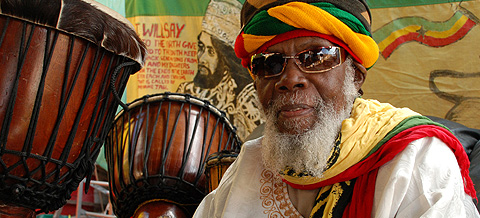
Rastafarianism is in postmodern encyclopedias. The Brazilian Webster defines movement in the following terms:
 Expanding political and religious movement, originating from the Jamaican cult that reveres the Ethiopian emperor Haile Selassie I as a divine personality. The movement was influenced by black activists from the 1930s, mainly Marcus Garvey (...) Rastafarianism combines elements of African religions, (...) biblical narratives and Afro-Caribbean culture. Its adherents believe that black people are the lost tribes of Israel, who will be redeemed with the return to África. The movement has no church or clergy, and ritual practice is spontaneous.
Rastafarians, or Rastafarians, express their feeling of fraternity through certain symbols: the style (which is not cut and forms long braids), the use of Ethiopian national colors (red, black, green and golden yellow), eating habits (they avoid pork) and the occasional use of cannabis (marijuana) as an aid to meditation. Jamaican popular music, especially reggae, with emphasis on singer-songwriter Bob Marley (1945-1981), constitutes a popular means of disseminating Rastafarian ideas."
(WEBTER/LARROUSSE, V.II - p 819. São Paulo: Folha da Manhã, 1997)
The role of Haile Selassie in the Rastafari universe is linked to the religious and socio-political-ideological aspects that guide the "Rasta" posture or behavior. The messianic aura of "Leão de Judah" constitutes a force of communion with ideals of peace, solidarity between people and universal love, in addition to the appreciation of all signs related to Afro-culture, on the African continent and in the world.
The trajectory of the Ethiopian king, his ideas, his image, his biography, achieved great international repercussion thanks to intense dissemination in the media. It was through the headlines of newspapers around the world that Selassie reached Jamaica, where Marcus Garvey recognized in him the Messiah, the Salvador of the black people prophesied by Garvey himself.
Expanding political and religious movement, originating from the Jamaican cult that reveres the Ethiopian emperor Haile Selassie I as a divine personality. The movement was influenced by black activists from the 1930s, mainly Marcus Garvey (...) Rastafarianism combines elements of African religions, (...) biblical narratives and Afro-Caribbean culture. Its adherents believe that black people are the lost tribes of Israel, who will be redeemed with the return to África. The movement has no church or clergy, and ritual practice is spontaneous.
Rastafarians, or Rastafarians, express their feeling of fraternity through certain symbols: the style (which is not cut and forms long braids), the use of Ethiopian national colors (red, black, green and golden yellow), eating habits (they avoid pork) and the occasional use of cannabis (marijuana) as an aid to meditation. Jamaican popular music, especially reggae, with emphasis on singer-songwriter Bob Marley (1945-1981), constitutes a popular means of disseminating Rastafarian ideas."
(WEBTER/LARROUSSE, V.II - p 819. São Paulo: Folha da Manhã, 1997)
The role of Haile Selassie in the Rastafari universe is linked to the religious and socio-political-ideological aspects that guide the "Rasta" posture or behavior. The messianic aura of "Leão de Judah" constitutes a force of communion with ideals of peace, solidarity between people and universal love, in addition to the appreciation of all signs related to Afro-culture, on the African continent and in the world.
The trajectory of the Ethiopian king, his ideas, his image, his biography, achieved great international repercussion thanks to intense dissemination in the media. It was through the headlines of newspapers around the world that Selassie reached Jamaica, where Marcus Garvey recognized in him the Messiah, the Salvador of the black people prophesied by Garvey himself.
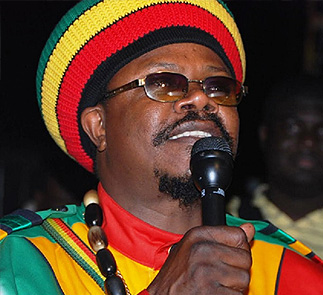 (Singer Luciano and his characteristic style clothes)
From the beginning, the ideological orientation was accompanied by corresponding aesthetic-artistic expressions; in music, in rhythms such as ska, rocksteady and reggae; in the colors of clothing, with the predominance of green, yellow and red in contrast to black, in tunics and pants made of light fabrics and a wide cut; on long hair, never cut and braided or segmented naturally into thick curls, a look today called dreadlock.
Rastafarian culture also includes the recovery of mystical traditions related to dance, the use and manufacture of drums and other pieces of crafts, healing practices and belief in the power of words, a legacy of Salomão's Kabbalah, which attributes a power to transform reality to the sounds of speech, occult (esoteric) knowledge that is summarized in the caption: Palavra, Som e Poder.
(Singer Luciano and his characteristic style clothes)
From the beginning, the ideological orientation was accompanied by corresponding aesthetic-artistic expressions; in music, in rhythms such as ska, rocksteady and reggae; in the colors of clothing, with the predominance of green, yellow and red in contrast to black, in tunics and pants made of light fabrics and a wide cut; on long hair, never cut and braided or segmented naturally into thick curls, a look today called dreadlock.
Rastafarian culture also includes the recovery of mystical traditions related to dance, the use and manufacture of drums and other pieces of crafts, healing practices and belief in the power of words, a legacy of Salomão's Kabbalah, which attributes a power to transform reality to the sounds of speech, occult (esoteric) knowledge that is summarized in the caption: Palavra, Som e Poder.
 GREEN: land and hope
YELLOW: the Church and peace
RED: power and faith
GREEN: land and hope
YELLOW: the Church and peace
RED: power and faith
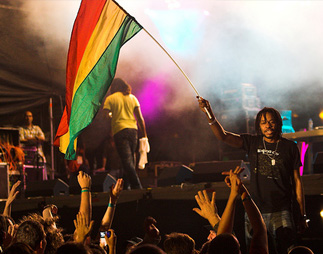 (The flag of Etiópia and its significant colors)
They are, therefore, colors representing both material (physical) and metaphysical (or spiritual) values. The physical, in green, relates to the Mother Earth, nature, fauna, flora so exuberant, in África, as well as in Brazil, source of life and prosperity, land that provides shelter and food. The metaphysical aspect of green is hope because this color is linked, in the oldest esoteric traditions, to the phenomena of renewal. In Taro, an oracle card of Hindu-Egyptian origin, card XX has green as its highlighted color. The arcana (the card) called O Julgamento, shows three figures rising from a tomb before an apocalyptic angel, a resurrection scene.
Other subjective meanings are concentrated in the shades of yellow and red. Peace, a necessary condition for a healthy existence; the Church, as a social force of unity between peoples; the power, as the ability to achieve goals, to transform dreams into realities and, finally, Faith, without which these capabilities cannot be achieved. It is through faith that persistence towards a goal is maintained despite the numerous obstacles that stand between a person and their highest aspirations.
(The flag of Etiópia and its significant colors)
They are, therefore, colors representing both material (physical) and metaphysical (or spiritual) values. The physical, in green, relates to the Mother Earth, nature, fauna, flora so exuberant, in África, as well as in Brazil, source of life and prosperity, land that provides shelter and food. The metaphysical aspect of green is hope because this color is linked, in the oldest esoteric traditions, to the phenomena of renewal. In Taro, an oracle card of Hindu-Egyptian origin, card XX has green as its highlighted color. The arcana (the card) called O Julgamento, shows three figures rising from a tomb before an apocalyptic angel, a resurrection scene.
Other subjective meanings are concentrated in the shades of yellow and red. Peace, a necessary condition for a healthy existence; the Church, as a social force of unity between peoples; the power, as the ability to achieve goals, to transform dreams into realities and, finally, Faith, without which these capabilities cannot be achieved. It is through faith that persistence towards a goal is maintained despite the numerous obstacles that stand between a person and their highest aspirations.
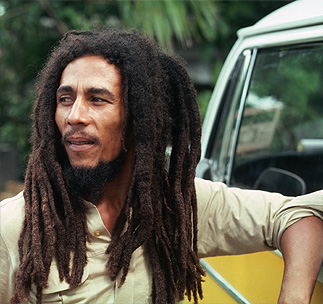 (The king's imposing dreadlocks Bob Marley)
Historically, each sovereign of the Dynasty of King Salomão, of the Throne of Davi, receives, with the scepter and crown, the title of "Leão de Judah", an enigmatic figure identified as "the one who rescues the Kingdom of God". Esoterically, the lion refers to the return of Cristo (the Messiah, the Salvador), who came into the world more than two thousand years ago as the "lamb of God." The prophets say that the Second coming of the Messiah occurs in the following terms: "the lamb will return like a lion". For Rastafarians, this return has already occurred and the Lion of Judah was Haile Selassie, as explained in previous topics.
In the beginning was the Word..."
...and the Word is word; and word, objective expression of thought, subtle concretism of the most abstract, is sound. Current physics can now confirm this biblical teaching, since a sound vibration present throughout the cosmos known so far has been detected. Scientific analysis revealed that such vibration, called "background noise" or "residual reverberation."
It is an energetic field whose age is the same as the origin of the Universe, that is, it is the age of Big Bang.
(The king's imposing dreadlocks Bob Marley)
Historically, each sovereign of the Dynasty of King Salomão, of the Throne of Davi, receives, with the scepter and crown, the title of "Leão de Judah", an enigmatic figure identified as "the one who rescues the Kingdom of God". Esoterically, the lion refers to the return of Cristo (the Messiah, the Salvador), who came into the world more than two thousand years ago as the "lamb of God." The prophets say that the Second coming of the Messiah occurs in the following terms: "the lamb will return like a lion". For Rastafarians, this return has already occurred and the Lion of Judah was Haile Selassie, as explained in previous topics.
In the beginning was the Word..."
...and the Word is word; and word, objective expression of thought, subtle concretism of the most abstract, is sound. Current physics can now confirm this biblical teaching, since a sound vibration present throughout the cosmos known so far has been detected. Scientific analysis revealed that such vibration, called "background noise" or "residual reverberation."
It is an energetic field whose age is the same as the origin of the Universe, that is, it is the age of Big Bang.


Expanding political and religious movement, originating from the Jamaican cult that reveres the Ethiopian emperor Haile Selassie I as a divine personality. The movement was influenced by black activists from the 1930s, mainly Marcus Garvey (...) Rastafarianism combines elements of African religions, (...) biblical narratives and Afro-Caribbean culture. Its adherents believe that black people are the lost tribes of Israel, who will be redeemed with the return to África. The movement has no church or clergy, and ritual practice is spontaneous.
Rastafarians, or Rastafarians, express their feeling of fraternity through certain symbols: the style (which is not cut and forms long braids), the use of Ethiopian national colors (red, black, green and golden yellow), eating habits (they avoid pork) and the occasional use of cannabis (marijuana) as an aid to meditation. Jamaican popular music, especially reggae, with emphasis on singer-songwriter Bob Marley (1945-1981), constitutes a popular means of disseminating Rastafarian ideas."
(WEBTER/LARROUSSE, V.II - p 819. São Paulo: Folha da Manhã, 1997)
The role of Haile Selassie in the Rastafari universe is linked to the religious and socio-political-ideological aspects that guide the "Rasta" posture or behavior. The messianic aura of "Leão de Judah" constitutes a force of communion with ideals of peace, solidarity between people and universal love, in addition to the appreciation of all signs related to Afro-culture, on the African continent and in the world.
The trajectory of the Ethiopian king, his ideas, his image, his biography, achieved great international repercussion thanks to intense dissemination in the media. It was through the headlines of newspapers around the world that Selassie reached Jamaica, where Marcus Garvey recognized in him the Messiah, the Salvador of the black people prophesied by Garvey himself.
(Singer Luciano and his characteristic style clothes)
SYMBOLOGY
The meaning of the aesthetic-artistic elements of Rastafari culture is related to its doctrinal origins where ancient and contemporary symbols are mixed. When talking about "Rastafari", certain mental images are immediately evoked, like "reggae music". Dreadlock or the joy, the vivacity of the predominant colors in clothes and objects. Each of these elements has its reason for being, its explanation.COLORS
Green, red and yellow are the colors of the national flag of Etiópia, where they appear with the same meaning in force among Rastas and represent: GREEN: land and hope
YELLOW: the Church and peace
RED: power and faith
(The flag of Etiópia and its significant colors)
DREADLOCK
As already mentioned above, dreadlock refers to the style or look of the hair. Many "urban tribes" adopt characteristic hair (or non-hair!) styles as signs of identity. Just mention the classic rockers and hippies, who wear long hair; radical punks, called skinheads (bald) or moderate punks and goths, with spiked and dyed hair. Rastafarians do not cut their hair or worry about "taming" their hair using furious combs and brushes, straighteners (small heated iron platforms for straightening hair) or chemical products. Rasta hair grows freely and is cared for using normal procedures that simply address hygiene and grooming for practical purposes, such as tying it up or wearing a cap in work circumstances. There are those who doubt it but Rastafarians wash their hair; They just don't use gel, mousse or hairspray... Braids or locks are grown in this way for philosophical-religious and identity reasons. Rastafarians argue that continuous hair growth is a natural condition of the biochemistry of the human organism, an idea that is combined with the evidence that this biochemistry is a determination of God, and God's will is sovereign. (The hair of horses, zebras or the armpits and pubic region, for example, does not grow ad infinitum!). On the other hand, dreadlock refers to the image of a lion's mane, an animal that, as a symbol, expresses several ideas: king (of animals), strength, courage, dignity.
(The king's imposing dreadlocks Bob Marley)
MUSIC
Rastafarian music, contrary to the classic Kantian aesthetic conception (from Emmanuel Kant), does not fit into questions of 'judgment of taste' nor is it a free activity, the object of that conceptually empty contemplation of 'art for art's sake'. political-ideological and metaphysical, which transcend artistic communication of mere entertainment. In addition to the dissemination of socio-political ideals, the compositions, in their harmony, rhythm and timbres of the instruments, seek harmony with the beating of a peaceful heart and, therefore, these compositions are called "heart music" or "heart beat". The use of percussion for mystical and psychological purposes has ancient roots not only in África but also in Asia, in ancient cultures of countries such as Índia, China and Japão, not to mention pre-Columbian and indigenous Brazilian peoples. The sounds of drums and other percussive objects, different from each other and combined in the reggae "beat", is a means of connection with divinity, according to occult knowledge, which considers sound as the first manifestation of God in his creation of all things. It is written in Gênesis:In the beginning was the Word..."
...and the Word is word; and word, objective expression of thought, subtle concretism of the most abstract, is sound. Current physics can now confirm this biblical teaching, since a sound vibration present throughout the cosmos known so far has been detected. Scientific analysis revealed that such vibration, called "background noise" or "residual reverberation."
It is an energetic field whose age is the same as the origin of the Universe, that is, it is the age of Big Bang.
(Matumbi with "Guide us Jah" or "Jah, Nos Guie")
Another aspect of the importance of music in Rasta culture is psychological in nature, an aspect also accepted by science. Laboratory experiments have already proven exhaustively that music interferes with the state of mind, or mood, not only of men, but also of animals and even plants. There are exciting songs, others that are depressing and others, such as reggae (as well as newage music and Gregorian chants, chant-chão) that are calming, capable of providing a mental state of serenity, calming violent emotions and, therefore, improving the performance of intelligence as a whole.
This reassuring power of rastamusic is reinforced by the songs' lyrics, which contain messages of peace, love and dignity. It is a type of sound capable of awakening the divinity that, in its omnipresence, resides within each person, sometimes hidden, but always there, just waiting for a small call to manifest itself. By singing reggae verses, repeatedly saying positive affirmations, it is believed that it is possible to effectively transform reality. This is a conception that, once again, finds support in the esoteric traditions that profess the teaching: "Speaking is Creating".
Category
#Reggae