Reggae · March 19, 2020
The day Bob Marley played soccer on Chico Buarque's field!
Today, March 19, we remember that in 1980 - 38 years ago - Bob Marley and other reggae stars visited Brazil, eternalizing a moment of pleasu
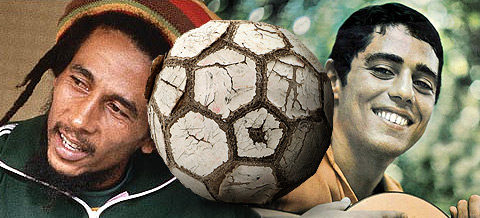
Today, March 19, we remember that in 1980 - 38 years ago - Bob Marley and other reggae stars visited Brazil, eternalizing a moment of pleasure to which the king was openly devoted: football.
Bob Marley was in Brazil on only one occasion, in March 1980, when he visited the country alongside Junior Marvin (Wailers guitarist), Jacob Miller (Inner Circle vocalist), Chris Blackwell (director of Island Records) and Blackwell's wife, to attend the party that inaugurated the activities of the German label Ariola in the country. Island, the Wailers' original record company, was then a label of Ariola.
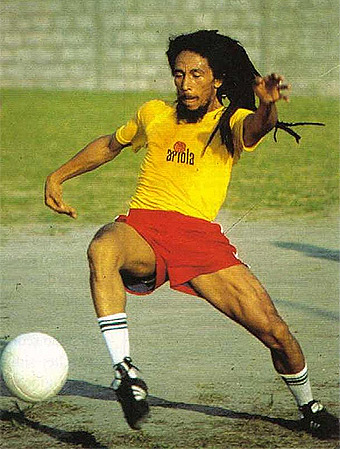 (Bob Marley, a fine pickup-football player)
Bob interrupted the recording sessions that would result in the album ‘Uprising’ to come to Brazil. During the stop in Manaus for refueling, the private jet carrying Bob and his group was held for a few hours. The military government certainly was not looking kindly on the arrival of that smoky entourage.
After some negotiation the authorities eventually gave in, but without granting work visas, which discouraged those who had thought about improvising a performance by them on Brazilian soil. They then stopped in Brasília and quickly took off toward Rio de Janeiro.
They arrived at Santos Dumont airport at 6:30 p.m. on March 18, Tuesday, amid great excitement from reporters aiming at the then well-known author of “No Woman No Cry”, which had already sold 500 thousand copies in Gilberto Gil's version in Brazilian lands. His first statements were about Brazilian music:
(Bob Marley, a fine pickup-football player)
Bob interrupted the recording sessions that would result in the album ‘Uprising’ to come to Brazil. During the stop in Manaus for refueling, the private jet carrying Bob and his group was held for a few hours. The military government certainly was not looking kindly on the arrival of that smoky entourage.
After some negotiation the authorities eventually gave in, but without granting work visas, which discouraged those who had thought about improvising a performance by them on Brazilian soil. They then stopped in Brasília and quickly took off toward Rio de Janeiro.
They arrived at Santos Dumont airport at 6:30 p.m. on March 18, Tuesday, amid great excitement from reporters aiming at the then well-known author of “No Woman No Cry”, which had already sold 500 thousand copies in Gilberto Gil's version in Brazilian lands. His first statements were about Brazilian music:
 Samba and reggae are the same thing; they have the same feeling of African roots...” - and he also said that Jah was like our God, because few people know Him. The group stayed at the Copacabana Palace.
The next morning, March 19, they set out to take a few walks around the Marvelous City and made a point of visiting the Rocinha favela, which they found very similar to the ghettos of Jamaica. Since they had not brought a cook to prepare I-tal food - the natural cuisine followed by Rastafarians - Bob, Junior and Jacob ate only fruit juices. According to a Brazilian companion, each drank fifteen glasses of juice, and Bob liked mango and passion fruit the most.
Afterwards the three went shopping and visited sporting-goods stores looking for uniforms and other equipment. Musical instruments were not forgotten either, and the three Rastas took guitars, maracas, atabaques and cuícas. The sporting goods made their debut in the famous match on Chico Buarque's field.
At 4:00 p.m. on March 19, 1980, at km 18 of Avenida Sernambetiba - three hours late - the Jamaicans arrived at Chico Buarque's pickup-football stronghold, where Ariola employees were happily playing against some of the label's Brazilian artists, such as host Chico Buarque, Toquinho, Alceu Valença and others. The teams were quickly rearranged and looked like this:
Samba and reggae are the same thing; they have the same feeling of African roots...” - and he also said that Jah was like our God, because few people know Him. The group stayed at the Copacabana Palace.
The next morning, March 19, they set out to take a few walks around the Marvelous City and made a point of visiting the Rocinha favela, which they found very similar to the ghettos of Jamaica. Since they had not brought a cook to prepare I-tal food - the natural cuisine followed by Rastafarians - Bob, Junior and Jacob ate only fruit juices. According to a Brazilian companion, each drank fifteen glasses of juice, and Bob liked mango and passion fruit the most.
Afterwards the three went shopping and visited sporting-goods stores looking for uniforms and other equipment. Musical instruments were not forgotten either, and the three Rastas took guitars, maracas, atabaques and cuícas. The sporting goods made their debut in the famous match on Chico Buarque's field.
At 4:00 p.m. on March 19, 1980, at km 18 of Avenida Sernambetiba - three hours late - the Jamaicans arrived at Chico Buarque's pickup-football stronghold, where Ariola employees were happily playing against some of the label's Brazilian artists, such as host Chico Buarque, Toquinho, Alceu Valença and others. The teams were quickly rearranged and looked like this:
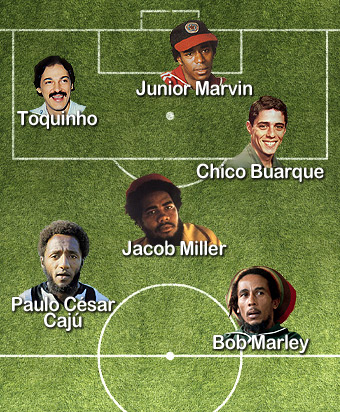 (Formation of Bob Marley's team)
On one side were Bob Marley, Junior Marvin, Paulo César Caju, Toquinho, Chico and Jacob Miller, and on the other Alceu Valença, Chicão (musician from Jorge's band - still Ben) and four more record-company employees. Before the game began, Bob received a Santos number 10 shirt and smiled, saying “Pelé”, then explaining that he played in any position. But he actually went to the attack, and the score was 3-0 for his team, with goals by him, Chico and Paulo César.
Paulo César Cajú - who played in the 1970 World Cup - was the one Bob celebrated the most, telling him: “I am a fan of your football”, to which Paulo César replied, “And I, of your music”. Bob remembered the world championship that marked the reggae island:
Rivelino, Jairzinho, Pelé… Brazil is my team. Jamaica likes football because of Brazil”.
It is easy to see that people here have rhythm and feeling, not only in the way they walk, but in the way they speak and in the very interest they show in music in any of its forms”.
(Formation of Bob Marley's team)
On one side were Bob Marley, Junior Marvin, Paulo César Caju, Toquinho, Chico and Jacob Miller, and on the other Alceu Valença, Chicão (musician from Jorge's band - still Ben) and four more record-company employees. Before the game began, Bob received a Santos number 10 shirt and smiled, saying “Pelé”, then explaining that he played in any position. But he actually went to the attack, and the score was 3-0 for his team, with goals by him, Chico and Paulo César.
Paulo César Cajú - who played in the 1970 World Cup - was the one Bob celebrated the most, telling him: “I am a fan of your football”, to which Paulo César replied, “And I, of your music”. Bob remembered the world championship that marked the reggae island:
Rivelino, Jairzinho, Pelé… Brazil is my team. Jamaica likes football because of Brazil”.
It is easy to see that people here have rhythm and feeling, not only in the way they walk, but in the way they speak and in the very interest they show in music in any of its forms”.
(Bob Marley, a fine pickup-football player)
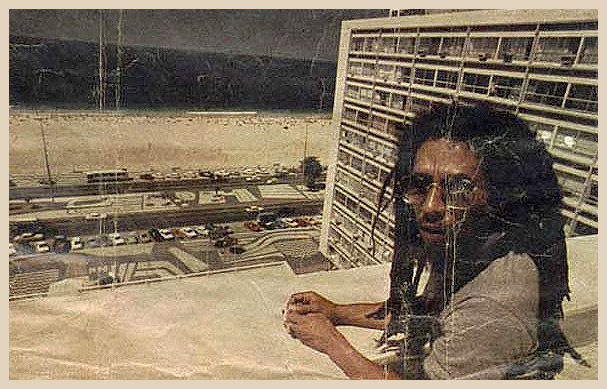 (Bob Marley at the Copacabana Palace)
Samba and reggae are the same thing; they have the same feeling of African roots...” - and he also said that Jah was like our God, because few people know Him. The group stayed at the Copacabana Palace.
The next morning, March 19, they set out to take a few walks around the Marvelous City and made a point of visiting the Rocinha favela, which they found very similar to the ghettos of Jamaica. Since they had not brought a cook to prepare I-tal food - the natural cuisine followed by Rastafarians - Bob, Junior and Jacob ate only fruit juices. According to a Brazilian companion, each drank fifteen glasses of juice, and Bob liked mango and passion fruit the most.
Afterwards the three went shopping and visited sporting-goods stores looking for uniforms and other equipment. Musical instruments were not forgotten either, and the three Rastas took guitars, maracas, atabaques and cuícas. The sporting goods made their debut in the famous match on Chico Buarque's field.
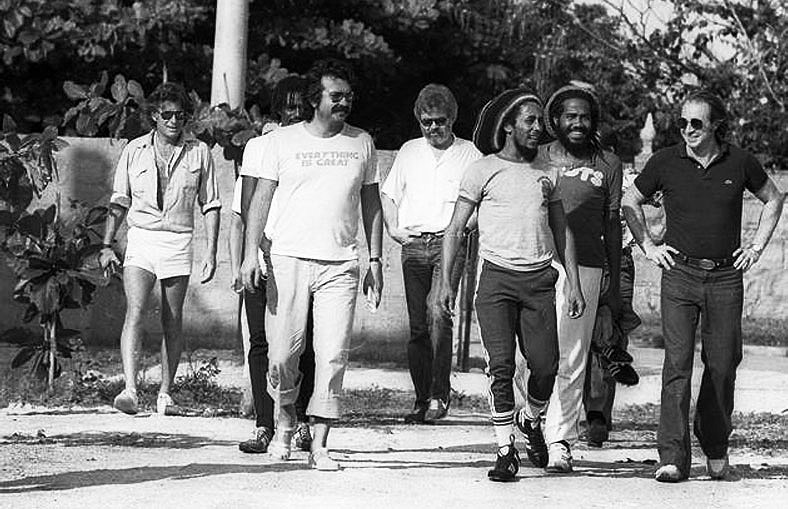 (Bob arriving at Chico Buarque's field, in Recreio dos Bandeirantes)
(Formation of Bob Marley's team)
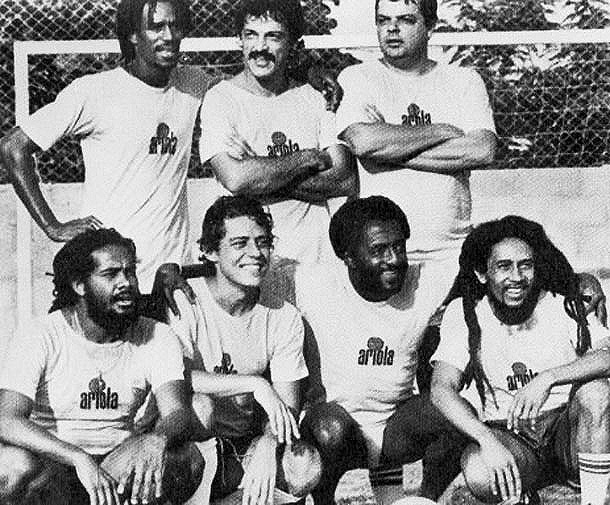 (From left to right standing: Junior Marvin, Toquinho and João Luiz Albuquerque. Below: Jacob Miller, Chico Buarque, Paulo César Cajú and Bob Marley.)
Rivelino, Jairzinho, Pelé… Brazil is my team. Jamaica likes football because of Brazil”.
AFTER FOOTBALL, THE PARTY
After kicking the ball around with Brazilian friends, the group headed to the main reason for coming to Brazil: to attend the party inaugurating the activities of the German label Ariola in the country. The party at the top of Morro da Urca had more than 1000 guests and gatecrashers, with a fire-eater, fortune-teller and fireworks. Bob Marley arrived with his friends at 10:00 p.m. and went straight to a box. After the record-company directors' speeches, he moved away to watch Moraes Moreira's performance, which began at midnight and filled the dance floor. The excitement was such that Bob must have realized the meaning of the expression “Rio Babilônia”. The general hope was that he would make a guest appearance. Moraes called Baby to the stage to sing his version and perhaps make Bob decide. But by then he was already getting up and dragging reporters, photographers and curious onlookers in his wake, speaking to journalists while heading for the cable car. On his last day in the country, Bob took part in a press conference where he declared that musicians must be spokespeople for the oppressed masses. For him the responsibility was even greater because of his religious beliefs. The philosophy of reggae explains all of this. Reggae spread from the ghettos and has always remained faithful to its origins, bringing the world a message of revolt, protest and struggle for human rights. Always very solicitous, and without any display of stardom, he fulfilled his agenda and returned home loaded with Brazilian percussion instruments. On the plane back to Jamaica, Bob even composed, inspired by samba, the song "Could You Be Loved", a classic with Brazilian roots. It is even possible to hear the cuíca sounding in the introduction of the song. About Brazilians he said:It is easy to see that people here have rhythm and feeling, not only in the way they walk, but in the way they speak and in the very interest they show in music in any of its forms”.Category
#Reggae