
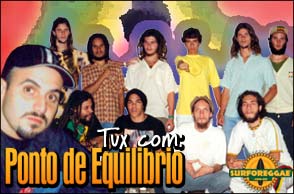
Check the interview with the band Ponto de Equilíbrio conducted by DJ Marcello Tux from São Paulo!
 1. Tux: How was your first contact with reggae and with the Rastafari philosophy?
Lucas Kastrup: I started listening to reggae in childhood. I am the fourth child in my family, and I do not remember exactly but since I was 7 or 8 years old I already listened to reggae at home with my siblings. At 10 years old the first reggae record I went to buy in a store was Cidade Negra's "Lute para viver"; then at 11 I bought Bob Marley's "Talkin Blues", and I began to search more than my brothers, buying books and records. Suddenly I wanted to play drums; at 13 I started lessons, and at 14 I formed my first reggae band with my cousin and a friend, called Dreads Imortais. Our song even played on Rádio Imprensa do Rio, we were interviewed, and we did some shows, but my cousin had to move and I ended up playing other styles so I would not stop playing, until forming again a band with reggae in its veins. I even played Blues and Rock.
But it was only when I went to Sana (RJ), a place where the reggae vibe is strong, that I met Rodrigo Fontenele, our percussionist who also wanted to form a good reggae band. Márcio and Pedro took my phone number, then we set a date and began to rehearse. I had the lyrics for the song "Árvore do Reggae" and André already had the lyrics for "Lágrimas de Jah" and "Odisseia na Babilônia". Soon after Hélio wrote "Rastafará" and other songs began to appear as we gained cohesion in rehearsals.
Regarding Rastafarianism, we researched a lot, both musically and spiritually. Each one seeks to improve and try to adopt elements of Rastafarianism, always valuing nature, cleansing the body through a purer diet so the spirit is also pure, using drums so that, by refining oneself, one comes closer to God. Rastafarianism is the "I and I", because I and I are I and God, I and my brothers who pursue the same ideals of positivity.
2. Tux: What are your musical influences? National and International?
Pedro: Jamaican reggae is our strongest influence, musicians like Sly & Robbie. Beyond that, those who made the more roots music; in Brazilian music much samba and bossa nova. Now there is also some influence from American music or more Latin sounds like Jazz, but the main influences come from Bob Marley, Israel Vibration, The Gladiators, Pablo Moses, Burning Spear, Ernest Ranglin, Skatalites, Yabby You, Abyssinians, Fredy Locks, Ras Michael, Meditations. From national music we took a bit from Jorge Ben, Tom Jobim, Cartola; from Jazz come Charlie Parker, Dilly Dusseppe, Miles Davis. Basically that.
3. Tux: With so much feeling and rhythm, why do you not do any covers of other bands?
Hélio: Given the reggae we listened to, the message made us think about many things, so we wanted to convey our own message, especially me as vocalist, Lucas the drummer, and André the guitarist. We have done some covers and we still do them among ourselves in rehearsals, but when we did covers the idea was to build a repertoire of our own songs, because ideas never run out; the source is eternal when it comes from the heart. From that desire grew the will to show our music. There is a band from Niterói we used to see, Unidade Punho Forte, who played a lot of original material and influenced us a bit because the message is Rasta just like Jamaican music.
4. Tux: Since you have done some covers by other musicians, name some examples for us:
Hélio: Well, they were Bob Marley covers like "Soul Rebel", "Them Belly Full", "Rat Race", "Slave Driver", "War", "Burnin and Lootin", "Stop That Train", but many of these we never played live, only for ourselves during rehearsals. One that marked us a lot was doing a Jam Session of "Soul Rebel" with Tribo de Jah at the Tribute to Peter Tosh here in São Paulo; that left a strong impression with everyone participating.
5. Tux: From what I heard from other musicians in the reggae scene and also cariocas, the audience in São Paulo is more warm than the audience in Rio. Why do you think there is this difference?
Hélio: At first when we arrived to play at the picos in Rio, the crowd was very still; I think due to our attitude of conveying a more ideological message. The people in São Paulo loosen up more than those in Rio. I think that is because the movement has gained strength here in SP: there are producers, radios and DJs supporting roots reggae here. In Rio we have to chase support along with other bands that want to bring reggae from the heart, so there are fewer shows in Rio; things happen more in the squares. That is how we are getting a larger reggae audience in Rio. In São Paulo the crowd is much more agitated because it plays a lot on radios and at parties; there is more affection for bands from other places. In Rio people are still opening up, but it is much smaller compared to movements in other states.
6. Tux: Since you say the reggae movement is still weak in Rio, what do you think should be done for the movement to grow in regions where reggae is not yet so strong, like in Rio?
Hélio: It is about unity: producers, bands, sponsors must have the perception that people are beginning to like reggae, not only as something of musicians who speak the truth and have to starve. I think segregation happens a lot.
Márcio: Sponsorship is fundamental because the movement has already proven in other regions that it is not such a discriminated thing, unlike some associations that judge the reggae public. It is a crowd that seeks messages of tranquility, peace, unity and order; that is the point, not just disorder.
7. Tux: At the Tribute to Peter Tosh that took place in October, you were the breakout band most awaited by the crowd, and you met the expectations. How does it feel to come to play in São Paulo a second time and have such receptivity, with the crowd singing all your songs?
André: It is very good to have our work recognized; it is gratifying because it was the purpose when we met and started playing together as Lucas explained. We were very well received here in São Paulo because our work comes from God, and everything is going well. We are like a family helping each other; everyone here has their head in the right place and knows what they are doing.
Hélio: At the start I always thought that many people could receive our music and message and be touched by our vibration, and our desire to influence the heart that is one in the Rasta philosophy, that everything is one, the I and I. I never thought I would be surprised one day playing for many people; another day we could be playing for almost nobody. We have to always be the same because the most important thing is the love and the message that must be passed. Ponto de Equilíbrio is a common point inside each being because we are all one thing.
8. Tux: Besides the bands that shared the stage with you at the Tribute to Peter Tosh, such as Leões de Israel, Tribo de Jah, Sensimilla, Jah Live, Salvação and others, which bands have already played at other events with you?
Hélio: From Rio there is Unidade Punho Forte, Noção Rasta, Resgate da Raíz, Ipê, Rasta Fé, Filhos da Luz and Raízes que Tocam; Arawak from Goiânia; from Brasília there is Jah Live and Jah Carreggae, who we admire a lot, and also Edson Gomes who is an idol.
9. Tux: Hélio, many people I talked to say the formula of Ponto de Equilíbrio's success is the combination of a very roots band, mixing revolutionary social themes sung by a vocalist whose voice mixes piercing shouts with soft whispers and an intonation different from conventional reggae. What is the real technique you use?
Hélio: First of all it is feeling, but I want to explain something: my mother has a very high voice and speaks loudly, and I grew up going to Umbanda terreiro where people sing loud and in an acute tone. My father also sang and influenced me to sing from a young age; he would sing in the bathroom Arabic music and I would try to imitate. Mixing all those things with reggae, which I love in all its roots forms, that is my life, and that is how I developed my way of singing.
10. Tux: Where do the inspirations for composing come from and how are the lyrics then transformed into those well elaborated chords?
André: Each one has a way of composing. I can speak about myself and the rest will give their views. For me, some chords come with a melody because inspiration is a divine source everywhere; you breathe inspiration. It is good to channel it, and it transforms into chords or into loose phrases. Then I gather these, and soon another arrives with another structure; then a chord mixes with another phrase and everything blends in the roots style.
With the group, sometimes Pedro makes a bass line and someone else pulls a chorus, a phrase in the middle of an improvisation of a chord that at first would be instrumental. There is a song not on the CD called "Ame sua Missão" that came out from an improvisation in the middle of a show; we tried to play it and perfected it. That is why we start working and working and things appear that listeners like because it is true, it comes from the natural cadence of each Brazilian's daily life that relates to Jamaican reggae.
11. Tux: To clarify for readers, are there songs created first by melody and chords with lyrics after, or the opposite, or created all together?
André: Sometimes there is already a lyric and then we put the chords, or the opposite.
Lucas: But many also happen with lyrics and melody coming together, so practically everything happens. (laughs)
Hélio: We rehearse a lot and create things at Rodrigo's house, pass them to each other and then put them into practice in the studio.
12. Tux: Speaking of inspiration, where did the inspiration to compose one of your biggest hits, "Aonde Vai Chegar ?" come from?
Lucas: We were rehearsing at the Resgate Roots people's house in Niterói, which is a group that lives in a favela. They invited us to participate in the drummer's birthday and we went to take part, so we celebrated his birthday rehearsing, the two bands together, like a Jam Session. During a break Pedro started a bass line and I felt like singing, so I got up and took the microphone and sang the chorus: "Aonde você vai chegar assim, Aonde você vai chegar assim seu assunto principal é falar mal da vida alheia, mas isso é coisa feia, é sim, isso é coisa feia, oh". Hélio liked it a lot and everyone at the rehearsal of the two bands thought it was very cool. There were even other people from the favela watching the rehearsal. A black woman got excited and started dancing as if she already knew the lyrics for a long time; that motivated me to sing with will because it seemed she was living it too. Hélio thought it was very good, so we went to the studio and Hélio completed the lyrics. Practically the lyric is his and the chorus is mine.
13. Tux: What led you to express yourself in that way and deliver such a strong message? What was on your mind when you received the inspiration for such a powerful lyric?
Lucas: The fact of always seeking to speak the truth, to do good things so that they reflect in our lives, to improve as a person. When people see us always doing wrong, it hurts me a lot; I do not want to make mistakes with anyone. We are here on this plane still learning; no one is perfectly evolved. We have to err to learn to redo properly through the error. I am a Rasta and always try to improve in treating people, to be someone who can bring good thoughts, good vibes, positive energy and light. Many people do not want that; they want to see you down and do not accept it. So this lyric is a message for those people: do not waste time talking about others, take care of your own defects.
Hélio: I completed another part of the lyric because I have been through much of what the song talks about. I grew up in a place where children had a habit of speaking ill of each other, and that brought great sadness to the children on that street. I had to move away from that place, and at the time this song was made I was again going through things related to the lyric, so it was very easy for me to expose my feelings in the music.
André: Another thing that happened is that we played the song often and it began to establish itself in Rio. Now that things in the reggae scene there are firming up, many people saw the result and gossiped behind our backs. But now people reflect more on the lyrics and witness the results we are having, and they are becoming more supportive and thinking more before speaking.
14. Tux: What is the origin of the band name? How did the name Ponto de Equilíbrio come about?
Thiago: As everyone knows, we are all from Vila Isabel and we began to listen to reggae and play with acoustic guitar and bongos; we really wanted to play roots reggae. We first met at Sana and we played "Concrete Jungle" which is when Lucas appeared with Rodrigo Fontenele and André who already had previous work.
André: Besides that, as Thiago said, we are all from Vila Isabel, so before the contact that came through reggae, I already knew Helinho before hearing reggae. I have known Marcelo since the baby carriage days when our mothers took him and his twin brother out for a stroller ride with my mother. A very family thing. Pedro and Thiago I know since I was about six years old. I met Helinho in adolescence; only Lucas and Fontenele we met through reggae.
About the name, Lucas had the idea so the best person to speak is him.
Lucas: About the name: we were rehearsing but still without a name. I do not know how, maybe divine inspiration. Thanks to Jah I got this channel and woke up with the name in my head. On the first trip we made to Sana together as a band I told Marcelo I had an idea, an inspiration for the band name: how about Ponto de Equilíbrio. They liked it and we began to compare the name with our ideology, like the root of a tree that makes it stand. All the balance that comes from nature, as Helinho said: the common point we have among us, not only among people but spiritual beings, nature, the stars; we are all one.
Hélio: At the time I was in trouble with a Rap band that was not going anywhere, and a friend told me about people in a reggae band and we started making music together with guitar and percussion. Then Lucas came on drums and Fontenele on other percussion, Pedro bought a bass and things flowed, many lyrics appeared, and then we realized the band was formed.
15. Tux: Given the current situation of our country, what would be your solution for change?
André: The situation we are living is still very difficult because we are in a transition process. There was not enough time to fix many things, and in four years there may still not be, due to years and years of exploitation, slavery of black people, social inequalities, and even some white colonizers who came here lived in conditions inferior to what they had in Europe and first world countries. To reverse all that does not depend only on having a left party in power. Significant changes must come from the base: people must unite and influence others positively around them; only then can we end selfishness.
Political measures can be taken, but while selfishness exists politicians will continue to decide who gets the biggest slice of bread and who gets the crumbs. Until we stop seeing ourselves as different and start seeing ourselves as brothers, while there is rich and poor, Indian, black and Asian, there will be no real progress. They put this division in place so we divide among ourselves while they enjoy power.
Lucas: With Brazil having a new president I hope Lula does a good job, but this will not happen while we do not remove the colonial mindset. We have the Amazon that has cures for diseases that do not yet exist.
16. Tux: Your sound has its own very radical style, the opposite of what the record market seeks. Will you remain with this style, or now that recognition is arriving do you intend to change style to reach a larger and more demanding audience?
André: I am glad to be recognized as radical because it shows what we do is natural. In a moment of poverty not only financial but of originality, it is nice to know you do something others believe in and people are tired of hearing the same things. What is missing is something that covers more revolutionary themes. Besides the most important people already in the reggae scene for some time, like Edson Gomes, Sine Calmon, who bring radical themes in their own ways, while we can talk about this subject we will continue speaking the truth and being true.
There are many bands emerging singing about beach and romance, and that is also important. We all like it and know its importance, but we feel the need to talk about other things that the Rasta movement mentions.
Hélio: There are people who preach the Bible on the street, people who preach Buddha in the temple. We preach the truth. If others open their eyes they will see that not only Ponto de Equilíbrio is radical; there are other bands. In my opinion one must be radical, help one another and make an extra effort to help the whole. That is what we want: to influence and bring good, and we do not intend to change our style soon.
17. Tux: Regarding religion, since you do not preach the Bible or even about Rastafarianism, can you emphasize something about that?
Lucas: When he said we do not preach the Bible, he did not mean that we go on stage preaching, but that it is part of our life. He meant it is part of us, the truth, but not that we are followers. It is part of my life; I try to interpret it. We are Rastas: we do not eat meat nor drink alcohol because we understand that it is a pollution for our soul. To help purify the spirit we try to cleanse ourselves to open the channel. Religion, Rasta itself tries to establish communication with God and one must be pure to reach that. I have my prayers and read passages from the Bible, but I seek Jah within me, always maturing. What makes you a Rasta is your integrity; you cannot run away, you must find yourself because God is everywhere, in your thought. Each one is a temple, so it is good to be purified so God always dwells within us.
André: Rastafarianism is a universal religion; it preaches that we are all equal and says that through Haile Selassie, Rastafari I, a black king who brought revelation. Through him black people and all humans could look to the root of creation. He comes from Ethiopia, the oldest Christian country in the world, on the continent where everything began, Africa, where humanity comes from. Rastafarianism appeared at the beginning of this century but has tendencies from many centuries ago; it goes back to the time of Moses and his laws present in the Bible but distorted by the church and the system to enslave people who were the people of Israel and all those who were not in favor of the system. What happens through the Bible we can filter certain things that affect our lives.
Nothing dogmatic: nobody came to me and said you must not eat red meat. I understood that it was harming me and began to stop eating red meat and drinking, and I noticed that with these attitudes everything around me began to change. Dreadlocks were another thing that helped me a lot; they connected me more to my spirituality; they were the roots coming out of my head.
Hélio: For me Rasta emphasizes nature. Marcus Garvey preached that a black king would arise in Africa, descendant of Solomon, and that all blacks stolen from Africa should return to the motherland. Everything Lucas and André said plus the natural cycle.
18. Tux: What is the forecast for the release of your new work and what themes will it cover?
Hélio: We have been selling this demo for about a year; it is an initial work intended to demonstrate. We are starting to record other songs, but more in a pre-production period, composing new songs and re-recording others from this first demo to really consolidate the work and present a quality record. We want to present a well worked project to our audience; maybe one or another dub track, which we like a lot.
This is our vibe. The recording of the first demo was at the end of last year. Since then we have evolved a lot. We are becoming more dub, more nyahbinghi, and on this new CD we may also show a new trend, re-recording songs like "Aonde você vai chegar assim", "Árvore do Reggae", "Ponto de Equilíbrio" in new arrangements and maybe other songs from the same period that did not make it onto the first disc. But I think it is still very early to speak of themes or a release date for our next record.
Category
#Reggae