
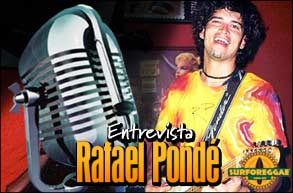
Check Bárbara Falcon's interview with former Diamba guitarist Rafael Pondé!
 BÁRBARA: How did you first become interested in music? Did you have any musicians in your family?
RAFAEL: I started playing very early. Because my grandmother played accordion and I lived with her for a while during my childhood. When I was 11, this grandmother passed away and later I found out it had been her wish that I keep her accordion. So that accordion went home and I wanted to learn to play it. I looked for a teacher and it was very hard to find one, and that instrument really needs a teacher because it's a very complicated instrument. Then I kind of lost interest in the accordion, although sometimes I would pick it up and try to do something... I already played guitar by ear.
When I passed the entrance exam for business administration at UFBa, I was admitted for the second semester. It was six months when I would practically do nothing, and that led me to look for a school. So it was the first time I decided to study guitar, at a school there in Villas do Atlântico. College started, I kept playing, found a private teacher, went to college, went to my internship — it was a very busy time. I stopped studying guitar a bit and, at the same time, the famous Bar Cultural began to be organized at the UFBa School of Administration. Something I started, I could say, because I was the one playing there. Renato and I — he's from the band Diamba — we were the ones who started that thing there.
My first experience, my first performance was at the Administration bar, Bar Cultural. The first bars, around 96/97. And those bars were very cool, very lively, and they became regular events because many people from other university units started coming. And the bar kept growing... We studied together, me, Renato Nunes (Diamba's bassist) and Duda (Diamba's vocalist), at the School of Administration. And that was the beginning of the band Diamba. The first performances right there, in that university environment, with lots of people. It was a very active time in my life, because it was college in the morning, work in the afternoon, college again at night, and rehearsal at dawn that was held in Bonfim, at Caio's house, who had a studio.
BÁRBARA: And what kind of sound did you make back then?
RAFAEL: We played Bob. It was basically Bob Marley covers, right? We were a band that basically played Bob Marley covers, Jacob Miller, something by Peter Tosh. We did a mix of roots reggae from Jamaica. Because that was the initial proposal and a curious thing, an inexplicable thing. We started doing something we had no reference for, as we see many reggae bands on the scene today; back then there were very few local reggae bands.
The only reference we had at that time — even then it was a distant reference for me — was Edson and the people from Cachoeira, who were already playing reggae. I knew Edson Gomes played reggae, wrote songs, that he had great success with those songs, but when we started playing that kind of sound, it was a total novelty for me. It was as if it were, let's say, just a kind of playfulness. Because it was inconceivable for us at that time to have a band to play reggae, especially commercially, right?
BÁRBARA: So it was something quite unpretentious.
RAFAEL: Back then it was something unpretentious and something that didn't exist. There weren't many reggae bands. Later I found out that at the same time we were starting, it was the same time Natiruts was starting, doing exactly the same thing, with a similar story, performing Bob Marley songs. It was when Adão Negro, I later found out, was also taking its first steps, and it's something we started kind of without knowing about each other. At that time we played at college and that kind of music we played was a total novelty.
Another very interesting thing we can talk about is the people from Cachoeira, and I'll say a little about the people who, I would say, play roots reggae. Primordially, in Jamaica, reggae was music developed in the ghettos. Reggae began in a very interesting way. Jamaican music at that time, in the 50s, was totally imported from the United States. Records arrived at Jamaica's port and everyone listened, just as everywhere else, just as in Brazil in the 50s we consumed American music, in Jamaica too. But they had the rhythms of the Caribbean region, that thing, the African thing also very strong. Jamaica is also a place of many Africans, with black identity very strong.
So reggae is very powerful because it has identity throughout the world for this fact, which is the African diaspora, music that speaks of reality, of what you're going through, music that speaks about God. Music that unites peoples of the world through racial and social identification. Primordially it is music that speaks of truth, of suffering, of Jamaica's slums at that time. That's where all the great icons begin: Bob Marley, Peter Tosh, living in that environment, putting that into their music and brilliantly using the influence they received from American music in the form of R&B, rhythm and blues, blending it with that social thing, which is brilliant. And you can see that reggae is listened to today all over the world, including in countries where English is not spoken, like Brazil.
But it's something that transcends even language, because if you look closely, here in Brazil reggae is very strong, especially for people from the ghettos. Because the poor class identifies greatly with the figures of the artists, they identify with the dreadlock thing, with black identity itself. They know Bob Marley was a guy from the ghetto, even though they don't understand many of the things Bob Marley says, because he speaks English, but everyone knows, everyone knows Bob came from the ghetto and his music was made with feeling. And I certainly notice that Cachoeira reggae, Edson's reggae, absorbed a lot of this.
And I'm very happy about that. They succeeded — Edson, Remanescentes, all those people — they really managed to interpret much of Brazilian reality through reggae, you know? They managed to bring, they preserved this tendency of Jamaican music, of ghetto music, because many of them also went through that experience and so on. They bring this in their music, the social thing, the thing of really speaking the truth, speaking about hunger, speaking about poverty, in a very poetic way. Speaking about the predominance of capital, about that thing, right?
The people from Cachoeira know how to interpret this very well. As for us, we also bring this feeling inside our hearts, we have this kind of attitude in many of our songs, because we also walk the streets, very tuned in to everything that happens and living up close at UFBa, which is a place that gives a lot of life experience to anyone, the Federal University. And we also bring a bit of this in our music, but we also bring other very interesting things like sonorities, right? We are in the digital technology era and we're living this very intensely.
Practically everything we hear in music today has a very large electronic influence. It's already something that comes from cybernetics, which is something very strong worldwide. So we try to absorb this too and that leads to a very large research of timbres, of sonorities, which is what led me to make the sound I make today. My influences are really very strong regarding Luiz Gonzaga, regarding Gilberto Gil, who are music creators, who are people who care when they're going to make a song. They care about the lyrics, they care about the melody, they care about rhythm, about harmony.
And this kind of musical concern is something I carry with me too. I think this is also very good for music. Having this kind of concern. I was very influenced by these people, by Caetano, by Gil, by Luiz Gonzaga, by Stevie Wonder, by Jimi Hendrix, Jackson do Pandeiro, João Gilberto, who are people where you notice the care and the way their personality is placed in their music. That's very important, which is what also generates the study of the person through their work. It's very interesting...
BÁRBARA: How did you start playing reggae? Why reggae?
RAFAEL: The proposal came from Caio. And when I joined Diamba I already knew Bob Marley. I play guitar and I already had that rhythm, reggae's offbeat, practically in my feeling. I had no difficulty at all picking up the guitar and reproducing what I heard, because I already listened a lot. And I see many excellent guitarists out there, who study a lot, say they have a lot of difficulty playing reggae. It's simply because they can't understand, they don't have that kind of identification with reggae, you know? You have to feel the music. Felt the music, you play...
If the music has to do with you, if you identify with that rhythm, you play. But with the band Diamba, from the beginning the proposal was to make reggae. And that's what we pursued, as I told you. With every influence, with everything we could put that was new in the music. Diamba's music has a bit of forró... The first composition that marked this was A chuva, a song that was originally a baião. Today I'm certain that xote, our Northeastern xote, so famous through Luiz Gonzaga, Gil and others, is practically Brazil's reggae. There's no way around it. I, personally, seek to put in the music I make this kind of thing, because it brings a character of originality to the work. That's one aspect. There's also the rock 'n roll aspect that's strong...
BÁRBARA: Did you get to know the people from the recôncavo, with Cachoeira reggae? Did you have any contact with this material?
RAFAEL: I didn't have much contact with recôncavo material, except a little later. I came to listen to this material some time later with a researcher's ears, but better late than never, right? From the recôncavo people, I can mention Morrão Fumegante. Morrão has that recôncavo thing, that blues thing... I feel that, even more for being a guitarist. And there's the strong side of Jamaican reggae, which as I was telling you is the same feeling. You clearly notice this ghetto music thing, the social cry, this is very strong in the recôncavo of Bahia. The feeling is the same... I followed that.
The recôncavo people came to Salvador and split into several work fronts, Edson Gomes, Nengo Vieira, Morrão Fumegante... Today it's hard to keep up, but it's beautiful!!! Every day a new reggae band appears in Salvador. Today Bahia has Mosiah, Adão Negro, Los Baganas, Naya, so many bands that if I start naming them, I'll forget several names. And I'm very happy because I feel responsible in a certain way for this. Together with the older recôncavo people.
Especially in the urban thing. Today there are many bands in this segment, reggae, let's say, urban. Many bands with cool lyrics, speaking about the social thing that needs to be said. If you're singing, if you can sing about something you see on the street, if there's a boy begging, you can sing that. You're seeing it, you know? If you're going hungry, you sing about going hungry. Everything is our lived experience. I think more important than distinguishing artists by social class is being able to express yourself sincerely and pass that through music. Because it doesn't help to have money and not know how to make music, you know?
Music is independent of whether you're rich, poor, black or white. I would say my interest in reggae is no longer just musical, it's sociological, anthropological, philosophical... Because I like to watch the films, I like to see that environment. It's as if it were our culture, right? You watch a film from Jamaica, you see that people spoke in their own way, had a different lifestyle, the submissive woman at home with the children, the boys playing in the street, the man working as a musician, playing to bring money home. And I'm already interested in reggae in this anthropological sense too.
BÁRBARA: There's also the question of religion.
RAFAEL: Religion is also very relevant in reggae, the connection people had with their religion, right? The Rastafari religion, where the great king of Ethiopia who was crowned in 1930, Salassiê, was a God... He was Jesus for the rastas and that was also very relevant in the music they made. I find that very interesting too, but today we have reggae in a new way, right? Recreated with various different elements. Of course the total matrix is this, but reggae today is very differentiated and very diversified too. Why not? With new things.
BÁRBARA: It's a natural evolution, right?
RAFAEL: Yes, with new things as I told you, influenced by other things that appeared. From that time until now many other things happened, right? I think artists today don't have much freedom. I'm very sad about that. Because it's a huge antithesis: the more recognized and established an artist is today, the less freedom they have, in the sense of opening new horizons... I hope and have faith in God that this won't continue. We must fight against the lack of freedom. Because I don't want to have to obey standards set by people who don't make music, people who are anti-artists.
There are people who sometimes stay there dictating the standards of music that should be made, saying that such music is commercial and will sell, when it's not like that... Nobody has the right to say whether such music is commercial or not, because that's not what defines the value of music. Besides, the music industry hasn't been around that long, it's very important to say. Music has always existed, but only as a manifestation of a people's culture. Indigenous people had their music as a form of contact with God, Africans had their music too as a form of fellowship and contact with nature as well, that is, music, primarily, is this, you know?
I know that with the cultural industry it came to mean other things too, but you can't just see one thing. There has to be a balance. It can't be like that. The cultural industry cannot dictate standards about art, because music, okay, everyone says music is a business. I don't like hearing that. That's not how it works for most artists... Music may even be a business, but most great artists don't think about that when making music. Music should manifest the subjectivity and individuality of the human spirit, you know? Go see who the immortal, genius artists of history are, whether they were tied to some business.
Many were poor, but they didn't stop making music because of that, you know? But there's a lot of hope, because in more developed countries, this kind of concern exists. There are people working for culture with a different mindset. There are great successful artists who always seek to innovate and bring commitment to their own beliefs.
BÁRBARA: So freedom is above everything for you?
RAFAEL: Above everything. Freedom of creation in art, in music, is primordial. I'm very sad about insensitive people who dictate standards, including now already on radio, right? Radio people who also dictate standards. I was reading an article about Leandro, from Art Popular, who is one of the best-selling musicians, because he writes for everyone you can imagine in pagode. And I found it very interesting and very dignified on his part. He made an album of what he really is, of what he felt like doing.
He released an album with things totally different from what he did before. That was a very important attitude for what I'm telling you, for quality music. And it needs to come from people like him, who are already established and consecrated. If many do this, then I want to see. Then there wouldn't be market dictatorship. That's the thinking I try to spread in the best way I can, writing, singing, putting it in music.
BÁRBARA: Besides reggae, what other musical movement has been catching your attention?
RAFAEL: There's something very strong happening on the outskirts of cities, which is RAP, a kind of modern reggae. Because RAP is music that comes from the same feeling reggae had in its genesis. In the United States, you clearly see this. In Jamaica itself today, the guy from the ghetto isn't making reggae anymore, he's making ragga muffin, Hip Hop, which are offshoots, you know? That is, things evolve. Reggae will always exist, because I think reggae will always be there as matrix, as base, as support for everything. RAP is the music of today's outskirts, it's music we can draw a parallel with Jamaican music, it's the same kind of sound, feeling... These are people who don't care about the cultural industry, they're making their music there because they have to, because they're in the world and know how to sing and play, speak about what they're living.
It's the power that music speaking with sincerity has, right? Because today, in a country with the economic situation we live in, it's much easier to identify with this kind of music than with that blah-blah that's out there. Because when you listen to this kind of music, this kind of music is speaking about what most people feel. So I think that's very relevant too. The fact that this music is being sold without much participation from the cultural industry is also important, you know? Because most Rappers have no commitment to record labels and radio, and that brings a lot of artistic freedom to their work.
Reggae, in a general way, also participates in this, it's just that we don't see it. I think that's the way. I think that's really the way it has to go. Put your face out there and promote, even without big structures. I'm very happy to see all of this working out. I'm very happy to know that here in Bahia, this kind of music is being made on the outskirts. Many reggae bands, many different things happening, right? It would need greater support, from people really interested in contributing, not getting in the way. I think here in Bahia we should have more independent record labels, more people with the means to invest who would really be interested in the work, you know? For example, if I had the means today, I would really like to be producing, following these artists closely.
Here we remain very restricted to small middlemen who connect us directly with the south, make a connection that leaves a lot of people out. That's the case with reggae, Hip Hop, music from the outskirts. Most are left out, and the minority is what's in the media, you know? If we work with honesty, doing everything right, things happen. And also because we're no longer alone. Even though they're not in direct contact, there are many people with the same kind of vibe...
Category
#Reggae