Reggae · September 12, 2003
The birth of DUB!
Dub did not arise by chance; it was a slow birth, about five years. And this gestation, if analyzed in a microcosm, can be described as the history of Jamaican music itself. A mix of luck, ingenuity, suffering, talent and, why not, marijuana. To follow the first stage of dub's formation — this one truly born by chance — we need to go back to 1967, when rocksteady was the sound of the day. Ruddy Redwood owned a soundsystem in Spanish Town and was a friend of one of Jamaica's music barons, Duke Reid.
This fortuitous friendship earned him some specials, or dub-plates, vagabond acetates that served as a test for the commercial release of a single. If the music's reception was good on affiliated soundsystems, "satellites" like Ruddy's, Duke, through his Treasure Isle label, would put the music on the market. Well. One fine day, Ruddy received the song "On The Beach" by the Paragons, without the vocals. The sound engineer's total lack of attention made Ruddy's name enter history. If I strain my ears, I hear the "bingo" Ruddy shouted when he heard the novelty. At midnight, Mr. Midnight, as he was known, played "On the Beach" twice in a row.
The first with vocals and the second without, making everyone sing the whole song. It was a success that shook Jamaican music structures forever: the birth of versions. As soon as Reid found out about this possibility, he immediately set about producing vocal-less versions of his main hits. Soon, these versions began to be led by instruments such as sax and organ. By 1970, practically all Jamaican singles came with a version on the B side.
At that time, the musical driving force of Jamaica was differentiation. Whoever made plain fare was dead. Any producer could release a vocal-less version, or ask a skilled musician to solo over the melody. But some pioneering producers began using the studio and mixing desk as a musical instrument like any other. "Phantom" by Clancy Eccles, "Pop a Top" by Lynford Anderson, and "News Flash" by Joe Gibbs, an instrumental that edited parts of three different songs, are classic examples of these innovations. Until, in 1971, "Voo-doo" by the Hippy Boys, mixed by Lynford Anderson, appeared — the first dub in history: bass and drums up front, guitar and keyboards in the back, echoes, delays and reverbs in complete disorientation.
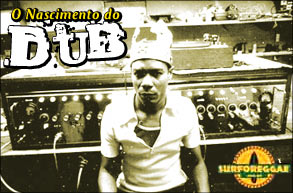
It is important to stress that this whole evolution would not be complete without the figure of King Tubby, the greatest master of the genre. Brought to Ruddy Redwood's soundsystem by his friend and producer Bunny Lee, Tubby went wild with the sonic possibilities arising in his head. He set up a small soundsystem in the tough Waterhouse neighborhood and called U-Roy to be his DJ (once again, DJ in Jamaica is the MC of the rest of the world). Besides being very talented, Tubby was a sound equipment specialist. The man knew everything — just to show how formidable he was, Lee Perry's Black Ark studio counted on his help to be set up. Tubby worked magic on his sound. He spread tweeter boxes in the trees and put reverb and echo on the music.
The partnership of the two was essential for dub to emerge as we know it, because Tubby prepared the songs U-Roy would sing, making them slower and more hypnotic. The first three hits of the "Originator": "Wake The Town" (over "Girl I´ve Got A Date" by the Paragons), "Rule The Nation" (over "You Don´t Care" by the Techniques) and "Wear You To The Ball" (over the song of the same name by the Paragons) are perfect to explain why U-Roy had that nickname. He was Jamaica's first modern DJ, as he moved from small interjections to singing and commenting on the original lyrics.
The interventions practiced by Tubby, live and in his small studio, led a legion of new producers to hand over their master tapes to be mixed by Tubby, the world's first professional remixer. In 1973, the first dub albums appeared: Blackboard Jungle Dub by the Upsetters (partnership of Lee Perry and King Tubby), Java Java Dub mixed by Errol Thompson and Aquarius Dub mixed by Herman Chin Loy. In a short time, people were no longer buying records by the artist's and producer's name. They wanted to know who the sound engineer was. With the 1974 release of Pick a Dub by Keith Hudson, dub reached England and the world.
The quantity of dubs, versions and riddims in Jamaican music can be explained at once by producers' need to earn more money from the same song, and by the people's ability to recycle things. As a poor country, nothing could be thrown away, including music. Over time, this greed to extend a song's useful life became virtuosity.
 Click here to access the author's blog.
MORE INFORMATION
Click here to access the author's blog.Category
#Reggae