
Reggae · January 25, 2004
Red Meditation gives an emotional interview to Surforeggae! Don't miss this authentic life lesson!
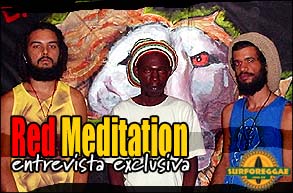
Delighted and with the feeling of having gone through a unique experience. That is certainly how you, a Surforeggae visitor, will feel after seeing with your own eyes the words spoken here by the members of the band Red Meditation. It is the new generation of Rastafaris showing what they came for, always speaking of faith, respect, and truth. I am sure you will learn a lot from what is here, and, like me, be able to share the knowledge and the beautiful words spoken here with other people.
 Rafael – How was the formation of the Band? How did it happen? Where did it start?
Popó: It started where everything starts, with Jah. Red Meditation began with Ras Carlos, one of the oldest Rastas in Salvador who brought reggae music here. We met and started making the sound at my house about 5 years ago. Then we kept improving more and more, until we reached this formation of today. After various experiences we ended up in the studio. The guys really wanted to make it happen, but we didn't have resources, a music studio. In the first recording we did with this formation, we established a work.
Rafael – Whose idea was the name Red Meditation and why the name?
Popó: It was Ras Carlos's idea, and Red Meditation because we wanted to make clear to people the foundation of being together, always meditating, seeking the word of God. There was a time when we were considered crazy, they said we lived preaching, it was church music. Red Meditation is that, a lot of meditation. Before the band was called “Red Jesus Meditation”, then we changed.
Ricardo: Red in Jamaican Patois means stoned
Rafael – What are the main influences?
Popó: Everything that speaks of Jah influences us.
Ricardo: I, as a musician, as a bassist, always seek the origin, the root of reggae, both in spirit and in music, for me to make Reggae, which is not just a music, it is praise to Jah, the musician who makes reggae has to be in the spirit, it is no use seeking knowledge in musical bases, in beats, rhythms if he does not have Jah inside the heart, because the one who will teach Reggae to him is Jah, not Sly & Robbie, Aston Barret, Bob Marley, the one who will teach is Jah. We listen to everything, especially the Reggae that are preaching Jesus Christ, Rastafari in this case. People like Luciano, Bob Marley, everything without exception. The knowledge we seek is truly divine wisdom, the nyambinghi, the root.
Rafael – Who writes the lyrics currently? Who makes the songs?
Ricardo: Molly's songs, she always came with the lyrics, and we arranged, put harmony. And now Popó's songs, he makes the songs, Vicente also, we make music together, practically everyone composes.
Popó: It's really a collective, each one does a part, we are always together composing.
Rafael – How did you feel being part of Pato Banton's backing band? A guy who is well known all over the world. Have you had any experience like that?
Ricardo: It was a very cool experience. We were going to accompany The Itals, but there were some ticket problems and they couldn't come. But the thing with Pato Banton was cool, mainly because he is a Rasta too, on the wave of Jesus Christ too, and it was good he came because he could see that there are Rastas here too, and despite the confusion that happened, he saw that there is a crowd that is seeking, at least from us he took that image. Whereas others already came and did not see so many Rasta bands, they saw more fashionable bands. It was positive because we explained to him that here there is a crowd fighting for a true philosophy, wanting to pass on true reggae, that passes the message of Jah, that gives an example, that is not just talking, it's living.
Rafael – You spent 7 months in São Paulo, how was that experience of spending this time in a different place, different people, different public, different styles?
Popó: It's always good. Each day for me is a surprise that God makes in our life. I was almost sure that this would happen, Jah would put us in a place to sing for more people, in a more organized place, with better structure.
Ricardo: We learned a lot too, and saw the need that exists not only here in Salvador, but everywhere, the lack that people have, the lack of love they need... they need to hear a true message. São Paulo I think is the most cursed city in Brazil, it's where people really need the example of Jesus Christ.
Rafael – And between the public of São Paulo and Salvador, what were the main differences you noticed?
Vicente: Here in Salvador, because it is a beach city, and because it has the largest black population outside Africa, we have more of a connection with reggae, a lived experience, and there in São Paulo it is more difficult, because there it is wild capitalism, it is much bigger.
Rafael – What was the largest audience you had there?
Ricardo: The largest audience we had there was, I think, about 3 thousand people.
Vicente: Here too, we don't play much, because there are not many places.
Rafael – The space here in Salvador is very restricted for bands that make more roots Reggae... here there is more space for who is in the media.
Ricardo: The media here is full of controversies, most of the time what is in evidence is not what has quality.
Vicente: Here in Salvador there are three or four places, and in São Paulo about fifteen.
Rafael – How was your first contact with music?
Ricardo: I started playing guitar at 11 years old, my mother gave me a guitar, a Religion teacher. Then here in Salvador I started doing samba de roda, a samba that already existed a long time here, the samba of the recôncavo, then I met Vicente and we started playing together in Funk, Instrumental bands, and Reggae always present in our life, he already played in other bands, when I met him I didn't even play bass yet. We started playing Reggae together, and when we united we never separated again.
Rafael – Since you played other styles, why did you choose Reggae?
Ricardo: I, sincerely, it was because I saw the truth in Reggae, not that the other music doesn't have truth, but Reggae is a music of feeling, of praise to Jah. I like Jazz, Funk, but Reggae is spiritual music, of liberation, so it touches me in the deepest way that the other music doesn't. I like Jazz, I have it in my heart, but Reggae I have in my spirit, in my blood, it's much stronger.
Rafael – What is your proposal today? What do you intend?
Vicente: Our main objective is to win the public for Jah, not to have success, nothing. We really want to make a Reggae Association here in Salvador, organize Reggae here, because Reggae here needs a lot of organization. And do social work, our biggest objective is this, to use music, the money music brings us to help the poor, all this crowd. Not only with money, because money doesn't bring everything.
Popó: We have to seek Jah, and all other things will be multiplied naturally..
Vicente: There are many people who help financially, but forget to help with spiritual food.
Rafael – How was the recording of your first CD?
Ricardo: It was live in the studio, like a rehearsal.
Rafael – Had the songs you recorded been played for a long time?
Ricardo: Yes, Molly's songs have been around since the first formations.
Popó: She was one of the first vocalists of Red Meditation.
Rafael – Who was the first vocalist?
Popó: Ras Carlos
Ricardo: We did four tracks on this cd, and the rest had already been played, it already played there in California too, the cd was independent, each one gave a help, we have always been independent because the support we seek is Jah himself, it is Jah who places it and few people give themselves to truly help. Those who come for interest we give no chance.
Rafael – What is the feeling of playing in “Rocinha”, one of the most mystical places in the Historic Center of Salvador?
Vicente: Rocinha is our Quilombo of Reggae in Bahia, we have to take our hat off, there is the Central of Reggae here in Salvador, we really like to play there
Rafael – There was even a rumor that they were wanting to end Rocinha, do you know anything about that?
Ricardo: I think, as Alumínio said, hypocrites will never want to hear the truth, and where there is truth, they will want to sabotage it in any way. Who wants to end Rocinha is the System, is the Government, because they don't gain anything with that. Rocinha is made by a community, and is divided among the musicians who are humble and depend on that, so that sustains a community. Due to the little organization that exists, it is still not possible to fight the Government, the System. So it's a fight, but as I told you, the fight is not only of Rocinha, Bem Aventurados or Red Meditation, it is the Universal fight. Pato Banton came here and was also shamed, was used in the same way by the system, so it is not only Rocinha, it is Reggae, it is the truth that is used.
Vicente: It's the fight of good against evil, if we were there playing pagode for them it would be wonderful, I think the Government would even invest.
Rafael – Besides music, what else do you do?
Ricardo: We have the association project, Red Meditation is not just a band, we intend in the future to have a studio, label, production company, all in the name of Jesus, through Red Meditation. Do social works, benefit shows, so Red Meditation is much more than a band, we have projects.
Popó: It's a community.
Ricardo: Red Meditation is a warrior who goes to São Paulo, goes to California, goes everywhere in the world to look for contact and strength to come back home and help those who need.
Rafael – Do you rehearse a lot? Or are you already well tuned and don't need it so much?
Ricardo: To get this tightness, we rehearsed every day.
Rafael – You understand each other well, I already saw.
Ricardo: Bass and drums are the soul of Reggae. We have already played a lot with Kamaphew, there is Mowabesa which is a Rasta work, a serious work that we are trying to push forward. We have already accompanied several artists, like Geraldo Cristal, Bem Aventurados.
Vicente: We are always rehearsing and composing, so it becomes easy.
Rafael – What do you think of the Reggae Movement in general in Brazil? And of the places you passed through, what were the main characteristics you noticed?
Vicente: Reggae here in Brazil is something new, it's not like abroad, because there they have much more information than here. Here the Afro movement is big, the Profane Africa, Candomblé, the Sacred Africa, Ethiopia, this movement here is still new, it's happening but it has a promising future. It's still in that little party, let's make a little reggae band, many bands that say things that don't educate anyone, but it's because the movement is at the beginning, it's still a child.
Popó: And most of the deeper information is in English, and then people have some difficulty knowing what happens.
Ricardo: The people who have the power here do not interpret what they say. They interpret only the groove, the beat, but the word, the message.... not generalizing, because there are bands that have the commitment. But most are more confusing than explaining. We are sad about that, we who follow virtue. May Jah comfort all of us more and more and always give support so we do not give up. If I have to die for this, I will die in the name of Jesus, just like Peter Tosh, Bob Marley, all raised the same flag, were judged, but today are honored. And the messages they tried to pass, to this day are alive, it's eternal.
Vicente: What happens here is that they like Reggae, but they don't like the Rasta. When they go to the real place, the Rasta experience, prejudice appears.... but this will happen, will get very strong the movement.
Ricardo: There is also the confusion of saying that Rastafari is one thing and the Bible is another. And it's not, Rastafari lives Jesus Christ, Rastafari alerted the whole world to the example of Jesus Christ. And this information is not passed. Many times we already left as crazy, long-haired, “drogadito”, even the ganja thing is misinterpreted and misinformed.
Vicente: Another important thing is that Society sees the Rasta as worshipers of Selassie, Tafari Makonen, and he still only spoke of Jesus Christ. Do we worship him? No, but we honor him, because to this day there has not been a guy, no President of any Country who governed in the name of Jesus Christ.
Ricardo: And who alerted the people so much to the Bible, besides being of the same root of David, Solomon, being prophesied by a Baptist, just as a Baptist prophesied Jesus. Marcus Garvey was a Baptist and prophesied Ras Tafari. So he came and did not undo anything Jesus said, if he came and undid it, Amen! But he only confirmed what Jesus said and alerted the people to follow that. But this information is confused by the System, nobody wants to know about it. They want to know about the Pope, about the Churches that rule “in quotes”, because they rule those who are slaves. It's all to confuse, only those who know the truth are those who seek it, because the truth is inside you. You identify what is truth and what is lie.
Vicente: Another interesting thing is that he translated the Bible from ancient scriptures that were in Aramaic, so the people could understand the teaching of Jesus Christ.
Rafael – What do you think about this association that is made between Reggae and the herb, of seeing Reggae music as something for druggies?
Popó: It's a lack of information. People, let's say, “are smoking before knowing”. In genesis, in the beginning God made the herbs to serve, not as a joke. That's why many of them go crazy, smoking too much without knowing the purpose, dirtying the identity of the Kings. Talking about something they have no knowledge of.
Vicente: The herb is something so benign, so many things can be made with it and they only see this side.
Rafael – It is a way of discriminating against a music, a movement that as you said seeks always to bring the truth.
Ricardo: Because the herb is prohibited here, they use that to veto reggae. But if we didn't smoke, they would invent something else. And if the herb didn't exist? Then it's because of the hair. Ah, and if the hair didn't exist? Then it's because of the beard. Because of what? Because of the truth. And the information about the herb here in Brazil is very little. All countries abroad already know the beneficial side of Ganja. There are many countries where smoking ganja is prohibited, but they know everything. They know that ganja cures cancer, is used in the treatment of glaucoma, has several ways of being used, like clothes, among others. We Rastas use it as meditation. I'm going to make a comparison, but a wrong comparison. It's like a person who tastes wines, he drinks that little sip of wine and that's it. But the alcoholic is different. So sometimes they equalize us to people who use it without control, without the information, without knowing what ganja is, where it comes from? what it's for? what it does to our body?
Vicente: That's why it's important that Reggae bands pass on the true information. Many times this association happens because the bands that are appearing more do not pass information about ganja. It's only, let's smoke, “fire in Babylon”.
Ricardo: Even that term “Fire in Babylon” they say it's for you to light a joint, but “Fire in Babylon” is you telling the truth, unmasking Babylon, setting fire to the System, that is to put “Fire in Babylon”
Vicente: Because the herb is not Babylon, it's ganja.
Ricardo: We don't say marijuana, we say herb, ganja, cannabis. Marijuana is a name that only exists here, implanted by the system to distort all the good it has.
Rafael – What do you think about piracy?
Popó: It's a way to help needy people. Pirate is the label they put.
Vicente: In truth, the artist never earned from record sales. Who earns is the label. The artist earns from the shows, so we are in favor of piracy. It's good for us, because the more people listen to our work, the more people will want to see us playing live.
Ricardo: And it's also good for some people who “do” piracy, because they are humble people, the street vendors, people who have no option, they survive with that, so piracy sustains many families that the labels do not sustain.
Popó: It's the most versatile distributor that exists.
Ricardo: And they are people who do it sincerely, humble people who say when they like and don't like. And the label doesn't, they take what they like and what they don't like, what is good and what is not good and sell it. In truth they are Fascists. And they are drowning in their own mud.
Rafael – What do you think about Red Meditation today being considered one of the most “roots” Reggae bands in Brazil.
Ricardo: Personally, I thank Jah for that. For me there is no best, all bands are good, they just need to find themselves. To make Reggae you have to be in the spirit, read the Bible and live what is written there. The truth cannot be hidden, who said that wasn't me, it was Jah.
Vicente: Reggae is that, reggae is praise, talk of this love, this strength. I went to play Reggae because it was the word of Jesus Christ that conquered me in Reggae.
Ricardo: It's not even the recognition of Babylon with us, it's the Recognition of Jah, he is separating the wheat from the chaff. He is showing that there isn't only a “Party” crowd, there are Ras Ciro Lima, Bem Aventurados, but many are already tired of fighting so much. We are young, we are the new generation and we live the Teachings of Jesus Christ.
Popó: The Reggae community of São Paulo is not used to seeing Rasta Reggae, and here we are used to the older Rastas, and this is being updated, new Young Rastas are emerging, a new seed was planted.
Ricardo: It's good to be valued, we give glory to Jah. People who still have feeling feel that, thanks to Jah. But we are not the best, everyone can. There is no you, there is no me. In our midst there is me and me, so you are me and I am you, so I am not better than you, nor me. Each one has their time.
Rafael – Returning to the question of the movement here in Bahia, do you think there is some kind of discrimination of the Bands that are appearing, with the bands that like you try to bring the message, the truth? Are the people who make Reggae disunited?
Ricardo: This is delicate.
Popó: This is delicate... Most times we only meet on stage, so there is a lack of understanding. We don't even have time to talk, to come to the brothers and exchange an idea like we are doing here now. We are in the divine wave, our thing is to pile up spiritual treasures. I don't know if there is discrimination, it's really a lack of contact.
Ricardo: But certainly it is very disunited, because if it were united the movement would be much bigger. And the bands that are up front are like Vicente said, they like Reggae, but they don't like the Rasta, and they use the music of the Rastas, and many, or rather, most of these bands that are in the media don't know half the story, of how many died and how many still die to defend this.
Ricardo: Living Rastafari is living Jesus Christ in a natural way, without Church, without idolatry, completely living what is written in the Bible, not only in word, in action, in works. Rastafari is not a doctrine, there is no rasta church, there are congregations, there are houses where we meet, but it is a natural way, it is the way to live Jesus Christ. We don't have a pastor, I am my pastor, you are your pastor, we live the teachings of Jesus Christ.
Ricardo: We do not seek self-promotion, but we seek to spread our testimony, our life, what happens with us that we want to pass to people. As much as we don't want to promote ourselves, we will, but we will be promoting the truth, in the truest way, without labels, always with love, giving example through music, which is the sweetest thing that exists.
Rafael – And the new record, when is it planned for?
Popó: Before Carnival, our wish is that it is ready before Carnival
Vicente: If Jah allows.
Ricardo: But we already have studio support, this time it will be a well recorded CD, with faith in Jesus Christ, not that the other wasn't, but it was a rush, it was recorded in a rehearsal. We are making the arrangements very carefully, Popó is being more and more blessed with the singer posture now. We are doing it very carefully, so that it becomes a really beautiful thing.
Rafael – In Portuguese this one?
Vicente: Eighty percent, let's say.
Ricardo: There are three songs in English, eleven songs in total
Rafael – And the theme, does it continue being the same?
Vicente: The theme is the same, talk about love, about the book of life, about the truth, clarify the history.
Ricardo: And talk about reality too.
Rafael – I think there is a lack in Brazil mainly, the bands to be more careful with that, many make lyrics that as Vicente said, don't educate anyone.
Ricardo: Exactly. While there are children who follow to the letter what he is saying. So you have to be careful with that, I agree with you.
Popó: May God enlighten everyone.
Vicente: Pagode already does that, it doesn't educate anyone. So, Reggae can't be like that. Reggae is music of Revolutionaries, of revolutionary men and our revolution is education.
Rafael – Maybe that's why Reggae doesn't appear on Television.
Ricardo: Reggae doesn't appear on television, because television has already seen that it makes much more money showing a leg, a butt than showing the truth. But this has to be changed by us. We have to show them that the truth should also be said. But they live in the System, in impiety. They are the wicked, who think that everything they do is right and the rest is wrong, that they do everything, they can do everything... so they will drown among themselves.
Popó: May God have mercy and the word reach them too. Either way, we are all equal.
Rafael – And about discrimination, what do you have to say? I see a lot of discrimination here, including about my person, for being a white guy who likes Reggae.
Ricardo: Even among us, even Popó is discriminated against by the big black guy next to him. Not by appearance, by color or by riches, but by what he says. Sometimes a big black guy next to him, who has the same condition, the same schooling, the same power, but Popó says one thing and he another, then he discriminates.
Ricardo: It's only the disunity that exists... It's what Selassie said. “While the color of men's skin is more important than the color of their eyes, there will be war”. What did he mean by that? That it doesn't matter your belief, your color, where you come from, it doesn't matter how much you have, we have to walk together, doing the works of Jesus, helping those who need, loving, forgiving. It doesn't matter that you believe in Buddha and I in Jesus, we have to walk together doing good things. Any religion preaches love, and the one that doesn't preach it is of the Devil.
Rafael – What do you think about bands that pass interesting, intelligent messages but do not follow what they say?
Ricardo: It's fascism.
Vicente: The worst discrimination is theological. There are black against black and white against white and this has to change.
Rafael – So guys, it was certainly very good to be able to talk with you, and I would like you to leave a message for those who, like me, respect and enjoy your work.
Ricardo: I would like to say that not only for you, but for everyone that the space of Red Meditation is open to talk, to Meditate that this is the function of Red Meditation, a lot of meditation. Everyone who needs this help can look for us. We have our site, soon we will be able to interact with people, they will be able to leave their questions. Ask people to read the Bible, interpret without doctrine, interpret for themselves. Follow the example of Jesus who was the greatest, the only holy man, the only one who came and resurrected was him. We can have all the powers he has, just believe truly. Faith removes mountains, but for those who truly believe. So I call for the example of Jesus Christ.
Popó: I wanted to say on behalf of Red Meditation that we love everyone.
Vicente: We love everyone, and if there is something we can do it is to follow the example of Christ, seek to know who he was. Every equipment has an instruction manual, we are also an equipment, a Divine equipment. And our manual is the bible, so we have to read to function properly
Ricardo: And do not close yourselves to things. If your Spirit is Holy, it will know what is good and what is bad. Always be open to be supportive, never exalt yourself. Love and unite. The Reggae movement needs union and respect, especially those bands that do not spread the philosophy, do not spread the history. If you are not Rastas, amen! But respect us, and seek to talk with us, do not move away. Let's love Reggae and the Rastas too. Because Reggae is the music of the Rastas, it is the music of Jesus, it is the praise. Respect us and give us the due space, because we preach the truth.
Rafael – How was the formation of the Band? How did it happen? Where did it start?
Popó: It started where everything starts, with Jah. Red Meditation began with Ras Carlos, one of the oldest Rastas in Salvador who brought reggae music here. We met and started making the sound at my house about 5 years ago. Then we kept improving more and more, until we reached this formation of today. After various experiences we ended up in the studio. The guys really wanted to make it happen, but we didn't have resources, a music studio. In the first recording we did with this formation, we established a work.
Rafael – Whose idea was the name Red Meditation and why the name?
Popó: It was Ras Carlos's idea, and Red Meditation because we wanted to make clear to people the foundation of being together, always meditating, seeking the word of God. There was a time when we were considered crazy, they said we lived preaching, it was church music. Red Meditation is that, a lot of meditation. Before the band was called “Red Jesus Meditation”, then we changed.
Ricardo: Red in Jamaican Patois means stoned
Rafael – What are the main influences?
Popó: Everything that speaks of Jah influences us.
Ricardo: I, as a musician, as a bassist, always seek the origin, the root of reggae, both in spirit and in music, for me to make Reggae, which is not just a music, it is praise to Jah, the musician who makes reggae has to be in the spirit, it is no use seeking knowledge in musical bases, in beats, rhythms if he does not have Jah inside the heart, because the one who will teach Reggae to him is Jah, not Sly & Robbie, Aston Barret, Bob Marley, the one who will teach is Jah. We listen to everything, especially the Reggae that are preaching Jesus Christ, Rastafari in this case. People like Luciano, Bob Marley, everything without exception. The knowledge we seek is truly divine wisdom, the nyambinghi, the root.
Rafael – Who writes the lyrics currently? Who makes the songs?
Ricardo: Molly's songs, she always came with the lyrics, and we arranged, put harmony. And now Popó's songs, he makes the songs, Vicente also, we make music together, practically everyone composes.
Popó: It's really a collective, each one does a part, we are always together composing.
Rafael – How did you feel being part of Pato Banton's backing band? A guy who is well known all over the world. Have you had any experience like that?
Ricardo: It was a very cool experience. We were going to accompany The Itals, but there were some ticket problems and they couldn't come. But the thing with Pato Banton was cool, mainly because he is a Rasta too, on the wave of Jesus Christ too, and it was good he came because he could see that there are Rastas here too, and despite the confusion that happened, he saw that there is a crowd that is seeking, at least from us he took that image. Whereas others already came and did not see so many Rasta bands, they saw more fashionable bands. It was positive because we explained to him that here there is a crowd fighting for a true philosophy, wanting to pass on true reggae, that passes the message of Jah, that gives an example, that is not just talking, it's living.
Rafael – You spent 7 months in São Paulo, how was that experience of spending this time in a different place, different people, different public, different styles?
Popó: It's always good. Each day for me is a surprise that God makes in our life. I was almost sure that this would happen, Jah would put us in a place to sing for more people, in a more organized place, with better structure.
Ricardo: We learned a lot too, and saw the need that exists not only here in Salvador, but everywhere, the lack that people have, the lack of love they need... they need to hear a true message. São Paulo I think is the most cursed city in Brazil, it's where people really need the example of Jesus Christ.
Rafael – And between the public of São Paulo and Salvador, what were the main differences you noticed?
Vicente: Here in Salvador, because it is a beach city, and because it has the largest black population outside Africa, we have more of a connection with reggae, a lived experience, and there in São Paulo it is more difficult, because there it is wild capitalism, it is much bigger.
Rafael – What was the largest audience you had there?
Ricardo: The largest audience we had there was, I think, about 3 thousand people.
Vicente: Here too, we don't play much, because there are not many places.
Rafael – The space here in Salvador is very restricted for bands that make more roots Reggae... here there is more space for who is in the media.
Ricardo: The media here is full of controversies, most of the time what is in evidence is not what has quality.
Vicente: Here in Salvador there are three or four places, and in São Paulo about fifteen.
Rafael – How was your first contact with music?
Ricardo: I started playing guitar at 11 years old, my mother gave me a guitar, a Religion teacher. Then here in Salvador I started doing samba de roda, a samba that already existed a long time here, the samba of the recôncavo, then I met Vicente and we started playing together in Funk, Instrumental bands, and Reggae always present in our life, he already played in other bands, when I met him I didn't even play bass yet. We started playing Reggae together, and when we united we never separated again.
Rafael – Since you played other styles, why did you choose Reggae?
Ricardo: I, sincerely, it was because I saw the truth in Reggae, not that the other music doesn't have truth, but Reggae is a music of feeling, of praise to Jah. I like Jazz, Funk, but Reggae is spiritual music, of liberation, so it touches me in the deepest way that the other music doesn't. I like Jazz, I have it in my heart, but Reggae I have in my spirit, in my blood, it's much stronger.
Rafael – What is your proposal today? What do you intend?
Vicente: Our main objective is to win the public for Jah, not to have success, nothing. We really want to make a Reggae Association here in Salvador, organize Reggae here, because Reggae here needs a lot of organization. And do social work, our biggest objective is this, to use music, the money music brings us to help the poor, all this crowd. Not only with money, because money doesn't bring everything.
Popó: We have to seek Jah, and all other things will be multiplied naturally..
Vicente: There are many people who help financially, but forget to help with spiritual food.
Rafael – How was the recording of your first CD?
Ricardo: It was live in the studio, like a rehearsal.
Rafael – Had the songs you recorded been played for a long time?
Ricardo: Yes, Molly's songs have been around since the first formations.
Popó: She was one of the first vocalists of Red Meditation.
Rafael – Who was the first vocalist?
Popó: Ras Carlos
Ricardo: We did four tracks on this cd, and the rest had already been played, it already played there in California too, the cd was independent, each one gave a help, we have always been independent because the support we seek is Jah himself, it is Jah who places it and few people give themselves to truly help. Those who come for interest we give no chance.
Rafael – What is the feeling of playing in “Rocinha”, one of the most mystical places in the Historic Center of Salvador?
Vicente: Rocinha is our Quilombo of Reggae in Bahia, we have to take our hat off, there is the Central of Reggae here in Salvador, we really like to play there
Rafael – There was even a rumor that they were wanting to end Rocinha, do you know anything about that?
Ricardo: I think, as Alumínio said, hypocrites will never want to hear the truth, and where there is truth, they will want to sabotage it in any way. Who wants to end Rocinha is the System, is the Government, because they don't gain anything with that. Rocinha is made by a community, and is divided among the musicians who are humble and depend on that, so that sustains a community. Due to the little organization that exists, it is still not possible to fight the Government, the System. So it's a fight, but as I told you, the fight is not only of Rocinha, Bem Aventurados or Red Meditation, it is the Universal fight. Pato Banton came here and was also shamed, was used in the same way by the system, so it is not only Rocinha, it is Reggae, it is the truth that is used.
Vicente: It's the fight of good against evil, if we were there playing pagode for them it would be wonderful, I think the Government would even invest.
Rafael – Besides music, what else do you do?
Ricardo: We have the association project, Red Meditation is not just a band, we intend in the future to have a studio, label, production company, all in the name of Jesus, through Red Meditation. Do social works, benefit shows, so Red Meditation is much more than a band, we have projects.
Popó: It's a community.
Ricardo: Red Meditation is a warrior who goes to São Paulo, goes to California, goes everywhere in the world to look for contact and strength to come back home and help those who need.
Rafael – Do you rehearse a lot? Or are you already well tuned and don't need it so much?
Ricardo: To get this tightness, we rehearsed every day.
Rafael – You understand each other well, I already saw.
Ricardo: Bass and drums are the soul of Reggae. We have already played a lot with Kamaphew, there is Mowabesa which is a Rasta work, a serious work that we are trying to push forward. We have already accompanied several artists, like Geraldo Cristal, Bem Aventurados.
Vicente: We are always rehearsing and composing, so it becomes easy.
Rafael – What do you think of the Reggae Movement in general in Brazil? And of the places you passed through, what were the main characteristics you noticed?
Vicente: Reggae here in Brazil is something new, it's not like abroad, because there they have much more information than here. Here the Afro movement is big, the Profane Africa, Candomblé, the Sacred Africa, Ethiopia, this movement here is still new, it's happening but it has a promising future. It's still in that little party, let's make a little reggae band, many bands that say things that don't educate anyone, but it's because the movement is at the beginning, it's still a child.
Popó: And most of the deeper information is in English, and then people have some difficulty knowing what happens.
Ricardo: The people who have the power here do not interpret what they say. They interpret only the groove, the beat, but the word, the message.... not generalizing, because there are bands that have the commitment. But most are more confusing than explaining. We are sad about that, we who follow virtue. May Jah comfort all of us more and more and always give support so we do not give up. If I have to die for this, I will die in the name of Jesus, just like Peter Tosh, Bob Marley, all raised the same flag, were judged, but today are honored. And the messages they tried to pass, to this day are alive, it's eternal.
Vicente: What happens here is that they like Reggae, but they don't like the Rasta. When they go to the real place, the Rasta experience, prejudice appears.... but this will happen, will get very strong the movement.
Ricardo: There is also the confusion of saying that Rastafari is one thing and the Bible is another. And it's not, Rastafari lives Jesus Christ, Rastafari alerted the whole world to the example of Jesus Christ. And this information is not passed. Many times we already left as crazy, long-haired, “drogadito”, even the ganja thing is misinterpreted and misinformed.
Vicente: Another important thing is that Society sees the Rasta as worshipers of Selassie, Tafari Makonen, and he still only spoke of Jesus Christ. Do we worship him? No, but we honor him, because to this day there has not been a guy, no President of any Country who governed in the name of Jesus Christ.
Ricardo: And who alerted the people so much to the Bible, besides being of the same root of David, Solomon, being prophesied by a Baptist, just as a Baptist prophesied Jesus. Marcus Garvey was a Baptist and prophesied Ras Tafari. So he came and did not undo anything Jesus said, if he came and undid it, Amen! But he only confirmed what Jesus said and alerted the people to follow that. But this information is confused by the System, nobody wants to know about it. They want to know about the Pope, about the Churches that rule “in quotes”, because they rule those who are slaves. It's all to confuse, only those who know the truth are those who seek it, because the truth is inside you. You identify what is truth and what is lie.
Vicente: Another interesting thing is that he translated the Bible from ancient scriptures that were in Aramaic, so the people could understand the teaching of Jesus Christ.
Rafael – What do you think about this association that is made between Reggae and the herb, of seeing Reggae music as something for druggies?
Popó: It's a lack of information. People, let's say, “are smoking before knowing”. In genesis, in the beginning God made the herbs to serve, not as a joke. That's why many of them go crazy, smoking too much without knowing the purpose, dirtying the identity of the Kings. Talking about something they have no knowledge of.
Vicente: The herb is something so benign, so many things can be made with it and they only see this side.
Rafael – It is a way of discriminating against a music, a movement that as you said seeks always to bring the truth.
Ricardo: Because the herb is prohibited here, they use that to veto reggae. But if we didn't smoke, they would invent something else. And if the herb didn't exist? Then it's because of the hair. Ah, and if the hair didn't exist? Then it's because of the beard. Because of what? Because of the truth. And the information about the herb here in Brazil is very little. All countries abroad already know the beneficial side of Ganja. There are many countries where smoking ganja is prohibited, but they know everything. They know that ganja cures cancer, is used in the treatment of glaucoma, has several ways of being used, like clothes, among others. We Rastas use it as meditation. I'm going to make a comparison, but a wrong comparison. It's like a person who tastes wines, he drinks that little sip of wine and that's it. But the alcoholic is different. So sometimes they equalize us to people who use it without control, without the information, without knowing what ganja is, where it comes from? what it's for? what it does to our body?
Vicente: That's why it's important that Reggae bands pass on the true information. Many times this association happens because the bands that are appearing more do not pass information about ganja. It's only, let's smoke, “fire in Babylon”.
Ricardo: Even that term “Fire in Babylon” they say it's for you to light a joint, but “Fire in Babylon” is you telling the truth, unmasking Babylon, setting fire to the System, that is to put “Fire in Babylon”
Vicente: Because the herb is not Babylon, it's ganja.
Ricardo: We don't say marijuana, we say herb, ganja, cannabis. Marijuana is a name that only exists here, implanted by the system to distort all the good it has.
Rafael – What do you think about piracy?
Popó: It's a way to help needy people. Pirate is the label they put.
Vicente: In truth, the artist never earned from record sales. Who earns is the label. The artist earns from the shows, so we are in favor of piracy. It's good for us, because the more people listen to our work, the more people will want to see us playing live.
Ricardo: And it's also good for some people who “do” piracy, because they are humble people, the street vendors, people who have no option, they survive with that, so piracy sustains many families that the labels do not sustain.
Popó: It's the most versatile distributor that exists.
Ricardo: And they are people who do it sincerely, humble people who say when they like and don't like. And the label doesn't, they take what they like and what they don't like, what is good and what is not good and sell it. In truth they are Fascists. And they are drowning in their own mud.
Rafael – What do you think about Red Meditation today being considered one of the most “roots” Reggae bands in Brazil.
Ricardo: Personally, I thank Jah for that. For me there is no best, all bands are good, they just need to find themselves. To make Reggae you have to be in the spirit, read the Bible and live what is written there. The truth cannot be hidden, who said that wasn't me, it was Jah.
Vicente: Reggae is that, reggae is praise, talk of this love, this strength. I went to play Reggae because it was the word of Jesus Christ that conquered me in Reggae.
Ricardo: It's not even the recognition of Babylon with us, it's the Recognition of Jah, he is separating the wheat from the chaff. He is showing that there isn't only a “Party” crowd, there are Ras Ciro Lima, Bem Aventurados, but many are already tired of fighting so much. We are young, we are the new generation and we live the Teachings of Jesus Christ.
Popó: The Reggae community of São Paulo is not used to seeing Rasta Reggae, and here we are used to the older Rastas, and this is being updated, new Young Rastas are emerging, a new seed was planted.
Ricardo: It's good to be valued, we give glory to Jah. People who still have feeling feel that, thanks to Jah. But we are not the best, everyone can. There is no you, there is no me. In our midst there is me and me, so you are me and I am you, so I am not better than you, nor me. Each one has their time.
Rafael – Returning to the question of the movement here in Bahia, do you think there is some kind of discrimination of the Bands that are appearing, with the bands that like you try to bring the message, the truth? Are the people who make Reggae disunited?
Ricardo: This is delicate.
Popó: This is delicate... Most times we only meet on stage, so there is a lack of understanding. We don't even have time to talk, to come to the brothers and exchange an idea like we are doing here now. We are in the divine wave, our thing is to pile up spiritual treasures. I don't know if there is discrimination, it's really a lack of contact.
Ricardo: But certainly it is very disunited, because if it were united the movement would be much bigger. And the bands that are up front are like Vicente said, they like Reggae, but they don't like the Rasta, and they use the music of the Rastas, and many, or rather, most of these bands that are in the media don't know half the story, of how many died and how many still die to defend this.
Ricardo: Living Rastafari is living Jesus Christ in a natural way, without Church, without idolatry, completely living what is written in the Bible, not only in word, in action, in works. Rastafari is not a doctrine, there is no rasta church, there are congregations, there are houses where we meet, but it is a natural way, it is the way to live Jesus Christ. We don't have a pastor, I am my pastor, you are your pastor, we live the teachings of Jesus Christ.
Ricardo: We do not seek self-promotion, but we seek to spread our testimony, our life, what happens with us that we want to pass to people. As much as we don't want to promote ourselves, we will, but we will be promoting the truth, in the truest way, without labels, always with love, giving example through music, which is the sweetest thing that exists.
Rafael – And the new record, when is it planned for?
Popó: Before Carnival, our wish is that it is ready before Carnival
Vicente: If Jah allows.
Ricardo: But we already have studio support, this time it will be a well recorded CD, with faith in Jesus Christ, not that the other wasn't, but it was a rush, it was recorded in a rehearsal. We are making the arrangements very carefully, Popó is being more and more blessed with the singer posture now. We are doing it very carefully, so that it becomes a really beautiful thing.
Rafael – In Portuguese this one?
Vicente: Eighty percent, let's say.
Ricardo: There are three songs in English, eleven songs in total
Rafael – And the theme, does it continue being the same?
Vicente: The theme is the same, talk about love, about the book of life, about the truth, clarify the history.
Ricardo: And talk about reality too.
Rafael – I think there is a lack in Brazil mainly, the bands to be more careful with that, many make lyrics that as Vicente said, don't educate anyone.
Ricardo: Exactly. While there are children who follow to the letter what he is saying. So you have to be careful with that, I agree with you.
Popó: May God enlighten everyone.
Vicente: Pagode already does that, it doesn't educate anyone. So, Reggae can't be like that. Reggae is music of Revolutionaries, of revolutionary men and our revolution is education.
Rafael – Maybe that's why Reggae doesn't appear on Television.
Ricardo: Reggae doesn't appear on television, because television has already seen that it makes much more money showing a leg, a butt than showing the truth. But this has to be changed by us. We have to show them that the truth should also be said. But they live in the System, in impiety. They are the wicked, who think that everything they do is right and the rest is wrong, that they do everything, they can do everything... so they will drown among themselves.
Popó: May God have mercy and the word reach them too. Either way, we are all equal.
Rafael – And about discrimination, what do you have to say? I see a lot of discrimination here, including about my person, for being a white guy who likes Reggae.
Ricardo: Even among us, even Popó is discriminated against by the big black guy next to him. Not by appearance, by color or by riches, but by what he says. Sometimes a big black guy next to him, who has the same condition, the same schooling, the same power, but Popó says one thing and he another, then he discriminates.
Ricardo: It's only the disunity that exists... It's what Selassie said. “While the color of men's skin is more important than the color of their eyes, there will be war”. What did he mean by that? That it doesn't matter your belief, your color, where you come from, it doesn't matter how much you have, we have to walk together, doing the works of Jesus, helping those who need, loving, forgiving. It doesn't matter that you believe in Buddha and I in Jesus, we have to walk together doing good things. Any religion preaches love, and the one that doesn't preach it is of the Devil.
Rafael – What do you think about bands that pass interesting, intelligent messages but do not follow what they say?
Ricardo: It's fascism.
Vicente: The worst discrimination is theological. There are black against black and white against white and this has to change.
Rafael – So guys, it was certainly very good to be able to talk with you, and I would like you to leave a message for those who, like me, respect and enjoy your work.
Ricardo: I would like to say that not only for you, but for everyone that the space of Red Meditation is open to talk, to Meditate that this is the function of Red Meditation, a lot of meditation. Everyone who needs this help can look for us. We have our site, soon we will be able to interact with people, they will be able to leave their questions. Ask people to read the Bible, interpret without doctrine, interpret for themselves. Follow the example of Jesus who was the greatest, the only holy man, the only one who came and resurrected was him. We can have all the powers he has, just believe truly. Faith removes mountains, but for those who truly believe. So I call for the example of Jesus Christ.
Popó: I wanted to say on behalf of Red Meditation that we love everyone.
Vicente: We love everyone, and if there is something we can do it is to follow the example of Christ, seek to know who he was. Every equipment has an instruction manual, we are also an equipment, a Divine equipment. And our manual is the bible, so we have to read to function properly
Ricardo: And do not close yourselves to things. If your Spirit is Holy, it will know what is good and what is bad. Always be open to be supportive, never exalt yourself. Love and unite. The Reggae movement needs union and respect, especially those bands that do not spread the philosophy, do not spread the history. If you are not Rastas, amen! But respect us, and seek to talk with us, do not move away. Let's love Reggae and the Rastas too. Because Reggae is the music of the Rastas, it is the music of Jesus, it is the praise. Respect us and give us the due space, because we preach the truth.
THE INTERVIEW
Rafael – How was the formation of the Band? How did it happen? Where did it start?
Popó: It started where everything starts, with Jah. Red Meditation began with Ras Carlos, one of the oldest Rastas in Salvador who brought reggae music here. We met and started making the sound at my house about 5 years ago. Then we kept improving more and more, until we reached this formation of today. After various experiences we ended up in the studio. The guys really wanted to make it happen, but we didn't have resources, a music studio. In the first recording we did with this formation, we established a work.
Rafael – Whose idea was the name Red Meditation and why the name?
Popó: It was Ras Carlos's idea, and Red Meditation because we wanted to make clear to people the foundation of being together, always meditating, seeking the word of God. There was a time when we were considered crazy, they said we lived preaching, it was church music. Red Meditation is that, a lot of meditation. Before the band was called “Red Jesus Meditation”, then we changed.
Ricardo: Red in Jamaican Patois means stoned
Rafael – What are the main influences?
Popó: Everything that speaks of Jah influences us.
Ricardo: I, as a musician, as a bassist, always seek the origin, the root of reggae, both in spirit and in music, for me to make Reggae, which is not just a music, it is praise to Jah, the musician who makes reggae has to be in the spirit, it is no use seeking knowledge in musical bases, in beats, rhythms if he does not have Jah inside the heart, because the one who will teach Reggae to him is Jah, not Sly & Robbie, Aston Barret, Bob Marley, the one who will teach is Jah. We listen to everything, especially the Reggae that are preaching Jesus Christ, Rastafari in this case. People like Luciano, Bob Marley, everything without exception. The knowledge we seek is truly divine wisdom, the nyambinghi, the root.
Rafael – Who writes the lyrics currently? Who makes the songs?
Ricardo: Molly's songs, she always came with the lyrics, and we arranged, put harmony. And now Popó's songs, he makes the songs, Vicente also, we make music together, practically everyone composes.
Popó: It's really a collective, each one does a part, we are always together composing.
Rafael – How did you feel being part of Pato Banton's backing band? A guy who is well known all over the world. Have you had any experience like that?
Ricardo: It was a very cool experience. We were going to accompany The Itals, but there were some ticket problems and they couldn't come. But the thing with Pato Banton was cool, mainly because he is a Rasta too, on the wave of Jesus Christ too, and it was good he came because he could see that there are Rastas here too, and despite the confusion that happened, he saw that there is a crowd that is seeking, at least from us he took that image. Whereas others already came and did not see so many Rasta bands, they saw more fashionable bands. It was positive because we explained to him that here there is a crowd fighting for a true philosophy, wanting to pass on true reggae, that passes the message of Jah, that gives an example, that is not just talking, it's living.
Rafael – You spent 7 months in São Paulo, how was that experience of spending this time in a different place, different people, different public, different styles?
Popó: It's always good. Each day for me is a surprise that God makes in our life. I was almost sure that this would happen, Jah would put us in a place to sing for more people, in a more organized place, with better structure.
Ricardo: We learned a lot too, and saw the need that exists not only here in Salvador, but everywhere, the lack that people have, the lack of love they need... they need to hear a true message. São Paulo I think is the most cursed city in Brazil, it's where people really need the example of Jesus Christ.
Rafael – And between the public of São Paulo and Salvador, what were the main differences you noticed?
Vicente: Here in Salvador, because it is a beach city, and because it has the largest black population outside Africa, we have more of a connection with reggae, a lived experience, and there in São Paulo it is more difficult, because there it is wild capitalism, it is much bigger.
Rafael – What was the largest audience you had there?
Ricardo: The largest audience we had there was, I think, about 3 thousand people.
Vicente: Here too, we don't play much, because there are not many places.
Rafael – The space here in Salvador is very restricted for bands that make more roots Reggae... here there is more space for who is in the media.
Ricardo: The media here is full of controversies, most of the time what is in evidence is not what has quality.
Vicente: Here in Salvador there are three or four places, and in São Paulo about fifteen.
Rafael – How was your first contact with music?
Ricardo: I started playing guitar at 11 years old, my mother gave me a guitar, a Religion teacher. Then here in Salvador I started doing samba de roda, a samba that already existed a long time here, the samba of the recôncavo, then I met Vicente and we started playing together in Funk, Instrumental bands, and Reggae always present in our life, he already played in other bands, when I met him I didn't even play bass yet. We started playing Reggae together, and when we united we never separated again.
Rafael – Since you played other styles, why did you choose Reggae?
Ricardo: I, sincerely, it was because I saw the truth in Reggae, not that the other music doesn't have truth, but Reggae is a music of feeling, of praise to Jah. I like Jazz, Funk, but Reggae is spiritual music, of liberation, so it touches me in the deepest way that the other music doesn't. I like Jazz, I have it in my heart, but Reggae I have in my spirit, in my blood, it's much stronger.
Rafael – What is your proposal today? What do you intend?
Vicente: Our main objective is to win the public for Jah, not to have success, nothing. We really want to make a Reggae Association here in Salvador, organize Reggae here, because Reggae here needs a lot of organization. And do social work, our biggest objective is this, to use music, the money music brings us to help the poor, all this crowd. Not only with money, because money doesn't bring everything.
Popó: We have to seek Jah, and all other things will be multiplied naturally..
Vicente: There are many people who help financially, but forget to help with spiritual food.
Rafael – How was the recording of your first CD?
Ricardo: It was live in the studio, like a rehearsal.
Rafael – Had the songs you recorded been played for a long time?
Ricardo: Yes, Molly's songs have been around since the first formations.
Popó: She was one of the first vocalists of Red Meditation.
Rafael – Who was the first vocalist?
Popó: Ras Carlos
Ricardo: We did four tracks on this cd, and the rest had already been played, it already played there in California too, the cd was independent, each one gave a help, we have always been independent because the support we seek is Jah himself, it is Jah who places it and few people give themselves to truly help. Those who come for interest we give no chance.
Rafael – What is the feeling of playing in “Rocinha”, one of the most mystical places in the Historic Center of Salvador?
Vicente: Rocinha is our Quilombo of Reggae in Bahia, we have to take our hat off, there is the Central of Reggae here in Salvador, we really like to play there
Rafael – There was even a rumor that they were wanting to end Rocinha, do you know anything about that?
Ricardo: I think, as Alumínio said, hypocrites will never want to hear the truth, and where there is truth, they will want to sabotage it in any way. Who wants to end Rocinha is the System, is the Government, because they don't gain anything with that. Rocinha is made by a community, and is divided among the musicians who are humble and depend on that, so that sustains a community. Due to the little organization that exists, it is still not possible to fight the Government, the System. So it's a fight, but as I told you, the fight is not only of Rocinha, Bem Aventurados or Red Meditation, it is the Universal fight. Pato Banton came here and was also shamed, was used in the same way by the system, so it is not only Rocinha, it is Reggae, it is the truth that is used.
Vicente: It's the fight of good against evil, if we were there playing pagode for them it would be wonderful, I think the Government would even invest.
Rafael – Besides music, what else do you do?
Ricardo: We have the association project, Red Meditation is not just a band, we intend in the future to have a studio, label, production company, all in the name of Jesus, through Red Meditation. Do social works, benefit shows, so Red Meditation is much more than a band, we have projects.
Popó: It's a community.
Ricardo: Red Meditation is a warrior who goes to São Paulo, goes to California, goes everywhere in the world to look for contact and strength to come back home and help those who need.
Rafael – Do you rehearse a lot? Or are you already well tuned and don't need it so much?
Ricardo: To get this tightness, we rehearsed every day.
Rafael – You understand each other well, I already saw.
Ricardo: Bass and drums are the soul of Reggae. We have already played a lot with Kamaphew, there is Mowabesa which is a Rasta work, a serious work that we are trying to push forward. We have already accompanied several artists, like Geraldo Cristal, Bem Aventurados.
Vicente: We are always rehearsing and composing, so it becomes easy.
Rafael – What do you think of the Reggae Movement in general in Brazil? And of the places you passed through, what were the main characteristics you noticed?
Vicente: Reggae here in Brazil is something new, it's not like abroad, because there they have much more information than here. Here the Afro movement is big, the Profane Africa, Candomblé, the Sacred Africa, Ethiopia, this movement here is still new, it's happening but it has a promising future. It's still in that little party, let's make a little reggae band, many bands that say things that don't educate anyone, but it's because the movement is at the beginning, it's still a child.
Popó: And most of the deeper information is in English, and then people have some difficulty knowing what happens.
Ricardo: The people who have the power here do not interpret what they say. They interpret only the groove, the beat, but the word, the message.... not generalizing, because there are bands that have the commitment. But most are more confusing than explaining. We are sad about that, we who follow virtue. May Jah comfort all of us more and more and always give support so we do not give up. If I have to die for this, I will die in the name of Jesus, just like Peter Tosh, Bob Marley, all raised the same flag, were judged, but today are honored. And the messages they tried to pass, to this day are alive, it's eternal.
Vicente: What happens here is that they like Reggae, but they don't like the Rasta. When they go to the real place, the Rasta experience, prejudice appears.... but this will happen, will get very strong the movement.
Ricardo: There is also the confusion of saying that Rastafari is one thing and the Bible is another. And it's not, Rastafari lives Jesus Christ, Rastafari alerted the whole world to the example of Jesus Christ. And this information is not passed. Many times we already left as crazy, long-haired, “drogadito”, even the ganja thing is misinterpreted and misinformed.
Vicente: Another important thing is that Society sees the Rasta as worshipers of Selassie, Tafari Makonen, and he still only spoke of Jesus Christ. Do we worship him? No, but we honor him, because to this day there has not been a guy, no President of any Country who governed in the name of Jesus Christ.
Ricardo: And who alerted the people so much to the Bible, besides being of the same root of David, Solomon, being prophesied by a Baptist, just as a Baptist prophesied Jesus. Marcus Garvey was a Baptist and prophesied Ras Tafari. So he came and did not undo anything Jesus said, if he came and undid it, Amen! But he only confirmed what Jesus said and alerted the people to follow that. But this information is confused by the System, nobody wants to know about it. They want to know about the Pope, about the Churches that rule “in quotes”, because they rule those who are slaves. It's all to confuse, only those who know the truth are those who seek it, because the truth is inside you. You identify what is truth and what is lie.
Vicente: Another interesting thing is that he translated the Bible from ancient scriptures that were in Aramaic, so the people could understand the teaching of Jesus Christ.
Rafael – What do you think about this association that is made between Reggae and the herb, of seeing Reggae music as something for druggies?
Popó: It's a lack of information. People, let's say, “are smoking before knowing”. In genesis, in the beginning God made the herbs to serve, not as a joke. That's why many of them go crazy, smoking too much without knowing the purpose, dirtying the identity of the Kings. Talking about something they have no knowledge of.
Vicente: The herb is something so benign, so many things can be made with it and they only see this side.
Rafael – It is a way of discriminating against a music, a movement that as you said seeks always to bring the truth.
Ricardo: Because the herb is prohibited here, they use that to veto reggae. But if we didn't smoke, they would invent something else. And if the herb didn't exist? Then it's because of the hair. Ah, and if the hair didn't exist? Then it's because of the beard. Because of what? Because of the truth. And the information about the herb here in Brazil is very little. All countries abroad already know the beneficial side of Ganja. There are many countries where smoking ganja is prohibited, but they know everything. They know that ganja cures cancer, is used in the treatment of glaucoma, has several ways of being used, like clothes, among others. We Rastas use it as meditation. I'm going to make a comparison, but a wrong comparison. It's like a person who tastes wines, he drinks that little sip of wine and that's it. But the alcoholic is different. So sometimes they equalize us to people who use it without control, without the information, without knowing what ganja is, where it comes from? what it's for? what it does to our body?
Vicente: That's why it's important that Reggae bands pass on the true information. Many times this association happens because the bands that are appearing more do not pass information about ganja. It's only, let's smoke, “fire in Babylon”.
Ricardo: Even that term “Fire in Babylon” they say it's for you to light a joint, but “Fire in Babylon” is you telling the truth, unmasking Babylon, setting fire to the System, that is to put “Fire in Babylon”
Vicente: Because the herb is not Babylon, it's ganja.
Ricardo: We don't say marijuana, we say herb, ganja, cannabis. Marijuana is a name that only exists here, implanted by the system to distort all the good it has.
Rafael – What do you think about piracy?
Popó: It's a way to help needy people. Pirate is the label they put.
Vicente: In truth, the artist never earned from record sales. Who earns is the label. The artist earns from the shows, so we are in favor of piracy. It's good for us, because the more people listen to our work, the more people will want to see us playing live.
Ricardo: And it's also good for some people who “do” piracy, because they are humble people, the street vendors, people who have no option, they survive with that, so piracy sustains many families that the labels do not sustain.
Popó: It's the most versatile distributor that exists.
Ricardo: And they are people who do it sincerely, humble people who say when they like and don't like. And the label doesn't, they take what they like and what they don't like, what is good and what is not good and sell it. In truth they are Fascists. And they are drowning in their own mud.
Rafael – What do you think about Red Meditation today being considered one of the most “roots” Reggae bands in Brazil.
Ricardo: Personally, I thank Jah for that. For me there is no best, all bands are good, they just need to find themselves. To make Reggae you have to be in the spirit, read the Bible and live what is written there. The truth cannot be hidden, who said that wasn't me, it was Jah.
Vicente: Reggae is that, reggae is praise, talk of this love, this strength. I went to play Reggae because it was the word of Jesus Christ that conquered me in Reggae.
Ricardo: It's not even the recognition of Babylon with us, it's the Recognition of Jah, he is separating the wheat from the chaff. He is showing that there isn't only a “Party” crowd, there are Ras Ciro Lima, Bem Aventurados, but many are already tired of fighting so much. We are young, we are the new generation and we live the Teachings of Jesus Christ.
Popó: The Reggae community of São Paulo is not used to seeing Rasta Reggae, and here we are used to the older Rastas, and this is being updated, new Young Rastas are emerging, a new seed was planted.
Ricardo: It's good to be valued, we give glory to Jah. People who still have feeling feel that, thanks to Jah. But we are not the best, everyone can. There is no you, there is no me. In our midst there is me and me, so you are me and I am you, so I am not better than you, nor me. Each one has their time.
Rafael – Returning to the question of the movement here in Bahia, do you think there is some kind of discrimination of the Bands that are appearing, with the bands that like you try to bring the message, the truth? Are the people who make Reggae disunited?
Ricardo: This is delicate.
Popó: This is delicate... Most times we only meet on stage, so there is a lack of understanding. We don't even have time to talk, to come to the brothers and exchange an idea like we are doing here now. We are in the divine wave, our thing is to pile up spiritual treasures. I don't know if there is discrimination, it's really a lack of contact.
Ricardo: But certainly it is very disunited, because if it were united the movement would be much bigger. And the bands that are up front are like Vicente said, they like Reggae, but they don't like the Rasta, and they use the music of the Rastas, and many, or rather, most of these bands that are in the media don't know half the story, of how many died and how many still die to defend this.
Ricardo: Living Rastafari is living Jesus Christ in a natural way, without Church, without idolatry, completely living what is written in the Bible, not only in word, in action, in works. Rastafari is not a doctrine, there is no rasta church, there are congregations, there are houses where we meet, but it is a natural way, it is the way to live Jesus Christ. We don't have a pastor, I am my pastor, you are your pastor, we live the teachings of Jesus Christ.
Ricardo: We do not seek self-promotion, but we seek to spread our testimony, our life, what happens with us that we want to pass to people. As much as we don't want to promote ourselves, we will, but we will be promoting the truth, in the truest way, without labels, always with love, giving example through music, which is the sweetest thing that exists.
Rafael – And the new record, when is it planned for?
Popó: Before Carnival, our wish is that it is ready before Carnival
Vicente: If Jah allows.
Ricardo: But we already have studio support, this time it will be a well recorded CD, with faith in Jesus Christ, not that the other wasn't, but it was a rush, it was recorded in a rehearsal. We are making the arrangements very carefully, Popó is being more and more blessed with the singer posture now. We are doing it very carefully, so that it becomes a really beautiful thing.
Rafael – In Portuguese this one?
Vicente: Eighty percent, let's say.
Ricardo: There are three songs in English, eleven songs in total
Rafael – And the theme, does it continue being the same?
Vicente: The theme is the same, talk about love, about the book of life, about the truth, clarify the history.
Ricardo: And talk about reality too.
Rafael – I think there is a lack in Brazil mainly, the bands to be more careful with that, many make lyrics that as Vicente said, don't educate anyone.
Ricardo: Exactly. While there are children who follow to the letter what he is saying. So you have to be careful with that, I agree with you.
Popó: May God enlighten everyone.
Vicente: Pagode already does that, it doesn't educate anyone. So, Reggae can't be like that. Reggae is music of Revolutionaries, of revolutionary men and our revolution is education.
Rafael – Maybe that's why Reggae doesn't appear on Television.
Ricardo: Reggae doesn't appear on television, because television has already seen that it makes much more money showing a leg, a butt than showing the truth. But this has to be changed by us. We have to show them that the truth should also be said. But they live in the System, in impiety. They are the wicked, who think that everything they do is right and the rest is wrong, that they do everything, they can do everything... so they will drown among themselves.
Popó: May God have mercy and the word reach them too. Either way, we are all equal.
Rafael – And about discrimination, what do you have to say? I see a lot of discrimination here, including about my person, for being a white guy who likes Reggae.
Ricardo: Even among us, even Popó is discriminated against by the big black guy next to him. Not by appearance, by color or by riches, but by what he says. Sometimes a big black guy next to him, who has the same condition, the same schooling, the same power, but Popó says one thing and he another, then he discriminates.
Ricardo: It's only the disunity that exists... It's what Selassie said. “While the color of men's skin is more important than the color of their eyes, there will be war”. What did he mean by that? That it doesn't matter your belief, your color, where you come from, it doesn't matter how much you have, we have to walk together, doing the works of Jesus, helping those who need, loving, forgiving. It doesn't matter that you believe in Buddha and I in Jesus, we have to walk together doing good things. Any religion preaches love, and the one that doesn't preach it is of the Devil.
Rafael – What do you think about bands that pass interesting, intelligent messages but do not follow what they say?
Ricardo: It's fascism.
Vicente: The worst discrimination is theological. There are black against black and white against white and this has to change.
Rafael – So guys, it was certainly very good to be able to talk with you, and I would like you to leave a message for those who, like me, respect and enjoy your work.
Ricardo: I would like to say that not only for you, but for everyone that the space of Red Meditation is open to talk, to Meditate that this is the function of Red Meditation, a lot of meditation. Everyone who needs this help can look for us. We have our site, soon we will be able to interact with people, they will be able to leave their questions. Ask people to read the Bible, interpret without doctrine, interpret for themselves. Follow the example of Jesus who was the greatest, the only holy man, the only one who came and resurrected was him. We can have all the powers he has, just believe truly. Faith removes mountains, but for those who truly believe. So I call for the example of Jesus Christ.
Popó: I wanted to say on behalf of Red Meditation that we love everyone.
Vicente: We love everyone, and if there is something we can do it is to follow the example of Christ, seek to know who he was. Every equipment has an instruction manual, we are also an equipment, a Divine equipment. And our manual is the bible, so we have to read to function properly
Ricardo: And do not close yourselves to things. If your Spirit is Holy, it will know what is good and what is bad. Always be open to be supportive, never exalt yourself. Love and unite. The Reggae movement needs union and respect, especially those bands that do not spread the philosophy, do not spread the history. If you are not Rastas, amen! But respect us, and seek to talk with us, do not move away. Let's love Reggae and the Rastas too. Because Reggae is the music of the Rastas, it is the music of Jesus, it is the praise. Respect us and give us the due space, because we preach the truth.Category
#Reggae