
Reggae · February 02, 2004
UB40: The band's latest releases bring the established "vintage" style spanning three decades!
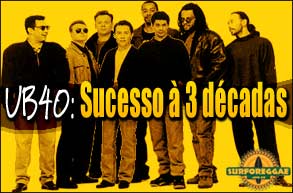
They have already sold more than 50 million records and traveled the world as ambassadors of reggae. They gave memorable shows in South Africa, the Soviet Union and – last year – in Sri Lanka. And, disproving the proverb that too many cooks spoil the broth of music, UB40 prospered by continually combining their resources and moving forward. With reggae recognized as a strong influence on modern R&B, ragga, hip-hop and garage, the Birmingham band also helped inspire generations of new stars in a career now in its third decade.
And now, 23 years after their first album - Signing Off, from 1980 – UB40 returns to its roots. This autumn, the loyal English reggae players return with an extensive British tour and an exceptional studio album, Homegrown, which shows the band returning to its traditional efforts.
"It's an album full of good songs," says guitarist Robin Campbell, whose brother Ali is the band's lead vocalist. "It has a more consistent sound than our last album. Last time we went in various directions. Now, we went the opposite way. The approach is simpler. It's an old-fashioned UB40 album."
"Ali is in his best form," he adds. "He sings beautifully and his melodies are fabulous. Homegrown is a modern record in terms of technology, but behind that, it's still vintage UB40." Homegrown – the band's 22nd album – was played and produced by the same eight members who formed UB40 in Moseley, Birmingham, in 1978.
Having learned to play their instruments and write their own songs while listening to their favorite reggae stars, UB40 has always been as much a gang as a band. And, despite their enormous success, the rare chemistry from the early days in Moseley is still there. "We try to keep what we had when we started," says Robin. "We are eight and we are all equal. We have always had a democratic lineup. Everything we achieved was always divided by eight. That made us very strong. Staying in Birmingham also helped us keep our feet on the ground. If someone gets too enthusiastic about themselves, we give them a hard time."
"Everyone in the group has a vote," adds percussionist Norman Hassan. "We grew up together, so UB40 is like a family. Nobody steps out of line." The first single from Homegrown, Swing Low, signals another uplifting success, being the official song of the English rugby team for the 2003 Rugby World Cup in Australia. To mark the release, the band played the single on the hallowed turf of Twickenham, home of British rugby, before the Investec Challenge match between England and France on September 6.
Robin says: "Making a rugby single wasn't the main thing on our minds, but we were approached by Rick Blaskey, executive music producer for many major international sporting events, on behalf of the RFU, and it seemed like a great idea. The way British sport is at the moment, the England rugby team is the one that should be supported – it's the best we've had in 20 years."
Swing Low has been the favorite anthem of English rugby fans for years. But the song also has a distinct history as an anti-slavery song: besides being a chilling World Cup chant, its sentiments fit perfectly with UB40's long-standing anti-racist philosophy. Instead of presenting the song in the firm rock style of their acclaimed Labour Of Love series, however, the band gave Swing Low a more contemporary touch, adding restless electronic beats, a sample of a rugby crowd singing and a gripping gospel choir at United Colours Of Sound.
The release of Swing Low and Homegrown comes after a period of intense activity. Following the previous studio collection, Cover Up (2001), UB40 completed a tour celebrating the 21st anniversary of Signing Off. And then, in 2002, they released a DVD collection and The Fathers Of Reggae, an epic album featuring a list of Jamaican legends – among them Gregory Isaacs, Toots Hibbert, Ken Boothe, Mighty Diamonds and John Holt – who put their own distinctive touch on the band's songs.
"The Fathers album meant a lot to us," says Robin. "I never enjoyed being in the studio so much. I was working with my gods, almost in tears. Some of the artists came to our studio in Birmingham, and they were all incredibly modest. I was surprised at how much they knew of our material. Ali asked John Holt if he could sing The Pillow – and he sang it perfectly!"
In 2003 UB40 received an Ivor Novello Award for International Achievement. They also reappeared on the British charts with The Platinum Collection. A box set bringing together all three volumes of the Labour Of Love series gave them another Top Ten record – strong testimony to their enduring popularity.
And, as if that weren't enough, the band also collaborated with international singers and rappers on foreign-language versions of songs from Cover Up: French rapper Nuttea and South African Ringo Madlingozi both performed the title track of Cover Up, Nuttea's interpretation becoming a Top Ten hit in France; and Japanese singer Mikidozan recorded another track, Since I Met You Lady, topping the International Chart in his homeland in the process.
Partnerships like these are typical of UB40's global perspective. They may have avoided all London notions of style, preferring the roots of the West Midlands, but the band was never parochial in its outlook: besides securing three international number 1 singles - Red Red Wine, I Got You Babe and (I Can't Help) Falling In Love – they achieved their multi-million international sales playing in the Soviet Union (1986), South Africa (1994) and at the 2002 peace festival in the Sri Lankan capital, Colombo.
"I'm proud that we've sold millions of albums," reflects Robin. "But record sales happen gradually, over a period of time. Those shows were the real mark on our lives."
While many bands blindly followed musical fashion, jumping from genre to genre in a desperate attempt to stay current, UB40 has always been faithful to reggae and its capacity for diversity and originality. For them, music first created in Jamaica in the 60s and 70s is as vibrant today as it was then. "To a point, reggae was written from history," says drummer James Brown. "But there would be no garage, drum and bass or hip-hop if it weren't for reggae. And current dance music wouldn't exist if it weren't for dub. If you listen to producers like Timbaland, their style is totally informed by reggae."
But what sets UB40 apart, as the memorable melodies of Homegrown attest, is its ability to blend seductive reggae rhythms with a very English appreciation of great pop. "We try to play reggae," says Robin. "But we grew up listening to the Beatles and Everly Brothers before reggae even existed. We never tried to make pop records, but that pop thing was always there – it's an accidental cocktail."
"We've always had our own hybridism," says Ali. "We're from Birmingham, so we never played roots reggae or Jamaican reggae. Originally we called it "jazz-dub reggae"."
With many rivers still to cross before they go home, UB40 marks its 25th year with one of the strongest albums of its career. And, with reggae as an increasingly present force on the pop charts through dancefloor stars like Shaggy and Sean Paul, the band is constantly reminded of its impact on younger singers.
"Whenever we approach some dancefloor star, they're more than happy to work with us," says Robin. "We've reached a stage where many of the new reggae stars grew up listening to us. We're revered by many young musicians, who heard our record for the first time when their parents were listening to it. I can feel our influence on many modern reggae records."
"When we made our first single - Food For Thought and King – the studio was so small that Norman had to record his percussion in another room," says Ali. "If you listen carefully, you can hear birds singing in the garden outside! With modern studios, we now have more freedom. But technology can't compose a song. What matters is the music we make as a band."
"Whatever we try to do, the sound is always UB40," Robin concludes. "If only two or three of us work on a track, it doesn't sound like UB40. But when the others add their contribution, it suddenly becomes a UB40 song."
 Learn more about UB40 right here on Surforeggae.
MORE INFORMATION
Learn more about UB40 right here on Surforeggae.Category
#Reggae