
Reggae · November 22, 2016
Part 1: To drive away the Devil!
Bob Marley was left wanting. He heard "War In a Babylon" before it was recorded and salivated. He asked for the song, but Lee Perry stood fi

Bob Marley was left wanting. He heard "War In a Babylon" before it was recorded and salivated. He asked for the song, but Lee Perry stood firm: that one already had an owner. "I had to be strong, otherwise that would have been just another song in Bob Marley's repertoire, even though it was of my authorship.
Later, he did something very similar on "Three Little Birds" (the bass line is very close). It was my chance and I grabbed it," recalls the fortunate co-author and performer of the track in the liner notes of the box set "Arkology" – a fine anthology of Perry's work across three CDs.
"War Ina Babylon" became an emblem of Jamaican music, opened the visibility horizon for singer Max Romeo and generated a homonymous album, released in 1976, of enormous relevance in the genealogy of reggae. Until then a luxury supporting actor, Romeo gained recognition as a versatile interpreter, a good lyricist and the voice of a powerful protest album packed with classics – such as "One Step Forward" and "Chase The Devil".
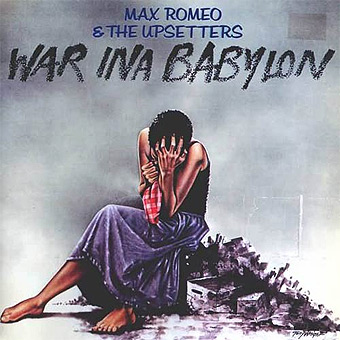 (Cover of the album "War Ina Babylon")
His potential found all the elements of resonance in the mythical Black Ark studio. The owner was one of the most eccentric figures in pop music history: Lee Perry – also known as Lee "Scratch" Perry, aka The Upsetter, the secret identity of Jah Lion, the pseudonym of Super Ape, nicknamed Pipecock Jakxon. Little Perry for intimates. As you prefer. Born Rainford Hugh Perry, the producer, composer and sound engineer cultivates as many controversies in his résumé as artistic name changes throughout his career.
In the same way that he disputes with Bob Marley the title of inventor of reggae, he also claims paternity of dub – attributed, by many, to the equally legendary producer King Tubby. In the All Music Guide bible (www.allmusicguide.com), the first lines of his profile present him more or less as follows: "Some call him a genius, others a complete madman. The truth is that he is both, but most importantly: Lee Perry is a central figure in reggae – producer, sound engineer and composer who, like King Tubby, helped shape the sound of dub, and made reggae a well-served slice of world pop music".
(Cover of the album "War Ina Babylon")
His potential found all the elements of resonance in the mythical Black Ark studio. The owner was one of the most eccentric figures in pop music history: Lee Perry – also known as Lee "Scratch" Perry, aka The Upsetter, the secret identity of Jah Lion, the pseudonym of Super Ape, nicknamed Pipecock Jakxon. Little Perry for intimates. As you prefer. Born Rainford Hugh Perry, the producer, composer and sound engineer cultivates as many controversies in his résumé as artistic name changes throughout his career.
In the same way that he disputes with Bob Marley the title of inventor of reggae, he also claims paternity of dub – attributed, by many, to the equally legendary producer King Tubby. In the All Music Guide bible (www.allmusicguide.com), the first lines of his profile present him more or less as follows: "Some call him a genius, others a complete madman. The truth is that he is both, but most importantly: Lee Perry is a central figure in reggae – producer, sound engineer and composer who, like King Tubby, helped shape the sound of dub, and made reggae a well-served slice of world pop music".
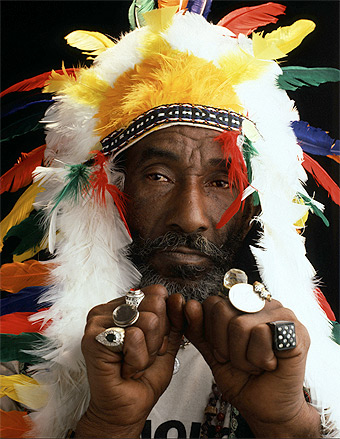 (The controversial Lee "Scratch" Perry)
Quite an introduction. His undisputed contributions to music coexist with bizarre episodes, and this mix results in one of the most intriguing musical biographies. In one of his most recent stunts, in 2002, he failed to board for São Paulo (where he would give two performances at Sesc Pompéia for the Dub Mamute festival) on the pretext that the plane ticket was cursed.
There were quite a few disappointed people and some asked for a refund of their ticket money. But those who chose to watch the other shows in the program did not regret it. The other protagonist of the festival, Mad Professor stood in for his partner Perry's band and cleansed the souls of those present. "Sun Is Shining", "Police And Thieves", "Burnin' and Lootin'", "Chase The Devil" and "War In a Babylon" were some of the topics covered in the live dub lesson that Sesc watched over two (or three?) nights.
Before canceling his departure, in an interview by Cláudia Assef for Folha de São Paulo, Perry promised: "after me, the country will be called 'Scratchzil'". In the same article, he commented on other legendary bizarre acts he starred in. In 1983, he set fire to his Black Ark believing the devil was circulating through the place. "And I didn't build another (studio) because I don't want to help Jamaica. They've already stolen enough from me" - says Perry.
(The controversial Lee "Scratch" Perry)
Quite an introduction. His undisputed contributions to music coexist with bizarre episodes, and this mix results in one of the most intriguing musical biographies. In one of his most recent stunts, in 2002, he failed to board for São Paulo (where he would give two performances at Sesc Pompéia for the Dub Mamute festival) on the pretext that the plane ticket was cursed.
There were quite a few disappointed people and some asked for a refund of their ticket money. But those who chose to watch the other shows in the program did not regret it. The other protagonist of the festival, Mad Professor stood in for his partner Perry's band and cleansed the souls of those present. "Sun Is Shining", "Police And Thieves", "Burnin' and Lootin'", "Chase The Devil" and "War In a Babylon" were some of the topics covered in the live dub lesson that Sesc watched over two (or three?) nights.
Before canceling his departure, in an interview by Cláudia Assef for Folha de São Paulo, Perry promised: "after me, the country will be called 'Scratchzil'". In the same article, he commented on other legendary bizarre acts he starred in. In 1983, he set fire to his Black Ark believing the devil was circulating through the place. "And I didn't build another (studio) because I don't want to help Jamaica. They've already stolen enough from me" - says Perry.
 They stole my tapes and didn't know how to appreciate my music. Bob Marley didn't even exist when I showed up. I wrote "Jah Live". If he had really written it, Jah wouldn't have let him die. Jah will return, will return.
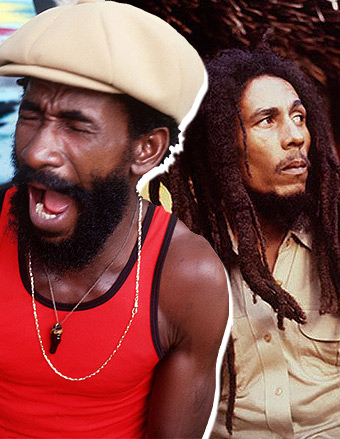 With this lineup, Bob Marley & The Wailers recorded "Soul Rebels". Released by Trojan Records, the album was the group's first to hit the international market. Musically, the new formation resulted in a leap in the Wailers' sound. In the Marley biography "Queimando Tudo", author Timothy White explains the change this way: "Working with the Wailers, Perry developed them to the point of becoming a unit with a strong rock propensity that typified the best in the exploration of reggae's early days. It was Scratch who redirected the group in musical and vocal terms.
He insisted that Bob change his loose way of singing and Marley's vocals suddenly became powerful, melancholic, free from the foolish gymnastics of trills that sometimes ruined the Wailers' 45-rpm ska and rocksteady records," he writes. And adds: "And Perry was not obsessed with horns like so many other Jamaican producers; he preferred a hardened rhythm guitar that could stick to punchy grooves and revolve around the bass line, which he allowed to come to the foreground.
Carl Barrett was a genius in the reggae "one drop" beat style (...) and had an accent that seemed like the first wild shake inside the snake den. Time was marked with considerable weight, volatile, insistent like a spoiled child."
Metaphors aside, while White prefers to attribute the transformation of the sound to an approximation with rock, another writer finds greater coherence in the comparison with American funk. According to Davit Katz, author of "People Funny Boy" (Lee Perry's biography), "James Brown was especially a strong influence" on those recordings. "Lee Scratch Perry confirms that Marley came to him with 'My Cup', a mutation of James Brown's recording 'Guess I've Got To Cry, Cry, Cry'. Perry felt unable to refuse it. And so a new phase of reggae began."
With this lineup, Bob Marley & The Wailers recorded "Soul Rebels". Released by Trojan Records, the album was the group's first to hit the international market. Musically, the new formation resulted in a leap in the Wailers' sound. In the Marley biography "Queimando Tudo", author Timothy White explains the change this way: "Working with the Wailers, Perry developed them to the point of becoming a unit with a strong rock propensity that typified the best in the exploration of reggae's early days. It was Scratch who redirected the group in musical and vocal terms.
He insisted that Bob change his loose way of singing and Marley's vocals suddenly became powerful, melancholic, free from the foolish gymnastics of trills that sometimes ruined the Wailers' 45-rpm ska and rocksteady records," he writes. And adds: "And Perry was not obsessed with horns like so many other Jamaican producers; he preferred a hardened rhythm guitar that could stick to punchy grooves and revolve around the bass line, which he allowed to come to the foreground.
Carl Barrett was a genius in the reggae "one drop" beat style (...) and had an accent that seemed like the first wild shake inside the snake den. Time was marked with considerable weight, volatile, insistent like a spoiled child."
Metaphors aside, while White prefers to attribute the transformation of the sound to an approximation with rock, another writer finds greater coherence in the comparison with American funk. According to Davit Katz, author of "People Funny Boy" (Lee Perry's biography), "James Brown was especially a strong influence" on those recordings. "Lee Scratch Perry confirms that Marley came to him with 'My Cup', a mutation of James Brown's recording 'Guess I've Got To Cry, Cry, Cry'. Perry felt unable to refuse it. And so a new phase of reggae began."
 Click now and read the second part of this column.
(Cover of the album "War Ina Babylon")
CANE IN SAMPA
(The controversial Lee "Scratch" Perry)
They stole my tapes and didn't know how to appreciate my music. Bob Marley didn't even exist when I showed up. I wrote "Jah Live". If he had really written it, Jah wouldn't have let him die. Jah will return, will return.
DREAM TEAM
The "beef" between Marley and Perry is not limited to the question of authorship of this or other songs. The fertile partnership did not take long to stir up the explosive temperaments of both. At the turn of the 60s to the 70s, they worked together intensely. The Wailers found in the company of the Upsetters – the studio band recruited by Perry – the instrumental comfort for the vocal harmonies. There was a lot of talented musician together. To the front trio (formed by Marley, Peter Tosh and Bunny Wailer) were added the Barret brothers – Aston "Family Man" (bass) and Carlton (drums), a tightly tuned defensive pair –, guitarist Alva Lewis and keyboardist Glen Adams (ex-Heptones). A complete team under the direction of Lee Perry.
SECOND PART
Click now and read the second part of this column.Category
#Reggae