
Reggae · August 22, 2003
Check the interview, ideology and plans of the reggae band Namastê!
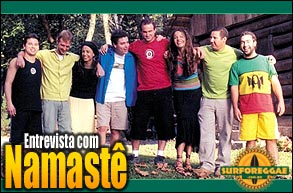
 Toni – How did it all begin?
Vilma: In reality the band started in Ponta Grossa, five years ago. At the beginning, it was me, Ana and Eduardo in this lineup, and we started playing with people who already worked with music in Ponta Grossa — my brother Everton and Ricardo, another drummer we had. Everton played bass, and my brother Beto played keyboard and sang. So the band started more or less with that structure, in which Ana and I only did backing vocals, and Eduardo played guitar. But then within that period we returned from Ponta Grossa to Curitiba. By the way, we are from Curitiba; we were there because of the band. The guys worked with music there, where the story ended up beginning.
We returned to Curitiba, and then the band also began to change. Other people came in — people from Cape Verde who lived here, another vocalist, another percussionist and a new singer. The band had several lineups during that time, during those five years. From two years ago, Diego came in on guitar, Wellington on bass, Rodrigo on keyboards, and Rafael who had already started on drums, and the last vocalist Fabinho left. Then we decided to take a stand and assume a real identity for the band, even regarding recording, counting on the female side — Ana and me. So the lineup closed that way, some time passed and Samuel came in on saxophone, and we have been playing like this for three years.
The band's story unfolds through these lineups. Sometimes we even ask ourselves: "Wow, it took us a long time to record," but that was our story, until we arrived and agreed that this is the crew that will stay, that will embrace the same idea. And today we have this characteristic — Ana and I on vocals, the guys also gave a whole new face instrumentally, they brought their own characteristics. We don't have brass for now; we have sax, which Samuel plays. In August it will be one year since our first CD, and the band's story also began to change because of that first CD, which was more of a return for the band regarding changes, investing in this identity of the band, and it was totally necessary. Here in Curitiba there is this shortage of bands making their own songs, not doing covers, which is also important.
Toni – And how did the first CD come about?
Eduardo: Close to what Vilma said, we waited to stabilize a lineup to be able to record. And in a year and a half, we were running after people to prepare, because we already had the songs well before. In fact we first looked to stabilize ourselves; Diego also brought new songs. It was no use releasing the CD if we were going through a series of changes — more than 15 people passed through the band. It was no use us wanting to record something, because recording a CD one way and another another way would not work out well; ideas change. First the lineup stabilized, then we recorded. The CD was a bit of a rush; we already had a lot ready, but we also did a lot in the studio, to have our own identity.
Vilma: It was an independent production; there was no record company or anything like that. It was putting things together, at first through compilation proposals. Like, in 1996, we had that thing of having at least three songs recorded to get into a compilation. So that was kind of an impulse, even in a way credibility — you think… "wow, someone, somehow, is already believing in your songs." And it was from those songs that we recorded the others, and people got to know those songs, and we closed the CD. But it was a long process, also because of money and our experience. Today we live the result of that; sometimes we play, even in very distant places, different in terms of ticket price and so on, you know?
Distinct places we never imagined what would come of it. Even today we keep getting to know our audience and don't know what will happen, even because of money — sometimes some people can't afford to pay to get into some places. But the cool thing is we see there is a crowd that really likes it, but at the same time it is hard to test that through the places we play. For example, we did a show a few days ago at UFPR, at the Polytechnic Center, and it was a crowd, both from the neighborhood and from far away. And people sang our songs; it was surprising, because I at least did not expect it. And that has to do with the CD — people get to know what is yours and go after the CD.
Toni – And your support? Who promotes you most, the radio stations?
Eduardo: Yeah, the parties, the songs, that's where they play most. But what really promotes is the show itself; radio has a limit. 96fm (www.96radiorock.com.br) is opening space now for local bands, giving good support, doing projects, but promotion is much more through shows than through their own promotion. So our songs became similar — one because we play a lot, so much that we made the CD, which records our idea, the person takes it home, listens, memorizes lyrics, learns, likes, and another because radio I think would come in fourth place. Normally promotion is done first by radio, then the CD, then the show.
But our process I think is the opposite — first the show, because the CD takes time to come, and then radio, which starts with interest when you are already beginning to be independent and starts to promote and strengthen your work even more. Radio wants an immediate return, on the spot, and here in Curitiba there are no entrepreneurs to invest in a regional band, so there is no way to have a quick return.
Toni – Your expectations for CD, shows, the future?
Eduardo: We are planning to make another CD to release, who knows, at Christmas; everything is moving forward, but our process is slower than a band that already has a structure that can maintain a career, where the label goes and backs it, and in about four months the CD is ready. Our process is much slower; we have to do shows, arrange the songs, arrange sponsorship to make the CD, or pay out of our own pocket. It is a process that only in one year, a year and a half, two years, will work out.
Ana: And also, there is the issue of the first CD — people sometimes feel a bit saturated with the work. But there is a process; we are working outside Curitiba, and for people from outside, our first CD has not arrived yet. So it is still fresh, although here many people already expect the next CD. But if we had conditions to go out and promote our first CD elsewhere, it would not saturate so much here, and we would have time to record the CD. So the band would always be updating itself.
Eduardo: We went to Porto Alegre now, and although in August it will be one year since we released this CD, only now will it be promoted there, after six months. So a band that already has a label releases the CD and it is already promoted in the media throughout Brazil. And we promote as opportunities appear.
Toni – Will the band keep the original style, or add brass later?
Eduardo: Yeah, we already worked with brass; in the studio we recorded some songs with brass. I believe the lineup today is already stabilized; adding or removing a person today is very complicated, especially since we are eight people, besides the crew. Because the person coming in has to get into our rhythm, and that's complicated. The guy who comes in can be an excellent musician, but it is work rhythm, which is another thing. So for us, I think this lineup is the good one, that closed with our style.
Toni – And relationships between bands?
Eduardo: Ah, there is unity because of the same interests, but in truth a lot is still missing. Bands get along off stage, exchange ideas, but when it comes to organizing something involving everyone, it's complicated. For example, if we organize a reggae festival, no band will want to play last, or first. So it is a matter of interest, and saying we are all united is a lie. And that in any work — reggae in Curitiba is strong, the crowd really digs it. But organizing things together is still an illusion.
Vilma: But there is nothing one against the other; that is pettiness, it does not even reach the level of bands, I think in any relationship in life, sometimes it is pettiness of people that mess up band-to-band relationships, and then you see each band's maturity.
Eduardo: Selfishness, for example — the band has a name, the venue calls you because of the name, the house packs, and the next day the guy does not want you anymore, calls another band with a lower fee. That opportunism rolls, money involved, people lose a bit of value.
Toni – Tell us about your rehearsal space?
Vilma: We rehearse at Rafael's house; we rehearse a bit in a studio, but you have to pay. And at Rafael's there is space, his drum kit is already there, the amps are there too. So it is more an organizational matter for us, schedules matching, making things work, each one has their interests. What is hard to preserve in routine, in daily life. A band is not just playing — there is sound check, problems, creation, someone who does not like the creation, someone who does not like your song. That influences; sometimes it helps, sometimes it hinders the process. They are internal things, but I think we always resolve them, we move forward slowly, but we are going. Now we will try to play outside. Good news always comes that encourages in a way, that gives more spirit.
Toni – How did it all begin?
Vilma: In reality the band started in Ponta Grossa, five years ago. At the beginning, it was me, Ana and Eduardo in this lineup, and we started playing with people who already worked with music in Ponta Grossa — my brother Everton and Ricardo, another drummer we had. Everton played bass, and my brother Beto played keyboard and sang. So the band started more or less with that structure, in which Ana and I only did backing vocals, and Eduardo played guitar. But then within that period we returned from Ponta Grossa to Curitiba. By the way, we are from Curitiba; we were there because of the band. The guys worked with music there, where the story ended up beginning.
We returned to Curitiba, and then the band also began to change. Other people came in — people from Cape Verde who lived here, another vocalist, another percussionist and a new singer. The band had several lineups during that time, during those five years. From two years ago, Diego came in on guitar, Wellington on bass, Rodrigo on keyboards, and Rafael who had already started on drums, and the last vocalist Fabinho left. Then we decided to take a stand and assume a real identity for the band, even regarding recording, counting on the female side — Ana and me. So the lineup closed that way, some time passed and Samuel came in on saxophone, and we have been playing like this for three years.
The band's story unfolds through these lineups. Sometimes we even ask ourselves: "Wow, it took us a long time to record," but that was our story, until we arrived and agreed that this is the crew that will stay, that will embrace the same idea. And today we have this characteristic — Ana and I on vocals, the guys also gave a whole new face instrumentally, they brought their own characteristics. We don't have brass for now; we have sax, which Samuel plays. In August it will be one year since our first CD, and the band's story also began to change because of that first CD, which was more of a return for the band regarding changes, investing in this identity of the band, and it was totally necessary. Here in Curitiba there is this shortage of bands making their own songs, not doing covers, which is also important.
Toni – And how did the first CD come about?
Eduardo: Close to what Vilma said, we waited to stabilize a lineup to be able to record. And in a year and a half, we were running after people to prepare, because we already had the songs well before. In fact we first looked to stabilize ourselves; Diego also brought new songs. It was no use releasing the CD if we were going through a series of changes — more than 15 people passed through the band. It was no use us wanting to record something, because recording a CD one way and another another way would not work out well; ideas change. First the lineup stabilized, then we recorded. The CD was a bit of a rush; we already had a lot ready, but we also did a lot in the studio, to have our own identity.
Vilma: It was an independent production; there was no record company or anything like that. It was putting things together, at first through compilation proposals. Like, in 1996, we had that thing of having at least three songs recorded to get into a compilation. So that was kind of an impulse, even in a way credibility — you think… "wow, someone, somehow, is already believing in your songs." And it was from those songs that we recorded the others, and people got to know those songs, and we closed the CD. But it was a long process, also because of money and our experience. Today we live the result of that; sometimes we play, even in very distant places, different in terms of ticket price and so on, you know?
Distinct places we never imagined what would come of it. Even today we keep getting to know our audience and don't know what will happen, even because of money — sometimes some people can't afford to pay to get into some places. But the cool thing is we see there is a crowd that really likes it, but at the same time it is hard to test that through the places we play. For example, we did a show a few days ago at UFPR, at the Polytechnic Center, and it was a crowd, both from the neighborhood and from far away. And people sang our songs; it was surprising, because I at least did not expect it. And that has to do with the CD — people get to know what is yours and go after the CD.
Toni – And your support? Who promotes you most, the radio stations?
Eduardo: Yeah, the parties, the songs, that's where they play most. But what really promotes is the show itself; radio has a limit. 96fm (www.96radiorock.com.br) is opening space now for local bands, giving good support, doing projects, but promotion is much more through shows than through their own promotion. So our songs became similar — one because we play a lot, so much that we made the CD, which records our idea, the person takes it home, listens, memorizes lyrics, learns, likes, and another because radio I think would come in fourth place. Normally promotion is done first by radio, then the CD, then the show.
But our process I think is the opposite — first the show, because the CD takes time to come, and then radio, which starts with interest when you are already beginning to be independent and starts to promote and strengthen your work even more. Radio wants an immediate return, on the spot, and here in Curitiba there are no entrepreneurs to invest in a regional band, so there is no way to have a quick return.
Toni – Your expectations for CD, shows, the future?
Eduardo: We are planning to make another CD to release, who knows, at Christmas; everything is moving forward, but our process is slower than a band that already has a structure that can maintain a career, where the label goes and backs it, and in about four months the CD is ready. Our process is much slower; we have to do shows, arrange the songs, arrange sponsorship to make the CD, or pay out of our own pocket. It is a process that only in one year, a year and a half, two years, will work out.
Ana: And also, there is the issue of the first CD — people sometimes feel a bit saturated with the work. But there is a process; we are working outside Curitiba, and for people from outside, our first CD has not arrived yet. So it is still fresh, although here many people already expect the next CD. But if we had conditions to go out and promote our first CD elsewhere, it would not saturate so much here, and we would have time to record the CD. So the band would always be updating itself.
Eduardo: We went to Porto Alegre now, and although in August it will be one year since we released this CD, only now will it be promoted there, after six months. So a band that already has a label releases the CD and it is already promoted in the media throughout Brazil. And we promote as opportunities appear.
Toni – Will the band keep the original style, or add brass later?
Eduardo: Yeah, we already worked with brass; in the studio we recorded some songs with brass. I believe the lineup today is already stabilized; adding or removing a person today is very complicated, especially since we are eight people, besides the crew. Because the person coming in has to get into our rhythm, and that's complicated. The guy who comes in can be an excellent musician, but it is work rhythm, which is another thing. So for us, I think this lineup is the good one, that closed with our style.
Toni – And relationships between bands?
Eduardo: Ah, there is unity because of the same interests, but in truth a lot is still missing. Bands get along off stage, exchange ideas, but when it comes to organizing something involving everyone, it's complicated. For example, if we organize a reggae festival, no band will want to play last, or first. So it is a matter of interest, and saying we are all united is a lie. And that in any work — reggae in Curitiba is strong, the crowd really digs it. But organizing things together is still an illusion.
Vilma: But there is nothing one against the other; that is pettiness, it does not even reach the level of bands, I think in any relationship in life, sometimes it is pettiness of people that mess up band-to-band relationships, and then you see each band's maturity.
Eduardo: Selfishness, for example — the band has a name, the venue calls you because of the name, the house packs, and the next day the guy does not want you anymore, calls another band with a lower fee. That opportunism rolls, money involved, people lose a bit of value.
Toni – Tell us about your rehearsal space?
Vilma: We rehearse at Rafael's house; we rehearse a bit in a studio, but you have to pay. And at Rafael's there is space, his drum kit is already there, the amps are there too. So it is more an organizational matter for us, schedules matching, making things work, each one has their interests. What is hard to preserve in routine, in daily life. A band is not just playing — there is sound check, problems, creation, someone who does not like the creation, someone who does not like your song. That influences; sometimes it helps, sometimes it hinders the process. They are internal things, but I think we always resolve them, we move forward slowly, but we are going. Now we will try to play outside. Good news always comes that encourages in a way, that gives more spirit.
EVENT IMAGES
 Click here and see some photos of the reggae band Namastê.
MORE INFORMATION
Click here to learn more about the artist.Category
#Reggae