
Reggae · August 21, 2004
Surforeggae interviews Cidade Negra about the new album, their ideology, and more!
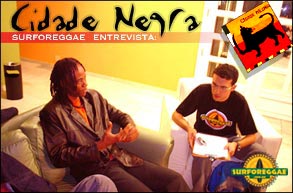
Cidade Negra, one of the leading bands of Brazilian Reggae, releases its newest album titled "Perto de Deus", which has everyone talking. The band, originally from Belford Roxo, turned back to its own roots! It was a whole arrangement, mixing, and production effort that is clearly more "roots".
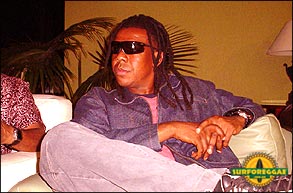
With the interview scheduled for 6:00 PM on the 20th, we went to the rooftop suite of the Imperial Hall hotel in São Paulo, where the band was giving short interviews for several media outlets. Right at the beginning, Da Gama, the band's guitarist, could not hide his surprise when he saw the Surforeggae team, since we have a strong partnership with one of his side projects, the radio show "Cidade do Reggae". Without further delay, let's get to the interview.
Note: The words marked with an asterisk have their meaning at the end of the page.
 Surforeggae: What led Cidade Negra to mix the new album in Jamaica?
 Da Gama: Our first contact with Jamaica came through shows and a music video, and we saw the need to strengthen ties with Jamaican producers so we could bring that special touch to our project. It is an honor to work with major names like Colin "Bulby" York*, one of the producers from the final phase of Studio One*, who was also a DJ; in fact, in Jamaica it is already traditional for great DJs to become great producers. For Cidade Negra, it is very clear that we should join the best in Reggae, in the birthplace of Reggae, and all that experience would reflect in our work. This is a first step toward an album made 100% in Jamaica.
 (Listen to this excerpt)
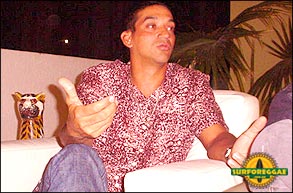 Lazão: Absolutely, the union of elements through the course of music is already in the blood, in its development. The dry drum intro, the silence... the bass line entering, the keyboards - in other words, an entire technique and "feeling" that have been explored for many years.
Da Gama: This closer connection is not only important for us, but also for Jamaicans themselves, who will be breathing the airs of MPB, which are natural to Cidade Negra. Pepeu Gomes, Luiz Melodia, Gilberto Gil, in short, mixing schools only strengthens this cultural exchange. And Reggae in Brazil, as you from Surforeggae know very well, is growing a lot, and even if it does not appear in mainstream media like Xuxa or Faustão, it has great strength in an alternative parallel market... the independent scene.
(Listen to this excerpt)
Surforeggae: Whose idea was it to invite Anthony B.* to take part in the track "Perto de Deus"?
Bino Farias: Actually, our first choice was Buju Banton, but he was out of Jamaica, traveling, and Anthony B. ended up being a great choice, since he is a church pastor and the song has a religious tone.
(Listen to this excerpt)
Lazão: Absolutely, the union of elements through the course of music is already in the blood, in its development. The dry drum intro, the silence... the bass line entering, the keyboards - in other words, an entire technique and "feeling" that have been explored for many years.
Da Gama: This closer connection is not only important for us, but also for Jamaicans themselves, who will be breathing the airs of MPB, which are natural to Cidade Negra. Pepeu Gomes, Luiz Melodia, Gilberto Gil, in short, mixing schools only strengthens this cultural exchange. And Reggae in Brazil, as you from Surforeggae know very well, is growing a lot, and even if it does not appear in mainstream media like Xuxa or Faustão, it has great strength in an alternative parallel market... the independent scene.
(Listen to this excerpt)
Surforeggae: Whose idea was it to invite Anthony B.* to take part in the track "Perto de Deus"?
Bino Farias: Actually, our first choice was Buju Banton, but he was out of Jamaica, traveling, and Anthony B. ended up being a great choice, since he is a church pastor and the song has a religious tone.
(Listen to this excerpt)
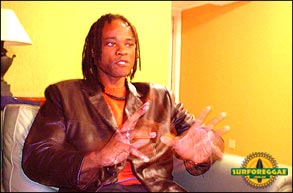 Da Gama: The mix certainly worked very well, not only because of Anthony's experience, but because the song helps on that ideological side.
Surforeggae: Jamaican music, although rich, is not widely promoted worldwide. Here in Brazil, did you have any difficulty producing an album with a more evident Reggae approach?
Toni Garrido: With the versatility of information nowadays, everyone is more tuned in and ends up getting quick access to releases and news, without depending so much on mainstream media - you at Surforeggae know this and work with it. The internet became a great tool to make this possible, where reggae can circulate with more authority among people who like the style and interact with one another. Since we were in Jamaica, there was no difficulty at all, quite the opposite. There you find the best producers, the beats, the reggae elements... man... that place is an oasis, haha.
Surforeggae: What is your view on Rastafarianism? Marcus Garvey* and the Lion of the Tribe of Judah* were mentioned in the song "Homem que faz a guerra" with rapper Rappin Hood.
Da Gama: Great Rappin Hood... many people will be surprised by his relationship with reggae. He is a guy who has known reggae for a long time, a fan of Bob Marley, and he cited Marcus Garvey with great authority. On his first album, he was already talking about a Reggae and Rap union, and he has always shown his admiration for the band. The mention of Marcus Garvey was cool because it brought us closer to our references. Really a great move.
(Listen to this excerpt)
Da Gama: The mix certainly worked very well, not only because of Anthony's experience, but because the song helps on that ideological side.
Surforeggae: Jamaican music, although rich, is not widely promoted worldwide. Here in Brazil, did you have any difficulty producing an album with a more evident Reggae approach?
Toni Garrido: With the versatility of information nowadays, everyone is more tuned in and ends up getting quick access to releases and news, without depending so much on mainstream media - you at Surforeggae know this and work with it. The internet became a great tool to make this possible, where reggae can circulate with more authority among people who like the style and interact with one another. Since we were in Jamaica, there was no difficulty at all, quite the opposite. There you find the best producers, the beats, the reggae elements... man... that place is an oasis, haha.
Surforeggae: What is your view on Rastafarianism? Marcus Garvey* and the Lion of the Tribe of Judah* were mentioned in the song "Homem que faz a guerra" with rapper Rappin Hood.
Da Gama: Great Rappin Hood... many people will be surprised by his relationship with reggae. He is a guy who has known reggae for a long time, a fan of Bob Marley, and he cited Marcus Garvey with great authority. On his first album, he was already talking about a Reggae and Rap union, and he has always shown his admiration for the band. The mention of Marcus Garvey was cool because it brought us closer to our references. Really a great move.
(Listen to this excerpt)
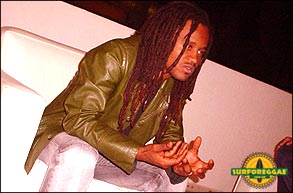 Toni Garrido: Despite the references to Rastafarianism, no one here is Rastafari... but we clearly have it as a reference. Being or not being rasta has nothing to do with your clothes or hair, but with attitude and your way of seeing and living life. We are not formally aligned with Rastafarianism because Da Gama leans more Baptist, Bino is more evangelical, Lazão and I are more on the spiritual side - in short, we are not followers of the ideology in a religious sense. The cool part of Rastafarianism is its ideological and anthropological spread, black pride in wearing long hair, and always staying connected to one's origins, and reggae is an instrument of that movement, which seeks calm, justice, and peace.
Bino Farias: And there is also the social issue, valuing Black people... the self-esteem of Black people.
Da Gama: Marcus Garvey fits this very well, because he is a very politicized pastor who always fought social issues, kind of like a Lula, a union leader, who elevated social struggle with spiritual struggle, going far beyond the philosophical matter.
Toni Garrido: There is this idea that every Black person should, at least once, go to Africa, the motherland. Africa was heavily invaded by European peoples and there is a need to look at it in terms of protection, because without this awareness it may end up being extinguished. Black people with money in Africa and outside it should help more in this strengthening and preservation. In Ethiopia, Emperor Haile Selassié resisted invasions, fought, and paid for it with more political and physical attacks.
Da Gama: And that photo is incredible... a great response to the attacks, as if saying: "We are here, come on!".
Toni Garrido: It is a horrible photo, caused by another horrible event. It was not truly a neo-pacifist response.
Toni Garrido: Despite the references to Rastafarianism, no one here is Rastafari... but we clearly have it as a reference. Being or not being rasta has nothing to do with your clothes or hair, but with attitude and your way of seeing and living life. We are not formally aligned with Rastafarianism because Da Gama leans more Baptist, Bino is more evangelical, Lazão and I are more on the spiritual side - in short, we are not followers of the ideology in a religious sense. The cool part of Rastafarianism is its ideological and anthropological spread, black pride in wearing long hair, and always staying connected to one's origins, and reggae is an instrument of that movement, which seeks calm, justice, and peace.
Bino Farias: And there is also the social issue, valuing Black people... the self-esteem of Black people.
Da Gama: Marcus Garvey fits this very well, because he is a very politicized pastor who always fought social issues, kind of like a Lula, a union leader, who elevated social struggle with spiritual struggle, going far beyond the philosophical matter.
Toni Garrido: There is this idea that every Black person should, at least once, go to Africa, the motherland. Africa was heavily invaded by European peoples and there is a need to look at it in terms of protection, because without this awareness it may end up being extinguished. Black people with money in Africa and outside it should help more in this strengthening and preservation. In Ethiopia, Emperor Haile Selassié resisted invasions, fought, and paid for it with more political and physical attacks.
Da Gama: And that photo is incredible... a great response to the attacks, as if saying: "We are here, come on!".
Toni Garrido: It is a horrible photo, caused by another horrible event. It was not truly a neo-pacifist response.
 (See this photo).
Surforeggae: Lazão, what was it like to record Bob Marley's "Concret Jungle" with Sérgio Yazbek*? Any special reason?
Lazão: This song is part of Cidade Negra's history because we listened to it nonstop, and its content said a lot to us. For those who do not know, we did not make an adaptation, but a literal translation, because we had no intention whatsoever of saying anything more important than what Bob Marley already said.
Renato Surforeggae: And it also happened with Jimmy Cliff's "The Harder They Come", right? In a way the song became more well known with Cidade Negra itself.
Lazão: Certainly.
Surforeggae: I would like each of you to talk a little about the album "Perto de Deus".
Bino Farias: A professional accomplishment. Because of the Jamaican mixing and production, the final result, in short... done with the right people at the right time.
(See this photo).
Surforeggae: Lazão, what was it like to record Bob Marley's "Concret Jungle" with Sérgio Yazbek*? Any special reason?
Lazão: This song is part of Cidade Negra's history because we listened to it nonstop, and its content said a lot to us. For those who do not know, we did not make an adaptation, but a literal translation, because we had no intention whatsoever of saying anything more important than what Bob Marley already said.
Renato Surforeggae: And it also happened with Jimmy Cliff's "The Harder They Come", right? In a way the song became more well known with Cidade Negra itself.
Lazão: Certainly.
Surforeggae: I would like each of you to talk a little about the album "Perto de Deus".
Bino Farias: A professional accomplishment. Because of the Jamaican mixing and production, the final result, in short... done with the right people at the right time.
 Da Gama: Truly a project, as Bino said, in which we managed to surprise by bringing together great people. Paul Ralphes* is a genius as a producer and DJ, with his ideas, his dub insights, which gave an excellent sound to the work, together with Anthony B.*, Rappin Hood, Sérgio Yazbek, etc.
(Listen to this excerpt)
Surforeggae: How do you see the Brazilian Reggae scene?
Da Gama: We can say that we helped spread the rhythm, but we are "children" of a crowd that had already been making things happen for years. Edson Gomes, Gilberto Gil, Luiz Wagner, Luiz Melodia, who was the first to wear real dreadlocks in Brazil - in short, people who truly spread the style until it became what it is today. The current reggae scene is getting stronger and stronger all over the country, but record labels and producers need awareness that there IS a potential market for Reggae, so they can also support new talents.
Surforeggae: What Brazilian reggae have you been listening to lately?
Toni Garrido: There are two that I love... one is Banda Grave from Rio de Janeiro, and the other is Enganjaduz, which has a Raggamuffin and hip-hop approach...
Rangel Surforeggae: They will even be at one of our events... (see event).
Toni Garrido: Very cool... Very cool...
Da Gama: Célia Sampaio, Walking Lions, Dagô Miranda, who has an album with a fantastic sound...
Lazão: Vell Rangel...
Surforeggae: The internet has become a strong publicity weapon for small bands. As they grow disproportionately, they forget basic foundations such as good recording, rehearsals, etc. What do you think about that?
Toni Garrido: You have to PLAY first and then PUBLICIZE! There are bands that play very little but promote a lot... since the internet is full of possibilities, a kid who knows computers well plugs in his little guitar, records a CD in "ProTools", distributes it around, and when he goes live, he is stiff, unprepared on stage... and there are many lazy people, they do not want to work on the music, they make their own sound as if they were recording a "jingle", they do not rehearse... the versatility of the internet deceives many music adventurers.
Da Gama: I agree, but there is also the point that it really is easier to book shows, so the band keeps practicing, traveling, and if that is aligned with serious work, there will certainly be a chance of some success.
Surforeggae: We at Surforeggae thank you for your attention, especially because we know you are doing many interviews, and we also thank you for the opportunity to learn more about the new work and the band.
Toni Garrido: It was a pleasure to receive you...
Lazão: Hey, I want a Surforeggae T-shirt, okay?
Renato Surforeggae: I will send one to Da Gama...
From there, Toni Garrido and Lazão start joking, making the atmosphere even more relaxed. This contact shows not only Cidade Negra's deep knowledge and experience in Reggae, but also a humble band that deserves everyone's respect.
Paul Ralphes: Former English bassist, DJ and producer.
Lion of the Tribe of Judah: Conquering lion of the tribe of Judah, the savior.
Haile Selassié I: First emperor of Ethiopia.
Marcus Garvey: Leader of the Black movement in the USA and Jamaica at the beginning of the century.
Colin "Bulby" York: Famous producer from the final phase of Studio One.
Studio One: Legendary hybrid of studio, label and distributor in Jamaica.
Rastafarianism: Movement to reconnect with African roots among peoples who were forcibly displaced by slavery contingencies.
Sérgio Yazbek: Recorded killer guitars on the Polygamya album, and current guitarist of Cidade Negra.
Anthony B.: Famous Jamaican DJ and producer.
See interview photos and citation images.
Click here and learn more about the band.
Official Website: www.cidadenegra.com.br
Cidade do Reggae radio website: www.radiocidade.fm
Da Gama: Truly a project, as Bino said, in which we managed to surprise by bringing together great people. Paul Ralphes* is a genius as a producer and DJ, with his ideas, his dub insights, which gave an excellent sound to the work, together with Anthony B.*, Rappin Hood, Sérgio Yazbek, etc.
(Listen to this excerpt)
Surforeggae: How do you see the Brazilian Reggae scene?
Da Gama: We can say that we helped spread the rhythm, but we are "children" of a crowd that had already been making things happen for years. Edson Gomes, Gilberto Gil, Luiz Wagner, Luiz Melodia, who was the first to wear real dreadlocks in Brazil - in short, people who truly spread the style until it became what it is today. The current reggae scene is getting stronger and stronger all over the country, but record labels and producers need awareness that there IS a potential market for Reggae, so they can also support new talents.
Surforeggae: What Brazilian reggae have you been listening to lately?
Toni Garrido: There are two that I love... one is Banda Grave from Rio de Janeiro, and the other is Enganjaduz, which has a Raggamuffin and hip-hop approach...
Rangel Surforeggae: They will even be at one of our events... (see event).
Toni Garrido: Very cool... Very cool...
Da Gama: Célia Sampaio, Walking Lions, Dagô Miranda, who has an album with a fantastic sound...
Lazão: Vell Rangel...
Surforeggae: The internet has become a strong publicity weapon for small bands. As they grow disproportionately, they forget basic foundations such as good recording, rehearsals, etc. What do you think about that?
Toni Garrido: You have to PLAY first and then PUBLICIZE! There are bands that play very little but promote a lot... since the internet is full of possibilities, a kid who knows computers well plugs in his little guitar, records a CD in "ProTools", distributes it around, and when he goes live, he is stiff, unprepared on stage... and there are many lazy people, they do not want to work on the music, they make their own sound as if they were recording a "jingle", they do not rehearse... the versatility of the internet deceives many music adventurers.
Da Gama: I agree, but there is also the point that it really is easier to book shows, so the band keeps practicing, traveling, and if that is aligned with serious work, there will certainly be a chance of some success.
Surforeggae: We at Surforeggae thank you for your attention, especially because we know you are doing many interviews, and we also thank you for the opportunity to learn more about the new work and the band.
Toni Garrido: It was a pleasure to receive you...
Lazão: Hey, I want a Surforeggae T-shirt, okay?
Renato Surforeggae: I will send one to Da Gama...
From there, Toni Garrido and Lazão start joking, making the atmosphere even more relaxed. This contact shows not only Cidade Negra's deep knowledge and experience in Reggae, but also a humble band that deserves everyone's respect.
Paul Ralphes: Former English bassist, DJ and producer.
Lion of the Tribe of Judah: Conquering lion of the tribe of Judah, the savior.
Haile Selassié I: First emperor of Ethiopia.
Marcus Garvey: Leader of the Black movement in the USA and Jamaica at the beginning of the century.
Colin "Bulby" York: Famous producer from the final phase of Studio One.
Studio One: Legendary hybrid of studio, label and distributor in Jamaica.
Rastafarianism: Movement to reconnect with African roots among peoples who were forcibly displaced by slavery contingencies.
Sérgio Yazbek: Recorded killer guitars on the Polygamya album, and current guitarist of Cidade Negra.
Anthony B.: Famous Jamaican DJ and producer.
See interview photos and citation images.
Click here and learn more about the band.
Official Website: www.cidadenegra.com.br
Cidade do Reggae radio website: www.radiocidade.fm
THE INTERVIEW
Surforeggae: What led Cidade Negra to mix the new album in Jamaica?
Da Gama: Our first contact with Jamaica came through shows and a music video, and we saw the need to strengthen ties with Jamaican producers so we could bring that special touch to our project. It is an honor to work with major names like Colin "Bulby" York*, one of the producers from the final phase of Studio One*, who was also a DJ; in fact, in Jamaica it is already traditional for great DJs to become great producers. For Cidade Negra, it is very clear that we should join the best in Reggae, in the birthplace of Reggae, and all that experience would reflect in our work. This is a first step toward an album made 100% in Jamaica.
(Listen to this excerpt)
Lazão: Absolutely, the union of elements through the course of music is already in the blood, in its development. The dry drum intro, the silence... the bass line entering, the keyboards - in other words, an entire technique and "feeling" that have been explored for many years.
Da Gama: This closer connection is not only important for us, but also for Jamaicans themselves, who will be breathing the airs of MPB, which are natural to Cidade Negra. Pepeu Gomes, Luiz Melodia, Gilberto Gil, in short, mixing schools only strengthens this cultural exchange. And Reggae in Brazil, as you from Surforeggae know very well, is growing a lot, and even if it does not appear in mainstream media like Xuxa or Faustão, it has great strength in an alternative parallel market... the independent scene.
(Listen to this excerpt)
Surforeggae: Whose idea was it to invite Anthony B.* to take part in the track "Perto de Deus"?
Bino Farias: Actually, our first choice was Buju Banton, but he was out of Jamaica, traveling, and Anthony B. ended up being a great choice, since he is a church pastor and the song has a religious tone.
(Listen to this excerpt)
Da Gama: The mix certainly worked very well, not only because of Anthony's experience, but because the song helps on that ideological side.
Surforeggae: Jamaican music, although rich, is not widely promoted worldwide. Here in Brazil, did you have any difficulty producing an album with a more evident Reggae approach?
Toni Garrido: With the versatility of information nowadays, everyone is more tuned in and ends up getting quick access to releases and news, without depending so much on mainstream media - you at Surforeggae know this and work with it. The internet became a great tool to make this possible, where reggae can circulate with more authority among people who like the style and interact with one another. Since we were in Jamaica, there was no difficulty at all, quite the opposite. There you find the best producers, the beats, the reggae elements... man... that place is an oasis, haha.
Surforeggae: What is your view on Rastafarianism? Marcus Garvey* and the Lion of the Tribe of Judah* were mentioned in the song "Homem que faz a guerra" with rapper Rappin Hood.
Da Gama: Great Rappin Hood... many people will be surprised by his relationship with reggae. He is a guy who has known reggae for a long time, a fan of Bob Marley, and he cited Marcus Garvey with great authority. On his first album, he was already talking about a Reggae and Rap union, and he has always shown his admiration for the band. The mention of Marcus Garvey was cool because it brought us closer to our references. Really a great move.
(Listen to this excerpt)
Toni Garrido: Despite the references to Rastafarianism, no one here is Rastafari... but we clearly have it as a reference. Being or not being rasta has nothing to do with your clothes or hair, but with attitude and your way of seeing and living life. We are not formally aligned with Rastafarianism because Da Gama leans more Baptist, Bino is more evangelical, Lazão and I are more on the spiritual side - in short, we are not followers of the ideology in a religious sense. The cool part of Rastafarianism is its ideological and anthropological spread, black pride in wearing long hair, and always staying connected to one's origins, and reggae is an instrument of that movement, which seeks calm, justice, and peace.
Bino Farias: And there is also the social issue, valuing Black people... the self-esteem of Black people.
Da Gama: Marcus Garvey fits this very well, because he is a very politicized pastor who always fought social issues, kind of like a Lula, a union leader, who elevated social struggle with spiritual struggle, going far beyond the philosophical matter.
Toni Garrido: There is this idea that every Black person should, at least once, go to Africa, the motherland. Africa was heavily invaded by European peoples and there is a need to look at it in terms of protection, because without this awareness it may end up being extinguished. Black people with money in Africa and outside it should help more in this strengthening and preservation. In Ethiopia, Emperor Haile Selassié resisted invasions, fought, and paid for it with more political and physical attacks.
Da Gama: And that photo is incredible... a great response to the attacks, as if saying: "We are here, come on!".
Toni Garrido: It is a horrible photo, caused by another horrible event. It was not truly a neo-pacifist response.
(See this photo).
Surforeggae: Lazão, what was it like to record Bob Marley's "Concret Jungle" with Sérgio Yazbek*? Any special reason?
Lazão: This song is part of Cidade Negra's history because we listened to it nonstop, and its content said a lot to us. For those who do not know, we did not make an adaptation, but a literal translation, because we had no intention whatsoever of saying anything more important than what Bob Marley already said.
Renato Surforeggae: And it also happened with Jimmy Cliff's "The Harder They Come", right? In a way the song became more well known with Cidade Negra itself.
Lazão: Certainly.
Surforeggae: I would like each of you to talk a little about the album "Perto de Deus".
Bino Farias: A professional accomplishment. Because of the Jamaican mixing and production, the final result, in short... done with the right people at the right time.
Da Gama: Truly a project, as Bino said, in which we managed to surprise by bringing together great people. Paul Ralphes* is a genius as a producer and DJ, with his ideas, his dub insights, which gave an excellent sound to the work, together with Anthony B.*, Rappin Hood, Sérgio Yazbek, etc.
(Listen to this excerpt)
Surforeggae: How do you see the Brazilian Reggae scene?
Da Gama: We can say that we helped spread the rhythm, but we are "children" of a crowd that had already been making things happen for years. Edson Gomes, Gilberto Gil, Luiz Wagner, Luiz Melodia, who was the first to wear real dreadlocks in Brazil - in short, people who truly spread the style until it became what it is today. The current reggae scene is getting stronger and stronger all over the country, but record labels and producers need awareness that there IS a potential market for Reggae, so they can also support new talents.
Surforeggae: What Brazilian reggae have you been listening to lately?
Toni Garrido: There are two that I love... one is Banda Grave from Rio de Janeiro, and the other is Enganjaduz, which has a Raggamuffin and hip-hop approach...
Rangel Surforeggae: They will even be at one of our events... (see event).
Toni Garrido: Very cool... Very cool...
Da Gama: Célia Sampaio, Walking Lions, Dagô Miranda, who has an album with a fantastic sound...
Lazão: Vell Rangel...
Surforeggae: The internet has become a strong publicity weapon for small bands. As they grow disproportionately, they forget basic foundations such as good recording, rehearsals, etc. What do you think about that?
Toni Garrido: You have to PLAY first and then PUBLICIZE! There are bands that play very little but promote a lot... since the internet is full of possibilities, a kid who knows computers well plugs in his little guitar, records a CD in "ProTools", distributes it around, and when he goes live, he is stiff, unprepared on stage... and there are many lazy people, they do not want to work on the music, they make their own sound as if they were recording a "jingle", they do not rehearse... the versatility of the internet deceives many music adventurers.
Da Gama: I agree, but there is also the point that it really is easier to book shows, so the band keeps practicing, traveling, and if that is aligned with serious work, there will certainly be a chance of some success.
Surforeggae: We at Surforeggae thank you for your attention, especially because we know you are doing many interviews, and we also thank you for the opportunity to learn more about the new work and the band.
Toni Garrido: It was a pleasure to receive you...
Lazão: Hey, I want a Surforeggae T-shirt, okay?
Renato Surforeggae: I will send one to Da Gama...
From there, Toni Garrido and Lazão start joking, making the atmosphere even more relaxed. This contact shows not only Cidade Negra's deep knowledge and experience in Reggae, but also a humble band that deserves everyone's respect.
CITATIONS:
Paul Ralphes: Former English bassist, DJ and producer.
Lion of the Tribe of Judah: Conquering lion of the tribe of Judah, the savior.
Haile Selassié I: First emperor of Ethiopia.
Marcus Garvey: Leader of the Black movement in the USA and Jamaica at the beginning of the century.
Colin "Bulby" York: Famous producer from the final phase of Studio One.
Studio One: Legendary hybrid of studio, label and distributor in Jamaica.
Rastafarianism: Movement to reconnect with African roots among peoples who were forcibly displaced by slavery contingencies.
Sérgio Yazbek: Recorded killer guitars on the Polygamya album, and current guitarist of Cidade Negra.
Anthony B.: Famous Jamaican DJ and producer.
PHOTOS AND ADDITIONAL INFORMATION
See interview photos and citation images.
Click here and learn more about the band.
Official Website: www.cidadenegra.com.br
Cidade do Reggae radio website: www.radiocidade.fmCategory
#Reggae